March 2026
The Organization of Scientific Area Committees (OSAC) for Forensic Science's Standards Bulletin provides a monthly update on forensic science standards moving through the OSAC Registry approval process and the development process at standards developing organizations (SDOs).
OSAC Registry Updates
There are no updates to the OSAC Registry this month. Visit the OSAC Registry to view the 245 forensic science standards currently available.
Standards Open for Comment
Open for Comment at OSAC
There are no standards currently open for comment at OSAC.
Open for Comment at SDOs
The following SDOs are accepting public comments on documents:
- The Academy Standards Board (ASB) has one document open for public comment in the area of footwear and tire (comment deadline April 9, 2026).
- ASTM has three documents open for comment in the areas of trace evidence and seized drugs (comment deadline March 30, 2026).
- SWGDE has seven documents open for comment until May 2, 2026.
Visit OSAC's Standards Open for Comment webpage to access these documents, as well as the instructions and deadlines for comment submissions.
SDO Updates
New Published Standards
ASB:
- ANSI/ASB Best Practice Recommendation 213, Victim Information Center - Best Practice Recommendation for Medicolegal Death Investigation Authorities, First Edition, 2026 (new standard).
ASTM:
- ANSI/ASTM E1618-25 Standard Test Method for Identification of Ignitable Liquids in Fire Debris Analysis by Gas Chromatography-Mass Spectrometry (revision of ANSI/ASTM E1618-19).
- ANSI/ASTM E2916-19e2 Standard Terminology for Digital and Multimedia Evidence Examination (transfer and update of terms editorially).
- ANSI/ASTM E3345-26 Standard Practice for Opinions on the Interpretation of Primer Gunshot Residue (pGSR) Analysis by Scanning Electron Microscopy/Energy Dispersive X-Ray Spectrometry (SEM/EDS) (new standard).
- ANSI/ASTM E3497-26 Standard Practice for Collection of Primer Gunshot Residue (pGSR) Particles from Clothing, Vehicles, and Other Inanimate Objects using Scanning Electron Microscopy (SEM) Stubs (new standard).
- NOTE: This is the SDO-published version of OSAC 2023-N-0010, currently on the OSAC Registry.
- ANSI/ASTM E3452-26 Standard Guide for Forensic Photogrammetry (new standard).
- NOTE: This is the SDO-published version of OSAC 2021-S-0037, currently on the OSAC Registry.
Work Proposals for New or Revised Standards
A Project Initiation Notification (PINS) was published in the ANSI Standards Action. This will begin an SDO’s work on the following standards.
ASB:
- ASB Standard 241, Standard for Topics in a Forensic Odontology Education and Training Curriculum, First Edition, 202x (new standard). This document provides the required topics for training and educational programs for forensic odontology. It does not provide lesson plans, practical exercises, or performance measures for successfully completing this training and education program. (PINS published in the February 20, 2026 ANSI Standards Action).
- NOTE: This is OSAC 2023-N-0025, Standard for Required Topics to be Included in Forensic Odontology Education and Training Curriculum, currently on the OSAC Registry.
ASTM:
- ASTM WK97853-202x, Practice for Uncertainty Estimation in the Context of Seized Drug Analysis (new standard). This standard provides minimum requirements for the estimation of uncertainty for qualitative and quantitative measurements in the analysis of seized drugs. In this context, the uncertainty analysis provides an assessment of the range of plausible true values for measurand, or quantity intended to be measured, for quantitative measurements (PINS published in the February 6, 2026 ANSI Standards Action).
- ASTM WK97971-202x, Reinstatement of E2326-14, Standard Practice for Education and Training of Seized Drug Analysts. Withdrawn in 2023, this standard will be revised and reinstated as a discipline-specific supporting standard to the interdisciplinary standard E2917 (PINS published in the February 27, 2026 ANSI Standards Action).
Other Forensic Science Standards-Related News & Events
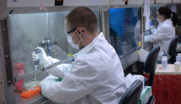
NIST Releases New Forensic Genetic Reference Material to Help Crime Labs Analyze Challenging Cases
NIST has released a new forensic DNA reference material, RM 8043, the first to include degraded DNA as well as mixtures of high-quality DNA from different individuals. This material will help crime labs verify that their methods produce accurate results when analyzing these kinds of samples.
|
RaDAR Program
NIST’s Rapid Drug Analysis and Research (RaDAR) lab provides near real-time insight into the nation’s illicit drug landscape. By analyzing drug samples sent from local, state, and federal partners, the lab identifies new compounds appearing in the illegal drug supply that may pose a health and safety threat to users, public health workers and law enforcement.
Check out the January 2026 RaDAR Newsletter to see the recent findings.
Noblis Requests Participation in Forensic Hand Detail Image Comparison Study
Noblis is currently conducting an NIJ-funded study on forensic detail hand image comparisons, with the goals of understanding the current state of the discipline, collecting a large-scale reference dataset of hand imagery, and characterizing the decision space of hand image comparison conclusions. This study is a direct response to the research and development need, “Hand Detail Comparisons Black Box and White Box Studies”, identified by OSAC’s VITAL Subcommittee.
Please consider participating in this multi-phased study. You do not have to participate in all phases.
Phase 1: State of the Discipline Questionnaire
This is a brief online multiple-choice questionnaire designed to characterize the current practice of hand image comparisons, including utilizing, training, and casework details.
- Noblis welcomes U.S. and Canada-based forensic labs, intelligence and law enforcement agencies, and independent practitioners to complete the questionnaire. Participation is NOT predicated on whether an agency does image comparison casework!
Phase 2: Hand Imagery Reference Dataset
This is a sample collection effort to compile a reference dataset of hand imagery; both online and in-person submissions will be accepted.
- Noblis welcomes any individual in the U.S. or Canada aged 18 or older to contribute.
Participation in any phase of this study will be completely confidential; the researchers will not disclose who did or did not contribute to any phase of the study. The study protocol has been reviewed and approved by PearlIRB (2025-0411-DFT).
Please contact Noblis at hand@noblis.org for more information or to receive updates about the study.
|
Upcoming Standard-Related Events
-
A2LA Annual Conference, April 12-15, 2026, Nashville, TN. OSAC will be sharing an update at A2LA’s Forensic Examination Advisory Committee (FEAC) Meeting held in conjunction with the conference.
Missed any of our previous issues? Check them out here:
|