Sample Totals for October 2025:
Qualitative Results: 316 (West), 447 (East), 763 (All)
Quantitative Results: 125 (Total)
Samples analyzed and included in these counts are voluntarily submitted samples that were collected and provided by public health, harm reduction, or law enforcement agencies from across the country. The trends observed in these samples may not be representative of broader trends within the United States drug supply.
Prevalence & Three Month Trends
Samples Collected in October 2025
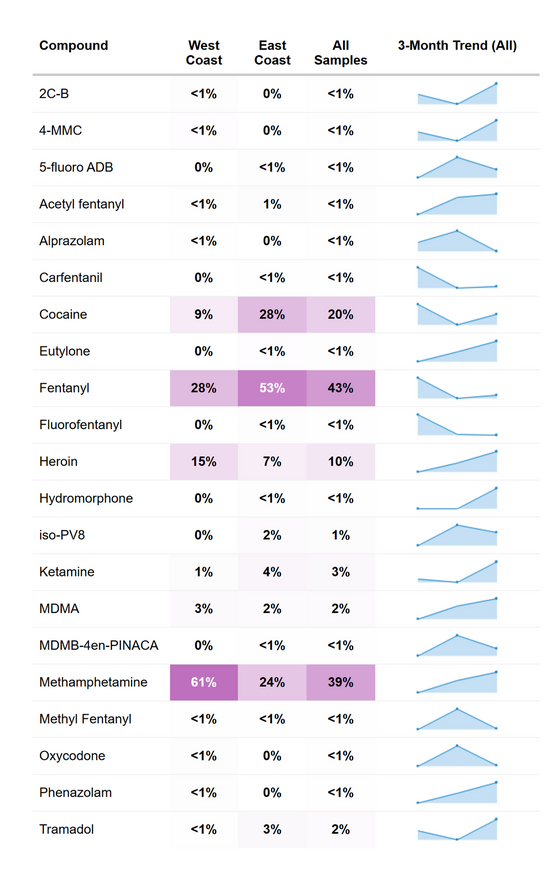
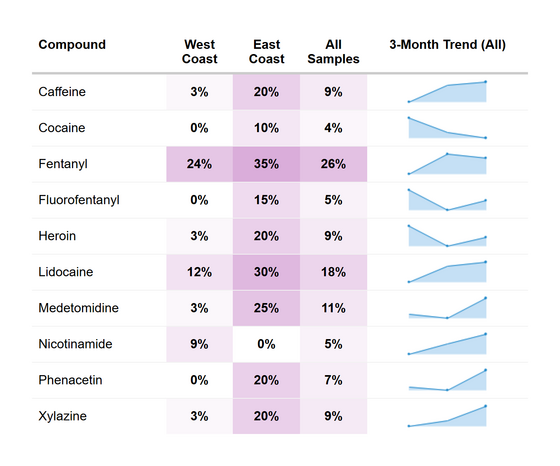
The tables below show the percent of samples containing select drugs (top) and adulterants (bottom). Percentages for West Coast samples, East Coast samples, and all samples are provided. A darker purple cell indicates a higher percentage.
The 3-Month Trend column has sparkline plots showing the percentage of samples containing the compound over the last three months. The right-most point on the plot corresponds to the percentage in the All Samples column. The center and left points are the percentages for September and August, respectively.
Important Notes:
- Determination of salt form or distinction between salt and free base was not completed.
- For some compounds, such as fluorofentanyl, isomer determination was not completed. For instances where isomer determination was completed, the specific isomer is listed.
- Many samples contain multiple substances therefore summed percentages may exceed 100%.
Drug Prevalence
Adulterant Prevalence
 Compound Abbreviations
- 4-MMC: 4-Methylmethcathinone
- BTMPS: Bis(2,2,6,6-tetramethyl-4-piperidyl) sebacate
- iso-PV8: α-Pyrrolidinoisoheptanophenone
- MDMA: Methylenedioxymethamphetamine
Co-Detection for Cocaine, Fentanyl, & Methamphetamine
Samples Collected in October 2025
The following tables provide information on compounds commonly co-detected with cocaine (top), fentanyl (center), and methamphetamine (bottom). In each table, the listed values reflect the percentage of cocaine, fentanyl, or methamphetamine containing samples that also contained the listed compound. The top ten co-detected compounds are provided for cocaine and methamphetamine while the top twenty co-detected compounds are provided for fentanyl.
Important Notes:
- Samples collected from drug use paraphernalia (e.g. syringe, cooker, straw, pipe) have been excluded from these counts due to the high probability of co-use with multiple substances.
- It is possible that the listed drug is a contaminant or minor component in a substance with a different main drug. For instance, cocaine may be present as a contaminant in a fentanyl sample but included in the cocaine co-detection count.
- Byproducts and precursors are not included in the tables below.
- Many samples contain multiple substances therefore summed percentages may exceed 100%.
Cocaine Co-Detection (61 Samples)
 Fentanyl Co-Detection (190 Samples)
 Methamphetamine Co-Detection (57 Samples)
New Compounds Identified
Samples Collected in October 2025
In October, four new compounds were detected for the first time in RaDAR samples.
Important Notes:
- Compounds discussed here are those that have been newly detected in RaDAR samples. This does not mean that it is the first identification of the compound in the drug supply.
- Determination of salt form or distinction between salt and free base was not completed.
 |
|
Desmethyltramadol, an opioid, was found in a single East Coast sample that contained no other compounds of interest.
|
|
AB-MDMSBA, a synthetic cannabinoid, was identified in a single East Coast sample that also contained fentanyl and medetomidine.
|
|
 |
 |
|
Dipropyltryptamine, a tryptamine, was identified in a single West Coast sample that contained no other compounds of interest.
|
|
4-Methoxy-N,N-Dimethyltryptamine, a tryptamine, was identified in a single West Coast sample that contained multiple other tryptamines.
|
|
 |
Sample Type Breakdown
Samples Collected in October 2025
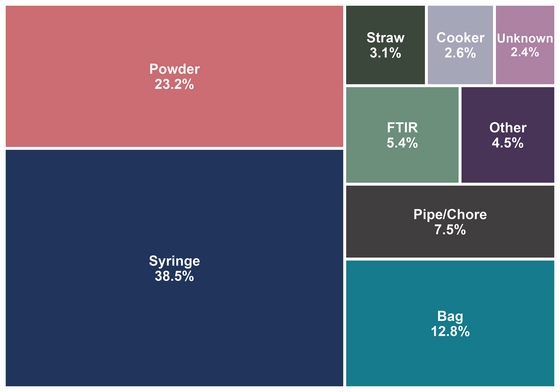
The plot below provides a breakdown of the types of items that samples were collected from.
Important Notes:
- Item types with a <1% contribution have been grouped into the "Other" category.
Drug Product Quantitation Summary
Samples Collected in October 2025
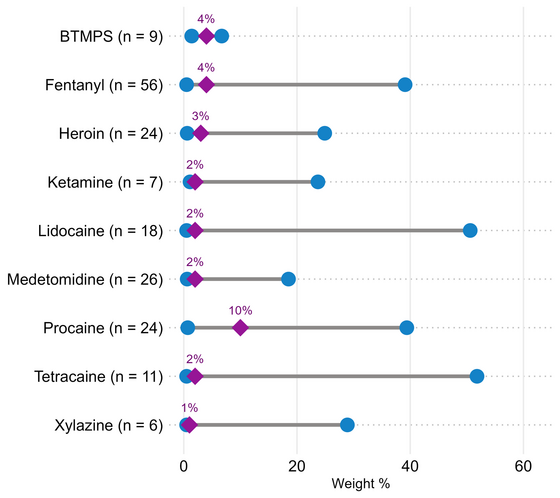
The plot below provides information on the quantitative testing of select drug product samples. Blue dots indicate the minimum and maximum weight percentages across all samples. The purple diamond represents the median weight percentage for all samples containing the compound.
Important Notes:
- Quantitative values less than 0.5% by weight have been omitted.
- Listed values are reported as the free base of the compound. Correction factors for salt form have not been applied.
In the News
How the Federal Government is Tracking Changes in the Supply of Street Drugs.
"The National Institute of Standards and Technology's new harm reduction initiative is helping prevent needless deaths." Read More.
Recent Publications
Enantiomeric Determination of Medetomidine in Street Drug Samples (August 2024 – February 2025) and Implications for Immunoassay Test Strip Analysis
Over the last several years there has been an influx of α2-agonists into the street drug supply. This began with the proliferation of xylazine, a potent veterinary sedative. Since 2023, another sedative, medetomidine, has been widely detected. Medetomidine, broadly, encompasses two enantiomers – dexmedetomidine and levomedetomidine – with the dex- enantiomer being pharmacologically active and used in licit human formulations. In this work, we investigate street drug samples containing medetomidine to better understand their enantiomeric makeup in the illicit supply. Read More.
Characterizing rapid changes in the prevalence and concentration of key compounds in Philadelphia’s street opioid retail supply, March 2024-March 2025
The objective of this observational epidemiological study is to examine recent shifts in the street opioid supply of the largest U.S. open-air drug market, including changes in prevalence and concentration of key compounds. Read More.
The Detection of Xylazine in Tijuana, Mexico: Triangulating Drug Checking and Clinical Urine Testing Data
Xylazine is a veterinary anesthetic increasingly present alongside illicit fentanyl in the United States and Canada, presenting novel health risks. Although xylazine remains less common in the Western US, Mexican border cities serve as key trafficking hubs and may have a higher prevalence of novel substances, but surveillance there has been limited. Read More.
|