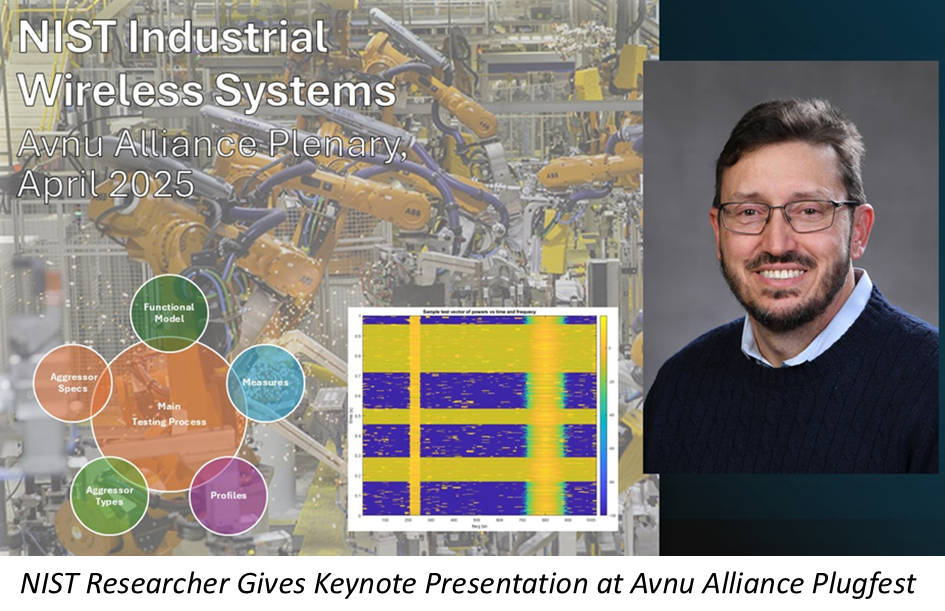
NIST researcher Rick Candell delivered a keynote presentation at the plenary session of the Avnu Alliance Plugfest in Malaga, Spain on April 8, 2025. The Avnu Alliance is a consortium of member organizations working together to create an interoperable ecosystem of low-latency, time-synchronized, highly reliable networking solutions using the IEEE open standard, Time-Sensitive Networking (TSN) and related networking protocols. Dr. Candell presented the standardization and research activities within the Industrial Wireless Systems team at NIST. He presented the ongoing activities, contributions, and standards activities of his team and how these activities directly relate to Wireless TSN performance. His main points included wireless opportunities, NIST contributions to industry, testbed activities in Wi-Fi and 5G, technology gaps, and the IEEE 3388 standard. He encouraged Avnu Alliance members developing wireless TSN solutions to fully consider the challenges of the wireless channel and how to test performance under real-world conditions.
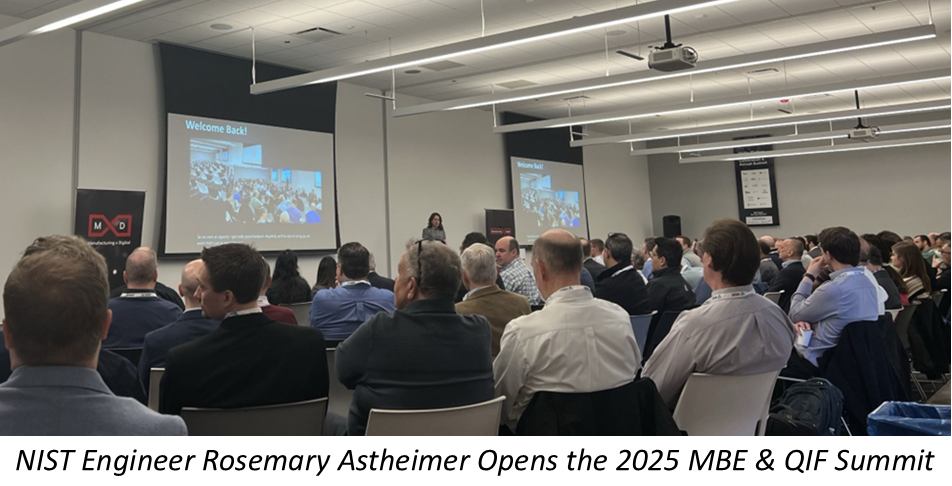
The event was led by NIST’s Rosemary Astheimer, who organized the technical content and served as Master of Ceremonies. The Summit focused on the success and lessons learned by those wanting to leverage model-based engineering data in the digital thread across the supply chain. Several presenters emphasized the need to more closely connect data between engineering, manufacturing, and quality, and how Universally Unique Identifiers (UUIDs) might be implemented to create that closed loop of technical information. Manufacturers looking to drive MBE initiatives were educated on the value of an Integrated Digital Environment, which also considers Model-Based Systems Engineering (MBSE), Product Lifecycle Management (PLM), and visualization tools used to present dashboards of information to support the review process.
The keynote presentation “Model-Based Everything” was provided by Christopher Garrett, Technical Advisor, Systems Engineering at the Air Force Life Cycle Management Center, Wright-Patterson Air Force Base. In his talk, Mr. Garrett discussed opportunities for government and industry to leap ahead of the competition, encouraging a more aggressive use of existing digital tools. The use of DoD 5000.97 on Digital Engineering and the MBE Maturity Index are tools to help drive these efforts were discussed.
Presentations will be made available on the Summit agenda page by April 25, 2025.
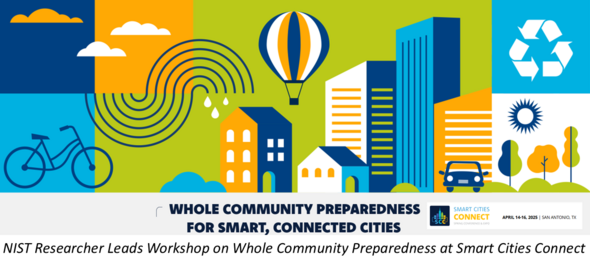
On 16 April 2025, NIST researcher Michael Dunaway and colleagues organized and led a workshop on “Whole Community Preparedness for Smart, Connected Cities” at the TechConnect Smart Cities Conference in San Antonio, TX. This event was the second in a workshop series that was initiated with a similar workshop held in August 2024 at the George H.W. Bush School of Government of Texas A&M University in Washington, D.C. For both events the goal was to identify requirements, metrics, and standards for enhancing public safety, post-disaster recovery, and overall community resilience through the development and integration of digital technologies and cyber-physical systems.
The initial workshop brought together a team of senior first responders, emergency managers, researchers, smart city practitioners, and city, state, and federal authorities to provide perspectives on current and future requirements for enabling communities to more capably manage complex threats to public safety, health, and community welfare.
In the second workshop, the TechConnect Smart Cities Conference offered the opportunity for NIST to present outcomes from the August 2024 event and to solicit additional perspective on local preparedness needs and priorities by engaging with city officials and residents having direct experience in implementing technology-based solutions within their communities. The workshop was structured around a series of research questions and round-table discussions to broaden the base of knowledge about community and city efforts to build capacity in disaster communications, post-disaster recovery and overall community resilience. Four questions were used to frame the dialogue:
What capabilities should be developed to support communities in times of disaster or civil emergency?
What Key Performance Indicators (KPIs) should be developed and integrated into a community decision support system for disaster planning, preparedness, and recovery?
Should a community information and decision support system be designed as: - A dedicated system to be reserved for local/civic preparedness and response only; - A dual-use system having utility for both Blue-Sky (normal) and Gray-Sky (crisis) days? (Unsurprisingly, the latter alternative was the near-unanimous preference.)
How should operational considerations –i.e., efficiency of command/control/coordination—be balanced with civic considerations such as transparency/access/equity and the maintenance of public trust?
The outcomes from the TechConnect Smart Cities workshop are currently being compiled and will be integrated as a separate section of the forthcoming NIST Workshop Report on Whole Community Preparedness in Smart Cities and Communities, anticipated to be published in late Spring 2025.
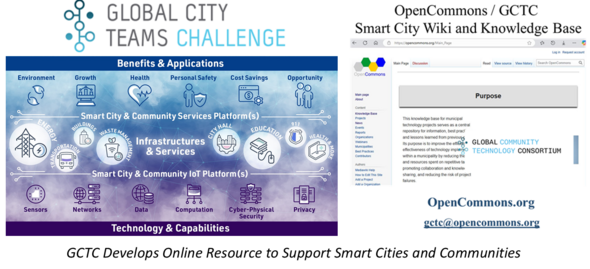
Since its formation at NIST in 2014, the Global City Teams Challenge (GCTC) has evolved to become a collaborative platform for cities, communities, industry, academic, and government stakeholders to jointly develop and deploy emerging technologies for smart cities and communities. NIST is supporting the ongoing transition of GCTC activities to the private sector, including through a GCTC partner non-profit, OpenCommons, which has a goal to serve as an information portal and library/archive for smart cities documents, frameworks, and guidebooks. Members of the GCTC have worked with NIST and collectively published a series of frameworks and blueprints for smart cities and communities, and this information will be available through the OpenCommons online resource to ensure that public access is maintained for future smart cities and communities, and that the work of NIST and its partners continues to serve the public good.
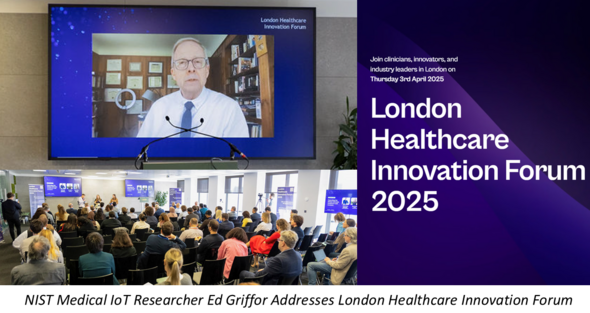
NIST researcher Dr. Edward Griffor co-organized the London Healthcare Innovation Forum on April 3, 2025 at London’s Canary Wharf in the United Kingdom. With over 250 participants, this event brought together clinicians, entrepreneurs, and leading experts in biosciences, medicine, healthcare, technology, legal, policy, and investment to discuss the future of healthcare innovation. Throughout the day, attendees engaged in conversations about the role of technology in revolutionizing patient care, the most significant industry challenges, and the necessary steps needed to drive impactful change.
In his address, Dr. Griffor emphasized the need for patients and physicians to achieve appropriate levels of trust in today’s and tomorrow’s healthcare technologies, including advanced sensing technologies for monitoring patient trajectory and disease evolution. Measurement methods and non-invasive sensor technology can build this trust, which is critical to healthcare, both in the capabilities of personnel, treatment approaches and enabling technologies. Sufficient trust triggers reliance, i.e., use guided by clear understanding of capabilities and limitations. Sensors for data collection and the use of artificial intelligence and machine learning for analytics in support of treatment or diagnosis can improve decision-making (ER Physician, EMS Paramedic, etc.) and improve the overall response, but only if healthcare personnel’s understanding is calibrated to tech capabilities.
Other participants emphasized Digital Health, or the Digital Fabric of Care, that requires seamless sharing of trustworthy patient information. This digital fabric is the infrastructure that underlies information sharing and brings “healthcare connectivity” and a common understanding of the “goodness” of that information. This summit, and the previous 2024 Healthcare Innovation meeting in Gdansk, Poland, engaged research institutions, Technologists, policy makers and healthcare workers to establish dialogue to shape and promote the Fabric of Care, to establish the connections and set targets for the Digital Fabric of Care.
On behalf of our Smart Connected Systems team at NIST, we greatly appreciate that you – our colleagues, collaborators, and industry stakeholders – have been interested in and engaged with our research, standards, measurements, publications, and conferences/workshops.
It has been my great privilege to lead programs and efforts at NIST including serving as editor and publisher of this monthly SCS newsletter. But all good things eventually come to an end – and so I bid you all a fond farewell, as I am taking an early retirement from NIST at the end of April 2025. As I depart, I am incredibly grateful to have worked with so many outstanding people, who collectively have appreciated the opportunity to serve the American public and advance NIST’s mission.
Cheers, Dave Wollman Deputy Division Chief, Smart Connected Systems Division, Communications Technology Laboratory, National Institute of Standards and Technology
Here is a Japanese poem that I have always enjoyed, which seemed fitting for the circumstances:
I have always known That at last I would Take this road, but yesterday I did not know that it would be today. Ariwara no Narihira