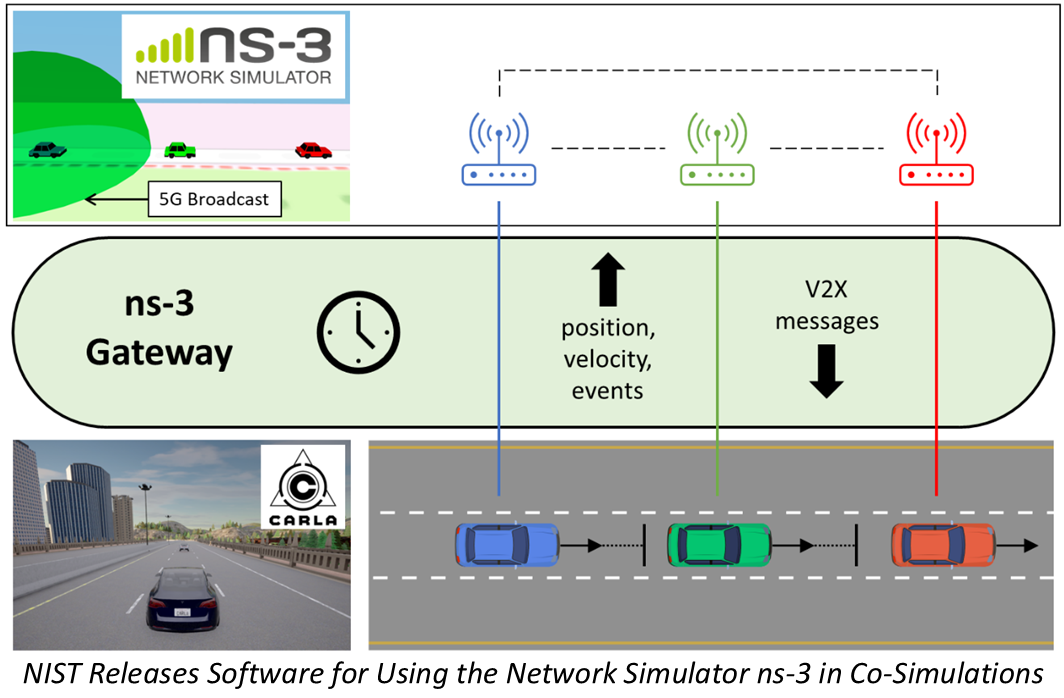
NIST has released open-source software for integrating ns-3 network models with external software and hardware to create high-fidelity simulations of complex systems. ns-3 is a network simulator for modeling user equipment such as phones and wireless devices, networking protocols, and the channels used to send information between devices. However, ns-3 was not designed to simulate physical system dynamics, and its simulation of device mobility is less realistic than specialized simulators such as Simulation of Urban Mobility (SUMO). This new NIST software lets you combine ns-3 network models with other software and hardware to leverage their individual advantages and run more realistic simulations.
transferring data between ns-3 and other software using TCP/IP,
synchronizing the time progression of ns-3 to an external time reference,
triggering the broadcast of data inside of ns-3 using an external function call, and
updating ns-3 node positions to automatically mirror entities simulated outside of ns-3.
NIST developed this software to research how vehicle-to-everything (V2X) communications can improve automated vehicle performance as part of its automated vehicles program. For this program, an automated development vehicle was connected to a network of simulated vehicles and infrastructure using this software to adjust driving behavior based on received network messages. Although developed for research into automated vehicles, the software is generic and can be used for any network model across any research domain.
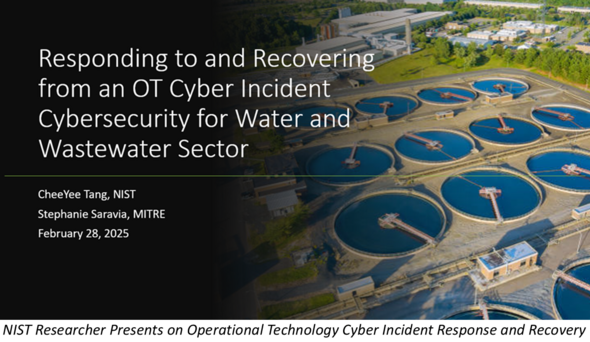
On February 28, 2025, NIST researcher CheeYee Tang (Smart Connected Systems Division), Dr. Michael Powell (NIST National Cybersecurity Center of Excellence-NCCoE), and Stephanie Saravia (MITRE/NCCoE) presented a comprehensive approach for response and recovery from an operational technology (OT) cyber incident to the water and wastewater SCADA User Group.
The U.S. Water and Wastewater Systems (WWS) sector, like many other sectors, has been impacted by various cyber incidents, including unauthorized access and ransomware. Continued compromises or failures of the WWS sector could cause cascading impacts across other critical infrastructures and disrupt society. The presentation outlined how WWS utility owners and operators can better prepare for, respond to, and recover from a cyber incident.
The presentation provided a comprehensive strategy and detailed step by step guidance on developing a response and recovery plan specific to the WWS sector. It also discussed some technical capabilities and products that are commercially available to streamline the response and recovery effort.
Participants asked many questions during the presentation, resulting in a lively discussion regarding the application of NIST guidance and resources to the WWS sector, especially for smaller WWS utilities. Randy Petersen from the San Jacinto River Authority, and the host of SCADA User Group shared, "I just wanted to say thank you again for a fantastic presentation, you all just set the bar high for any future speakers."
The goal of the WWS sector SCADA User Group is to enable organizations to share their cybersecurity practices and challenges that are specific to WWS process control. Additional information is available at: https://scadausergroup.com
The NCCoE Cybersecurity for the Water and Wastewater Sector project aims to demonstrate practical cybersecurity solutions for WWS utilities of all sizes. The reference implementations will use commercially available products and services to address four WWS cybersecurity challenges: asset management, data integrity, remote access, and network segmentation. Commercial products and services will be integrated into a demonstration of the reference design. The project also provides a platform for broad discussion between WWS utilities, asset owners, industry stakeholders, and technology vendors, to find solutions to mitigate cybersecurity risks facing the industry. The project will result in a series of publicly available NIST cybersecurity publications. Additional information is available at: https://www.nccoe.nist.gov/projects/securing-water-and-wastewater-utilities
In March 2025, Sandia National Laboratories hosted a workshop on Semiconductor Traceability and Market Provenance, bringing together industry leaders, standards experts, and policymakers from around the world to discuss the future of semiconductor supply chain security. The event fostered discussions on the challenges and opportunities of international collaboration to protect critical infrastructure and safeguard national interests by ensuring assured semiconductor supply chains.
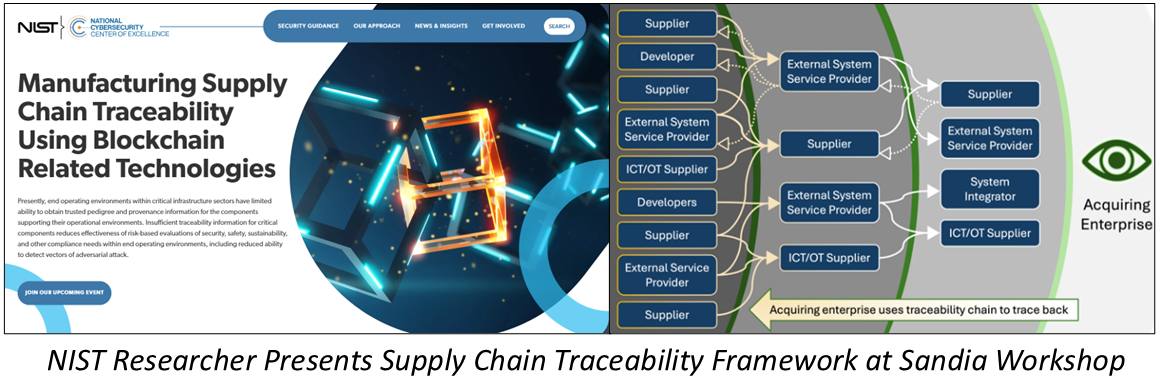
As part of the workshop, NIST researcher Michael Pease presented an overview of the NIST National Cybersecurity Center of Excellence (NCCoE) project on Supply Chain Traceability Using Blockchain-Related Technologies. The session highlighted the NIST Internal Report (IR) 8536 Supply Chain Traceability: Manufacturing Meta-Framework, a comprehensive approach designed to help organizations meet growing regulatory and industry requirements for supply chain transparency and security. Pease noted that NIST IR 8536 is targeted for a second round of public comment in April 2025, allowing stakeholders to provide further input on refining its guidance to better address the evolving needs of supply chain security.
Building on insights from previous panel discussions and audience engagement, Pease outlined practical solutions for collecting, storing, and sharing traceability information—all without the requirement for a globally distributed ledger. The framework introduces flexible, scalable mechanisms that enable manufacturers and regulators to establish trusted traceability records, ensuring supply chain integrity without imposing a one-size-fits-all technology mandate.
The workshop underscored the critical importance of advancing traceability standards and frameworks to support secure, resilient semiconductor supply chains. NIST and NCCoE’s ongoing research and collaboration efforts – along with the upcoming second public comment period for NIST IR 8536 – continue to play a pivotal role in shaping the future of supply chain security, fostering global partnerships, and driving innovation in traceability solutions.
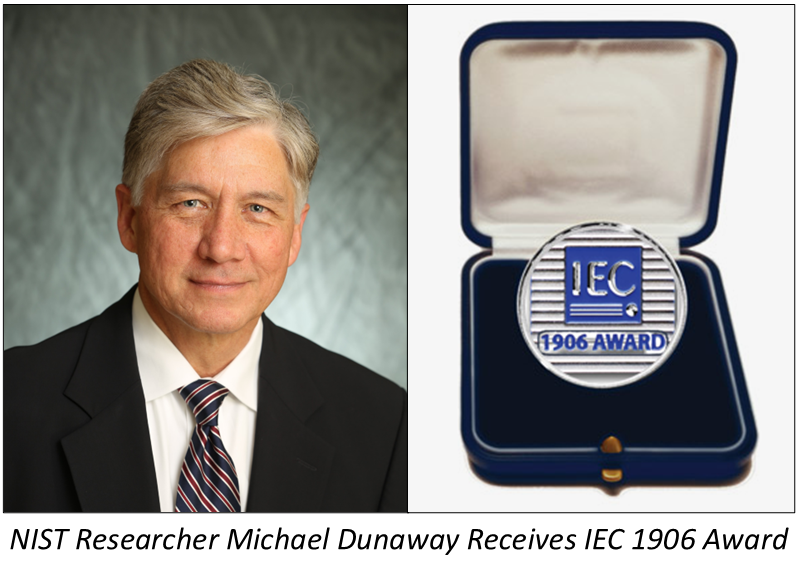
NIST Researcher Dr. Michael Dunaway in the Smart Connected Systems Division was awarded the IEC 1906 Award for his contributions to the International Electrotechnical Commission Systems Committee (IEC SyC) on Electrotechnical Aspects of Smart Cities to the development of an international Smart Cities Reference Architecture. Dr. Dunaway serves on the U.S. National Committee Technical Advisory Group (US TAG) Systems Committee for Smart Cities, which is the only US TAG currently representing Smart Cities in international standards organizations.
The scope of the IEC SyC on Smart Cities is to foster the development of standards to support the integration, interoperability, and effectiveness of city systems. Within the IEC, a Technical Committee (TC) is focused on specific technical fields and components, while a Systems Committee (SyC) is focused on overarching systems and integration across multiple technical domains. The US TAG is administered by the Telecommunications Industry Association (TIA) through the U.S. National Committee to the International Electrotechnical Commission (IEC).
The IEC 1906 Award was established in 2004 by the IEC Executive Committee and commemorates the IEC's year of foundation and honors IEC experts around the world whose work is fundamental to the IEC. The Award also recognizes exceptional and recent achievement related to the activities of the IEC and which contributes in a significant way to advancing the work of the Commission. Dr. Dunaway’s receipt of the 1906 Award was announced at the IEC SyC Plenary meeting in Sydney, Australia, and it was presented to Dr. Dunaway at the annual meeting of the US National Committee to the IEC in Doral, Florida, in January 2025.