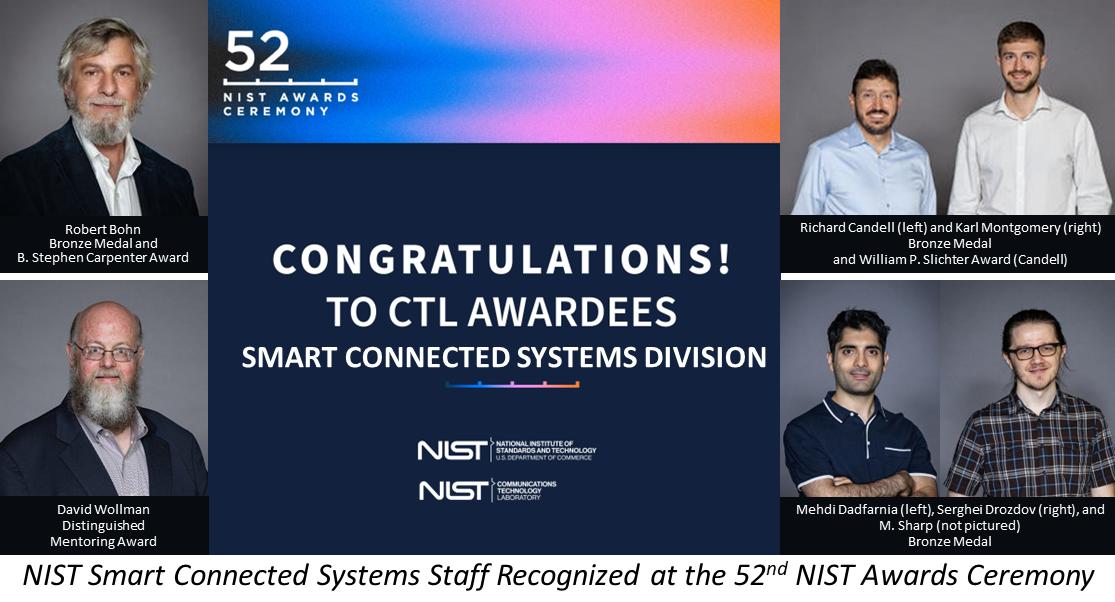
On January 15, 2025, NIST held its 52nd Annual Awards Ceremony in Gaithersburg Maryland, and Boulder, Colorado. At this celebratory event, several NIST Smart Connected Systems Division (SCSD) staff members were recognized with 2024 awards for their outstanding work.
NIST presented Department of Commerce Bronze Medals to:
Richard Candell and Karl Montgomeryfor the advancement of transmission scheduling in wireless time-sensitive networks for industrial robotic control applications in manufacturing
Mehdi Dadfarnia, Serghei Drozdov, and M. Sharpfor developing an open-source manufacturing simulator that enables users to plan production and compare AI-based and traditional maintenance policies
Robert Bohnfor leadership in establishing and managing an international team to develop a Beyond-5G testbed to advance global communication service and network federation.
The Bronze Medal Award recognizes outstanding work of unusual initiative or creative ability in the development and improvement of methods and procedures, including significant contributions affecting major programs and scientific accomplishments. Additional information is available online describing these NIST efforts in its 5G core networks testbed, wireless time-sensitive networks, and SimPROCESD, NIST’s open-source manufacturing simulator.
NIST also recognized SCSD staff with several NIST “named” awards at the ceremony:
NIST B. Stephen Carpenter Award to Robert Bohn for creating and leading an international team to advance global communication service and network federation. The NIST Carpenter Award recognizes outstanding achievements in building ties between NIST and the international measurement community.
NIST Distinguished Mentoring Award to David Wollman for his exceptional guidance, commitment to fostering career development, and dedication to the NIST community. The NIST Distinguished Mentoring Award recognizes the value of mentoring and its positive impact on the mission of NIST and fostering excellence in others via formal or informal mentoring relationships.
Measurement science and standards are needed to support the safe and predictable operation of future automated vehicles (AVs), and to realize their potential to significantly impact our daily lives and improve competitiveness and well-being in our nation. NIST AV researchers from NIST’s Communications Technology Laboratory, Information Technology Laboratory, and Engineering Laboratory visited the National Highway Traffic Safety Administration's (NHTSA) Vehicle Research and Test Center (VRTC) in East Liberty, Ohio on 20-21 November 2024. VRTC is NHTSA’s in-house vehicle research and test facility.
The NIST teams shared their approaches to virtual and physical AV testing of sensor technologies, AV perception robustness, scenario simulation setup, and integrated virtual and on-track testing. NHTSA colleagues provided overviews of their research progress on the first day of the visit and tours of the VRTC labs and on-track testing of Automated Driving Systems using augmented reality on the second day. The NIST team also toured the 4500-acre Transportation Research Center (TRC) where VRTC is located in Ohio.
The two-day meeting concluded with discussions of topics for potential collaboration on virtual and physical AV Testing. Follow-up discussions on these topics is underway.
On January 14, 2025, NIST held the second of three stakeholder workshops in its ongoing series on Digital Twins, building upon the initial workshop held in October 2024. This workshop centered on advancing the conversation about standards and infrastructure required to support Digital Twin ecosystems, with a focus on:
Key Components of Digital Twin Ecosystems
Barriers to Interoperability
Sustainability across the Digital Twin Lifecycle
The event featured a keynote address from Greg Porter, Principal Solutions Architect at Sev1Tech, and panel discussions with representatives from commercial enterprises and standards organizations. Participants actively engaged in breakout sessions, providing detailed insights into current ecosystems and identifying critical needs for future development. Thank you to all attendees for their valuable contributions; these important discussions sill continue during the third workshop in late April 2025. This upcoming workshop will spotlight Digital Twin Trust and Security, with a particular focus on Verification, Validation, and Uncertainty Quantification (VVUQ). Once the agenda and speakers are finalized, NIST will share registration details for this virtual event.
NIST is committed to producing actionable insights and supporting the evolution of Digital Twin technologies. Summary reports from each workshop, as well as a comprehensive final report, are planned. The October workshop summary is nearing approval for publication and will be available soon. Notes and feedback from the January workshop are currently being compiled into a summary report.
For suggestions or questions about the workshop series, or to propose agenda topics, please contact Mr. Simon Frechette at simon.frechette@nist.gov or Mr. Michael Pease at michael.pease@nist.gov.
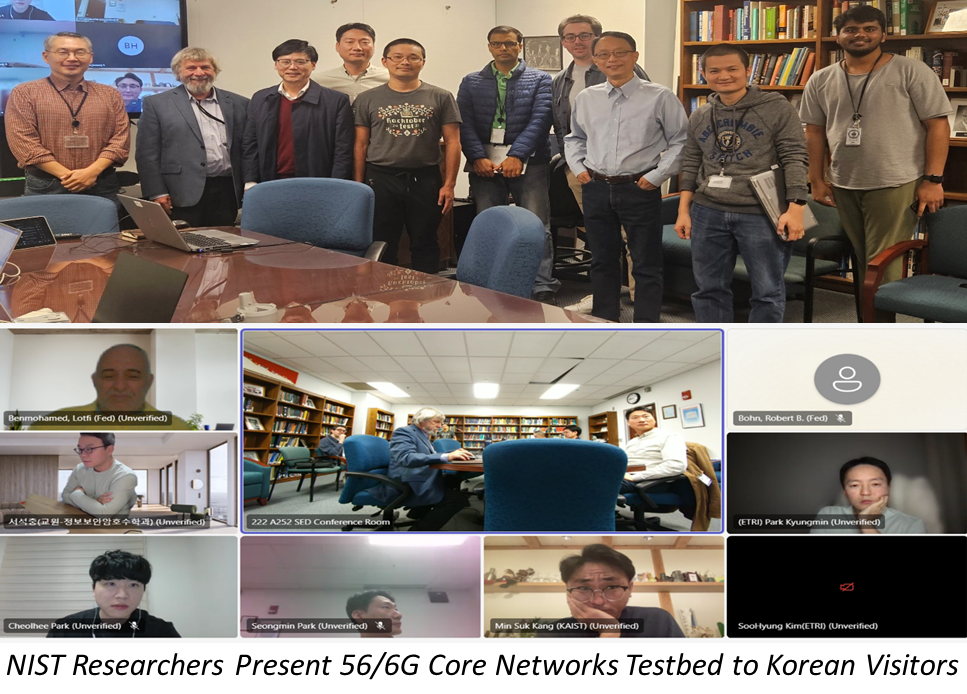
On 5-7 November 2024, NIST’s Transformational Networks and Services Group hosted a team of researchers from South Korea in a hybrid meeting, held at the NIST campus in Gaithersburg, Maryland, and online. The Korean team was led by in-person attendees Prof. Jonghyun Kim of the Electronics and Telecommunications Research Institute (ETRI)/Sejong Univ (3rd person from the left in the top photo), Dr. Seongmin Park of Korea Internet and Security Agency (KISA) (4th person from the left in the top photo). Dr. Dowon Kim from Korea (1st person on the left in the top photo), currently at NIST in the NIST Cybersecurity Division, participated in person for this meeting. Additional online participants included those from ETRI, KISA, Korea Advanced Institute of Science & Technology (KAIST), Sejong University, and Kookmin University.
The meeting included discussions on 6G security and associated collaboration research, and the NIST 5G/6G testbed. The Korean team discussed their concepts on trust-model-based intelligent incident response in 6G open network environments. They also described their goals to develop intelligent intrusion response technology including consideration of open architectures of 6G environments, decentralization of functions and network intelligence and creation of open standards. The Korean team is currently collaborating with University of Oulu, Finland, and the Finnish Institute of Technology.
The NIST team described the current NIST 5G/6G testbed deployment as including four bare metal servers and one managed switch. The deployment software, called 5gdeploy, has support for four Core Network (CN) implementations and six Radio Access Network (RAN) simulators, as well as two physical RAN implementations utilizing Software Defined Radio (SDR) units. 5gdeploy can automatically generate configuration files and initialization scripts for the chosen CN and RAN implementation, from a base template that defines the 5G network topology and configuration. It then deploys the 5G network onto the bare metal servers using Docker Compose containerization technology, which isolates the software environment and promotes reproducibility. Within this platform, researchers are given options to adjust the deployment parameters, such as placing the network functions onto different bare metal machines, restricting the CPU usage of a network function, or introducing traffic impairments. Researchers can then deploy traffic generators between the simulated 5G User Equipment and the Data Network, to measure how different choices of deployment parameters affect end-to-end network performance. The NIST team also presented testbed use cases that include teleoperation and edge learning.
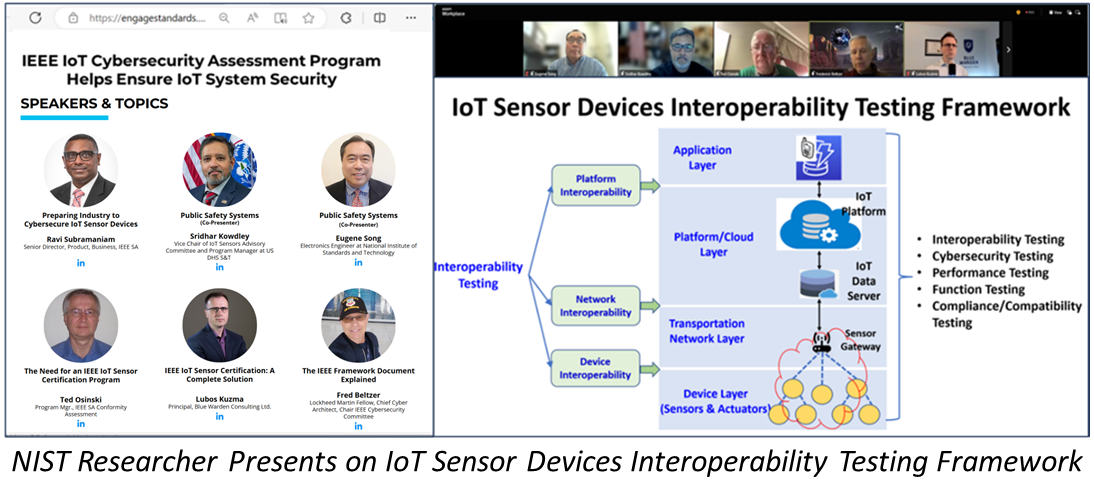
NIST researcher Dr. Eugene Song and Mr. Sridhar Kowdley from the Department of Homeland Security (DHS) Science and Technology Directorate (S&T) co-presented on Public Safety Systems at the IEEE IoT Cybersecurity Assessment Program Helps Ensure IoT System Security Webinar, held on December 5, 2024. This webinar overviewed the preparation for cybersecure IoT devices, cybersecurity best practices and DHS Public Safety System cybersecurity requirements for IoT sensors, and a framework document that outlines the protection of devices and certification to help make devices secure.
In the presentation, DHS S&T program manager Mr. Kowdley introduced the DHS research strategic, context, and priority, and described the public safety Internet of Things (IoT) requirements: cybersecurity and interoperability. Dr. Song presented a four-layer IoT sensor devices interoperability testing framework. Dr. Song explained that sensors are used everywhere in IoT and play an important role in real-time monitoring and control applications, and that interoperability is a significant challenge for IoT sensor devices – millions or even billions of sensors in IoT are provided by different manufacturer/vendors, they may use different wired and wireless connectivity, adopt different standard communication protocols, and even their own proprietary protocols.
Dr. Song pointed out that interoperability testing & certification (T&C) is a solution to overcome IoT sensor devices interoperability challenges. To support interoperability T&C, a four-layer IoT sensor devices interoperability testing framework was proposed, including:
Device layer: sensor and actuator devices.
Network layer: sensor gateway devices and other types of IoT devices.
Platform/cloud layer: different popular IoT platforms and cloud services.
Application layer: IoT applications, such as smart home, public safety, smart city et al.
In this testing framework, the three kinds of interoperability and interoperability testing between four layers are as follows:
Device interoperability testing between network layer and device layer.
Network interoperability testing between platform/cloud layer and network layer.
Platform interoperability testing between application layer and platform/cloud layer.
With this interoperability testing framework, a set of different interfaces/standardized communication protocols between layers will be identified, and then interoperability testing methods/procedures/specifications between layers will be developed based on the interfaces/protocols identified to help achieve and assure interoperability of IoT sensor devices.
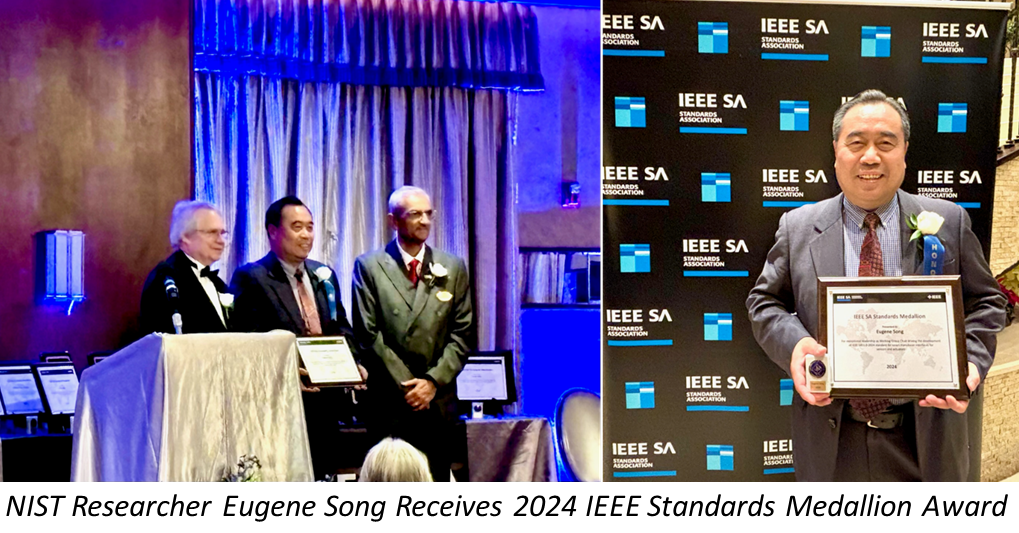
On December 8, 2024, Dr. Eugene Song was recognized at the 2024 IEEE Standards Association (SA) Awards Ceremony held in Somerset, New Jersey. At this annual event, the IEEE SA recognizes outstanding participation across a variety of areas including standards development and standards-related work, leadership, and distinguished service, through awards including the Standards Medallion Award, Standards Committee Award, Emerging Technology Award, Lifetime Achievement Award, and more. The IEEE SA Standards Medallion is awarded for major contributions to the development of standards, including:
Leadership in standardization of new technologies
Assuring achievement of standards development goals
Identifying opportunities to better serve the needs of standards users
Other contributions viewed as deserving of such recognition
At the event, Dr. Eugene Song received his 2024 IEEE SA Medallion Award “for exceptional leadership as Working Group Chair driving the development of IEEE 1451.0™-2024 standard for smart transducer interfaces for sensors and actuators.” The IEEE 1451.0TM-2024 Standard, published on June 26, 2024, defines common functions of Internet of Things (IoT) sensor network devices, network services, transducer services, and transducer electronic data sheet (TEDS) formats to help achieve interoperability in network and transducer interfaces. This standard also defines the universal unique identification (UUID), security framework, and time synchronization framework for IEEE 1451.0-based IoT sensor networks. IoT sensor network devices (smart sensors and/or actuators, controller devices) equipped with UUID, TEDS, and standardized interfaces and communication protocols can thus achieve global identity, time-synchronized, secured, and plug-and-play interoperability, making IoT sensor network installation, maintenance, and upgrades easier and reducing the total life-cycle costs of IoT sensor networks.
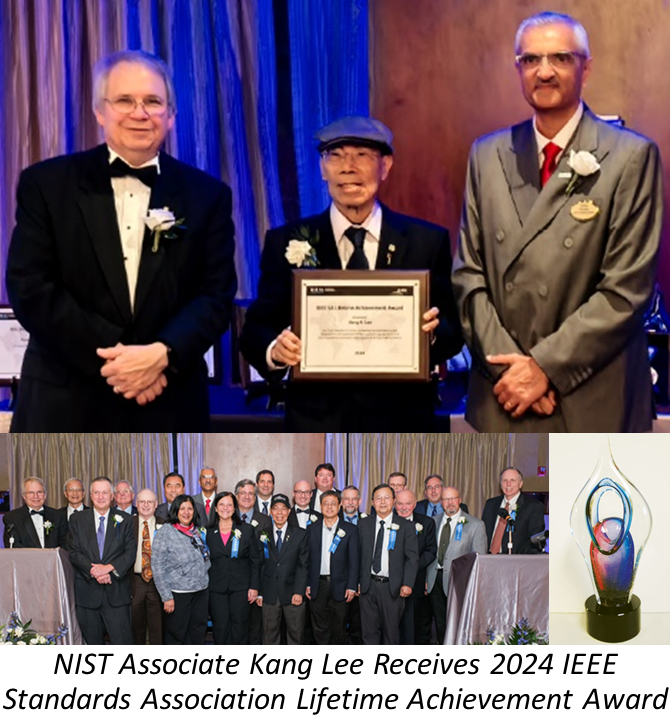
NIST’s Mr. Kang B. Lee, a long-time NIST staff member and currently an associate with the Industrial Wireless Systems Project team after his retirement, was honored with the 2024 IEEE Standards Association Lifetime Achievement Award “for three decades of tireless leadership and dedication to the development and promotion of IEEE precision time protocol and other standards profoundly impacting global industry and commerce.”
On December 8, 2024, Lee received his Lifetime Achievement Award at the 2024 IEEE Standards Association (SA) Awards Ceremony held in Somerset, New Jersey. At this annual event, the IEEE SA recognizes outstanding participation across a variety of areas including standards development and standards-related work, leadership, and distinguished service. The IEEE SA Lifetime Achievement Award recognizes significant technical contributions and a 15+ year commitment to standards development within IEEE and other standardization activities.
Lee’s Lifetime Achievement Award description recognized his lengthy career, tireless leadership and dedication, and outstanding contributions, including leading and contributing to many standards efforts and organizing and chairing many IEEE conferences, symposia, and workshops. At the start of his career (1974) at the National Bureau of Standards (NBS), Lee worked on various sensory feedback control techniques on machine control and software error compensation systems, and then explored the development of smart sensor technology for smart manufacturing and production. He led a team of six hardware and software engineers and machinists to apply the resulting technology to develop and deliver two advanced manufacturing production stations to the U.S. Navy machine shops for producing precision parts on demand for the timely maintenance of submarines in Mare Island and Portsmouth, respectively. Then Lee aimed to standardize the results of these smart sensor works by organizing the 1994 Smart Sensor Interface Standard Conference held at NIST, and subsequently became the Chair of the IEEE Instrumentation and Measurement Society (IMS)’s Technical Committee on Sensor Technology to champion the development of the Smart Transducer Interface Standards for Sensors and Actuators, known worldwide as IEEE 1451.
In 2000, Lee worked with Dr. John Eidson of Hewlett Packard on synchronizing time in networks - the idea of timing and control derived from smart sensor interfaces, and initiated and guided the development of a precision time synchronization standard IEEE 1588 to support a wide variety of applications. Lee went on to organize the first International IEEE Symposium on Precision Clock Synchronization for Measurement, Control, and Communications (ISPCS), and introduced its first Plugfest, which is a way for manufacturers of 1588-based devices and networks to get together to perform interoperability testing for standards conformance. Due to the popularity of the 1588 standard, the industry refers to it simply as the Precision Time Protocol (PTP). After two decades of effort and two revisions of the IEEE 1588 standard, PTP has achieved a time precision of better than 100 picoseconds, a ten thousandfold improvement from 1 microsecond based on the first version of the standard. Lee was also one of 29 innovators worldwide profiled by the EE Times’ Great Minds, Great Ideas Project (2006) in which he was recognized for paving the road to ubiquitous computing (a concept now known as the Internet of Things).
In reflecting on his lifetime achievement award, Kang Lee identified his recommended path to success: once you have come up with a good idea, then you should develop a clear plan, set achievable goals, build a strong team, effectively promote the idea, and face the challenge pursuing it with hard work and consistency and a willingness to adapt and change. Lee also expressed gratitude for NBS and NIST management for providing opportunities and support throughout his entire federal career.