Virtual Event
2023 NIST-NSF
Disaster Resilience
Research Symposium
NEXT WEDNESDAY!
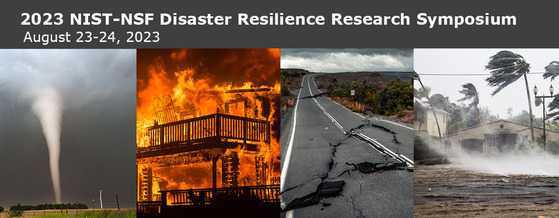
The National Institute of Standards and Technology (NIST), and the National Science Foundation (NSF), are pleased to announce their sixth annual Disaster Resilience Research Symposium, to be held next week, August 23-24, 2023.
Keynote presentations include:
 |
|
David Alexander
Senior Science Advisor for Resilience at the U.S. Department of Homeland Security (DHS)
Day 1 keynote address entitled "Research, Development, and Innovation for Enhancing
Resilience of Cyber-Physical Critical Infrastructure”
|
 |
|
Shanna McClain
Disasters Program Manager for NASA's
Earth Science Applied Sciences Program
Day 2 Keynote address entitled "From Space to Solutions: Empowering Disaster Resilience
through Earth System Science”
|
August 23, 2023 - Special discussion session on resiliency and bridging the divide between science and policy.
Featuring Ms. Toni-Shae Freckleton, Chief of the New York Liaison Office of the UN Office for Disaster Risk Reduction (UNDRR): "Bridging the Science-Policy Divide: From Resilience Thinking to Resilient Practices."
August 24,2023 - Special panel discussion session on the theme of Disaster Data Sharing with:
Ellen Rathje (University of Texas at Austin), Adam Smith (NOAA), Matthew Hoehler (NIST), Gerard Lemson (Johns Hopkins University/NIST), Garrett Layne (NASA), and Judith Mitrani-Reiser (NIST).
The symposium will also feature presentations from 32 grant awardees funded by NIST and NSF on topics related to infrastructure and community resilience, earthquake engineering, wind engineering, and wildland-urban interface fires. The grantee project titles include:
- Measurement of Near-Surface Pressure, Wind and Wind-Induced Load Characteristics Using Novel Sensors in Thunderstorm, Tornado and Tornado-Like Environments
- Wireless Sensor Network (WSN) System and LIDAR Experiments for the Characterization of Strong Wind Loads on Non-Structural Components and Near-Surface Wind Profiles
- Analysis, Comparison and Experiment Investigation of Hurricane Wind, Storm-Surge and Wave Load Model
- Disaster Recovery and Response Innovation through Fuel Cell Deployment
- Leveraging Uncertain Disaster Field Data for Community-Scale Assessment of Connected Buildings and Lifelines
- Assessing the Utility of Safe-to-Fail Design to Improve Climate Hazards Resilience of Interdependent Infrastructure Systems
- Enhancing Windstorm Resilience of Coastal Communities Through Ultra-High Performance Glass Fiber Reinforced Polymer Concrete Seawalls
- Collaborative Research: Assessment of Building Resiliency in Tornadoes Considering Transient Internal Pressure Effects
- 4-D Measurement and Modeling of Engineering-Relevant Windstorm Characteristics
- Collaborative Research: Examining the Vulnerability and Recovery of Small Farms to Natural Hazards and the Impact to Rural Community Resilience
- Assessing Urban Post-Earthquake Community Recovery to Inform
Pre-Disaster Planning
- Scalable Assessment of Urban Earthquake Resilience: A Novel
Model-informed Deep Learning Paradigm
- Spatiotemporal Maps of Damaging Winds from Integrated Remote
and In Situ Observations
- Characterization of Hurricane Boundary Layer Turbulence for Wind Hazard Mitigation
- Reconstruction of Four-Dimensional Near-Surface Wind Characteristics from Debris and Damage Attributes using Computer Vision
- Collaborative Research: Understanding Urban Resilience to Pluvial Floods Using Reduced-Order Modeling
- Leveraging Crowdsourced Data to Assess Spatiotemporal Patterns of Resilience in Diverse Gulf Coast Communities Impacted by Natural Hazards
- Modeling Intergovernmental Fiscal Impacts of Coastal Hazards
- Collaborative Research: Development of Realistic Seismic Input
Motions for Improving the Resilience of Infrastructure to Earthquakes
- Residual Axial & Lateral Load Carrying Capacity of Pile Supported Marine Terminal Exhibiting Seismically-induced Local Buckling in Inground Plastic
- Resilience of Steel Moment Frame Systems with Deep, Slender Column Sections
- Collaborative Research: Quantifying the Risk & Impact of Wind and Hail Storms in a Warming Climate
- Innovative Measurement and Modeling of Dynamical Social and Health Effects of Windstorms
- An Integrated Housing Design and Logistics Operations Modeling and Analysis Framework for Hurricane Relief
- Developing a Selective Column Retrofit Framework for Damaged and Aging Reinforced Concrete Bldgs. to Improve Community Resilience after Earthquakes
- Designing for and Assessing Functional Recovery in Seismic Retrofit of Existing Concrete Buildings: A Framework
- Collaborative Research: Wildland Urban Interface & the Built Environment Design, Evacuation & Retreat Under No-Notice Fire Hazards
- Quantitative Measurement of Wildfire Behavior in the Field: Leveraging Remote Sensing for Reproducible Observation and Improved Understanding
- Seismic Assessment and Retrofit Methods for Existing Non-Ductile Reinforced Concrete Wall Structures
- Seismic Rehabilitation of Existing Unreinforced Masonry Buildings
- Development of a Fundamental Model for Ignition of Structural Wildland-Urban Interface (WUI) Fuels Subjected to Firebrand Attack
- Forecasting WUI Fire Resilience: Quantifying Firebrand Generation and Transport to Identify Communities at Risk
For more information on the event, or to register, CLICK HERE. Capacity is limited, so we recommend registering as soon as possible to secure your spot. We will continue to update the website with more information as it becomes available. In the meantime, please feel free to reach out to us with any questions.
Sincerely,
Nicolas Bouvet, Co-Chair DongHun Yeo, Co-Chair
email: nicolas.bouvet@nist.gov email: donghun.yeo@nist.gov
|