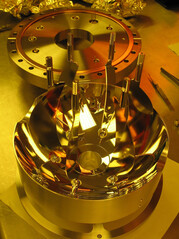
Why Does Matter Exist? Roundness of Electrons May Hold Clues
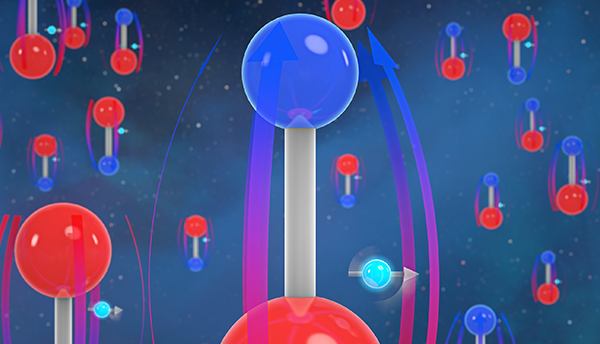 In the first moments of our universe, countless numbers of protons, neutrons and electrons formed alongside their antimatter counterparts. As the universe expanded and cooled, almost all these matter and antimatter particles met and annihilated each other, leaving only photons, or flashes of light, in their wake.
And if the universe were perfectly symmetrical, with equal amounts of matter and antimatter, that would be the end of the story — and we would never have existed. But there must have been an imbalance — some leftover protons, neutrons and electrons — that formed atoms, molecules, stars, planets, galaxies and eventually, people.
|