Data Release 5.0 for the Adolescent Brain Cognitive Development Study
ABCD Data Release 5.0 has been shared. The ABCD Study® has changed the way tabulated data are downloaded for the 5.0 release. The imaging and non-imaging tabulated data are packaged as a single .zip file containing all of the relevant tables for the domain. To obtain the data you must be logged into NDA (authenticated). Visit https://nda.nih.gov/study.html?id=2147 and select the “ABCD 5.0 Tabulated Release Data” file in the Results section to download all tabulated imaging and non-imaging 5.0 data. As in past releases, neuroimaging and other file-based data (e.g., genomics; raw behavioral data) are accessible via the NDA Download Manager tool.
All data access information is documented on the NDA ABCD Featured Dataset page (https://nda.nih.gov/general-query.html?q=query=featured-datasets:Adolescent%20Brain%20Cognitive%20Development%20Study%20(ABCD) and includes pointers to an external ABCD Study wiki at https://wiki.abcdstudy.org/ where data release notes and general information about the data resource are provided. All users should review the release notes for detailed information on the released data. Note that with the change to how release notes are made available, they will be updated regularly and thus users are advised to check https://wiki.abcdstudy.org/release-notes/start-page.html for the most up-to-date information. Release notes for qualified users only (i.e., non-public) are available at https://nda.nih.gov/study.html?id=2147. The 5.0 data ontology and dictionary can be viewed at https://data-dict.abcdstudy.org/.
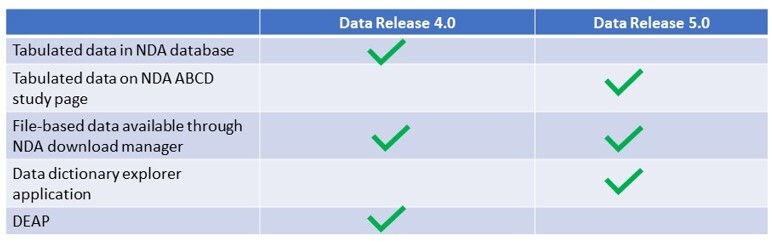
The table below highlights key differences between the 4.0 and 5.0 data releases. Note that the Data Exploration and Analysis Portal (DEAP) has been decommissioned as of June 1, 2023. In addition, study creation no longer works with how the data are shared this year.
 Data Release 5.0 contains early longitudinal data on the full participant cohort, including 2-year follow-up neuroimaging data (second imaging timepoint), as well as phenotypic data through the 3-year follow-up visits. Interim data are available for the 4-year follow-up visit, including some of the neuroimaging data. Also available are ABCD derived scores from linked external school performance and environmental data, including the Stanford Education Data Archive, EPA Smart Location Database, American Community Survey Area Deprivation Index, FBI’s Uniform Crime Report, lead exposure risk and air pollution indices, among others. Smokescreen genotyping array data with TOPMed imputations are available as well. These include common variations, as well as variations associated with addiction, smoking behavior, and nicotine metabolism.
|