|
 |
|
ODS Announcement
|
We will soon transition ODS Digest: News & Insights to a new email distribution platform. We will send additional emails this month detailing any actions you may need to take to remain subscribed. We thank you for subscribing to our newsletter, and we appreciate your support and patience as we make this shift.
|
|
 |
|
ODS Events
|
SAVE THE DATE: ODS Sleep Workshop – September 15–16
ODS will host a virtual workshop on September 15–16, “Sleep in a Bottle? Research needs and gaps in ingested, non-prescription interventions for better sleep.” Co-organized by the NIH National Center on Sleep Disorders Research of the National Heart, Lung, and Blood Institute, the workshop aims to better understand the most important gaps in knowledge of dietary supplements and other non-prescription products taken to improve sleep. Discussions will also focus on prioritizing future research, identifying required tools and resources, and determining how future studies could help advance our knowledge of sleep and circadian rhythms.
ODS 2025–2026 Seminar Series
Stay tuned for details about the ODS 2025–2026 Seminar Series, which will start in September. The ODS Seminar Series presents virtual seminars on dietary supplement research and related topics. It is intended for those interested in dietary supplement research but is open to everyone. Visit the ODS Seminar Series webpage to learn more.
|
|
 |
|
Co-Funding Opportunities
|
ODS provides funding support to the NIH Institutes, Centers, and Offices (ICOs) through our co-funding program. Co-funding allows ODS to promote dietary supplement-related science by supporting NIH extramural dietary supplement-related research project grants, training and career development grants, and scientific conferences with primary ICOs. See the list of active ODS co-funding opportunities and learn more on our Grants & Funding webpage.
|
|
|
|
Science Shorts
|
Despite longstanding calls to improve dietary supplement data collection, the best method for assessing dietary supplement intake remains unclear, and different tools produce vastly different estimates of use and nutrient exposure. A new collaborative study, co-authored by ODS, examined two common dietary supplement assessment tools—the Diet History Questionnaire-II (DHQII), which is a food frequency questionnaire or FFQ, and the Automated Self-Administered 24-hour Dietary Recall (ASA24)—to see how they compare in tracking supplement use and nutrient intakes among nearly 800 adults age 50 to 74 over the course of a year. The researchers found the two tools often gave different estimates of how many people were using supplements and how much of certain nutrients—especially vitamin D—people were getting from them. For example, the amount of vitamin D intake reported using the ASA24 was often much higher than what the DHQII showed. These differences suggest some tools may be better suited than others depending on the specific nutrient being studied and that questionnaires alone may not always provide a complete picture of supplement use.
|
|
 |
|
Featured Fact Sheets
|
Our calcium and vitamin B12 fact sheets for health professionals have a fresh new format. Each fact sheet section now includes a concise summary—perfect for a quick reference. Want more in-depth information? Click on the expandable summaries to access more detailed information, including references to the peer-reviewed literature. These essential resources provide clear, evidence-based information about the effectiveness, safety, and use of these vital nutrients. Looking for general information? We also offer calcium and vitamin B12 fact sheets for consumers.
Other new features! All ODS health professional fact sheets now include mouse-over references—simply hover over reference numbers to see full citation details; no need to scroll. Plus, key data tables—including Recommended Dietary Allowances (RDA) and Tolerable Upper Intake Levels (UL)—are now available for download as CSV files, making it easier to import information directly into spreadsheets and word processing tools.
|
|
|
 |
|
News Around NIH
|
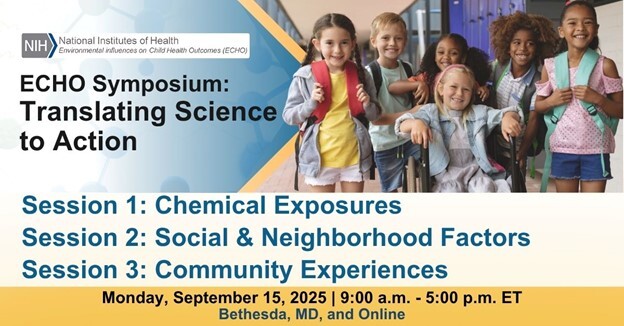 ECHO Symposium: Translating Science to Action
The Environmental influences on Child Health Outcomes (ECHO) Program will host a virtual and in-person symposium on September 15, bringing together researchers, clinicians, policymakers, advocates, and community leaders to explore how environmental factors influence child health—and how to translate science into meaningful action. Register now on the event site.
Workshop: Inflammaging: Mechanisms, Markers, and Intervention Strategies
As people age, their immune systems become less balanced, leading to a constant, low-level inflammation known as “inflammaging.” This type of inflammation is linked to many diseases that become more common with age. On September 22–23, the National Institute on Aging (NIA), along with other NIH partners, will host an in-person workshop, “Inflammaging: Mechanisms, Markers, and Intervention Strategies,” focused on understanding inflammaging—what causes it, how to measure it, and how it might be prevented or treated. The workshop will also explore the latest research and technology helping scientists study the immune system in greater detail, including how certain immune cells, like macrophages, contribute to inflammation. Registration is now available on the NIA website.
|
|
About ODS
The Office of Dietary Supplements (ODS) is part of the National Institutes of Health (NIH), the nation’s medical research agency—supporting scientific studies that turn discovery into health.
|
Contact Us
Office of Dietary Supplements National Institutes of Health 6705 Rockledge Drive (Rockledge I) Room 730, MSC 7991 Bethesda, MD 20817
Email: ods@nih.gov
Website: https://ods.od.nih.gov
|
|
|
|
|



