|
Having trouble viewing this email? View it as a Web page.

|
|
The Transformative Potential of ScHARe’s Big Data, AI, and Multidisciplinary Research Collaboration Teams
Addressing minority health and health disparities requires innovative approaches that blend expertise across disciplines. In the latest NIMHD Insights blog, two NIH Science Collaborative for Health disparities and Artificial intelligence bias Reduction (ScHARe) research teams explain how they are leveraging Big Data, AI, and advanced data science methodologies to increase understanding of how Social Determinants of Health contribute to health inequities.
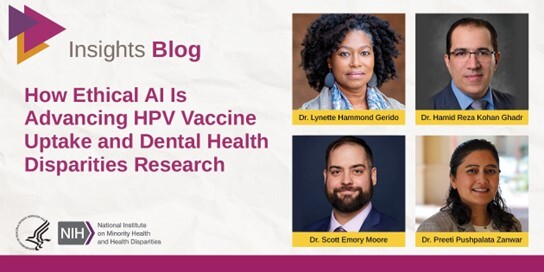 One team – co-led by Lynette Hammond Gerido, Assistant Professor in the Department of Bioethics at the Case Western Reserve University School of Medicine, and Scott Emory Moore, Assistant Professor at the Frances Payne Bolton School of Nursing at Case Western Reserve University – is using Big Data and data-driven techniques to understand health disparities in HPV vaccine uptake among marginalized communities. Another team – co-led by Hamid Reza Kohan Ghadr, Principal Scientific Consultant at Akna Health, and Preeti Pushpalata Zanwar, Lecturer in Applied Health Economics & Outcomes Research and Health Policy at Thomas Jefferson University – explains how they are leveraging AI to address disparities in dental care access.
These research efforts offer methodological guidance for other researchers, present an opportunity to identify data-driven health policy interventions, and will contribute to the discourse on bias mitigation and AI.
|
|
|
|
|
|
|
|