|
|
March 2025

Change in PEGS Leadership
We are excited to announce that Lawrence S. Kirschner, M.D., Ph.D. will join Alison Motsinger-Reif, Ph.D. as a principal investigator for PEGS. We congratulate Dr. Janet Hall on her retirement, and thank her for all of her contributions to PEGS.
Dr. Kirschner is a Senior Clinician in the Clinical Research Branch at NIEHS and is the Medical Director of the NIEHS Clinical Research Unit. Dr. Kirschner is a physician-scientist and clinical endocrinologist with expertise in treating patients with pituitary and adrenal tumors, and inherited syndromes that cause endocrine tumors or other endocrine dysfunction. Prior to joining NIEHS, he served as a Professor of Internal Medicine in the Division of Endocrinology, Diabetes and Metabolism at The Ohio State University College of Medicine in Columbus, Ohio.
|
|
|
|
Environmental exposures are everywhere, even in our homes and workplaces. While some hazards at low levels may not be harmful, they can be more dangerous for some groups, especially children, pregnant women, people with certain health conditions, and older adults.
At the 2024 PEGS virtual meeting, we talked about how the environment affects our health and ways to lower our risk of exposure to lead, mold, pesticides, plastics, and chemicals that disrupt hormones. If you missed the meeting, you can see it online here.
In this PEGS newsletter, we will talk about some other environmental hazards — radon, carbon monoxide, and volatile organic compounds (VOCs) — and ways to reduce our exposure to them. One easy way to reduce indoor levels of these hazards is to air out your home regularly by opening windows.
|
|

Radon is an odorless and invisible gas that is the second leading cause of lung cancer after smoking.1 The EPA estimates that 21,000 lung cancer deaths within the United States are caused by radon exposure.1 This risk of lung cancer is higher if you have smoked cigarettes, and children are also more likely to experience negative effects.2,3
Radon is found naturally in the environment and is released from rocks, soil, and water. Areas close to mountains often have higher levels of radon, and in North Carolina, 77 out of 100 counties have elevated radon indoor air levels above 4 picoCuries per liter of air (pCi/L). Click here for a map that shows predicted indoor radon levels by county in North Carolina. Even if the map does not indicate that your county has high radon levels, that does not mean that your home is radon-free. All homes and buildings should be tested for radon regardless of your county’s radon level. For those of you in North Carolina, please contact the North Carolina Department of Health and Human Services at 1-800-662-2000 for more information.
|
Mitigation Strategies
Here are ways to reduce radon exposure in your home:
- Know your home’s radon level. Your home should be tested every two years (or every five years if you have a radon mitigation system).
- The NC Department of Health and Human Services (NCDHHS) distributes free radon test kits annually. Please check the Radon Program Website for more information.
- Discounted testing kits can be purchased through AirCheck or through Kansas State University. Please check out the video on how to use AirCheck kits here. Home radon test kits can also be purchased at most hardware stores.
- If you’re a smoker, you can receive a free radon testing kit through QuitlineNC by calling 1-800-784-8669. (QuitlineNC is also a free smoking cessation resource.)
- If radon levels are high, hire a professional to install a radon reduction system in your home.
- For more information about radon testing, visit the NCDHHS Radon Testing webpage.
- Open doors and windows to increase airflow in your home. Use fans to circulate the air through your house.
- If your home uses groundwater, private well water, or a public water system that uses ground water, use aeration or Granulated Activated Carbon (GAC) treatment where the water enters your home.
|
|
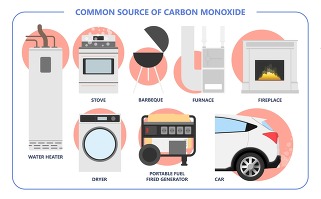
Carbon monoxide (CO) is also a gas that is colorless, tasteless, and odorless. It can be found in fumes that are produced when fuel is burned in cars/trucks, stoves, grills, fireplaces, gas ranges, gas furnaces, water heaters, dryers, or lanterns. CO levels can build up over time inside buildings, causing harm to people and animals by making it hard to breathe, leading to suffocation. Each year in the United States, about 450 people die from CO exposure, and thousands visit the emergency room for treatment to CO exposure.4 CO exposure can increase during cold weather and storms because of the use of gas-powered generators, kerosene heaters and other fueled heating methods used inside.4 In North Carolina, people have died from CO poisoning from running generators inside after losing power from hurricanes.5 It is important to remember that only heating appliances approved for indoor use should be used indoors and in rooms that are well ventilated. Generators should only be used outdoors. Common signs of elevated CO levels are headache, dizziness, weakness, upset stomach, vomiting, chest pain, and confusion.
|
Mitigation Strategies
Below are some ways to prevent CO poisoning in your home:
- Install a CO detector in your home and replace the batteries each year, just like you would for a home smoke detector.
- Each year, have your gas, oil, or coal-burning appliances, such as your furnace or water heater, serviced by a qualified technician.
-
DO NOT use a gas range or oven for heating. This can cause a buildup of CO in your home.
-
DO NOT burn charcoal indoors. The burning of charcoal (red, gray, black, or white) gives off CO.
-
DO NOT use a generator inside your home, basement, or garage or less than 20 feet from any window, door, or vent.
|
|
|
Volatile organic compounds (VOCs) are a large group of chemicals that can be found in household products. These chemicals may or may not give off a smell, so smelling is not a good indicator for health risk.6 Some common VOCs that may be present in your everyday life can be found in paints and lacquers, paint strippers, cleaning supplies, pesticides, adhesives, building materials and furnishings, and copiers.7 Low levels of a common VOC called benzene can also be found in outdoor air from secondhand tobacco smoke, gasoline fumes, exhaust from motor vehicles, and other emissions.8 Other common VOCs are formaldehyde (which may be found in cigarette smoke, wood products, preservatives used in some medicines, and cosmetics)9 and ethylene glycol (which may be found in antifreeze, brake fluids, ballpoint pens, and plastics).10
|
|
|
How much you breathe in and for how long you're exposed to VOCs in the air affect your health. Short-term exposure to high levels of VOCs can worsen asthma symptoms and cause headaches, nausea, dizziness, and irritation of the eyes, throat, and nose.6 Long-term exposure to high levels of VOCs can lead to serious health issues like cancer, liver and kidney damage, and damage to the central nervous system.6
Several studies done by the EPA have found levels of about a dozen common organic pollutants to be 2 to 5 times higher inside homes than outside of homes.7 This was regardless of whether the homes were located in rural or highly industrial areas.7
Mitigation Strategies
The following strategies can help reduce levels of VOCs in your home6:
- Reduce and remove the products in your home that give off VOCs.
- Store unused chemicals in places where people do not spend much time such as a garage or shed. Unused chemicals in homes can sometimes leak and release VOCs in the air.
- Consider low-VOC options for paints and furnishings.
- Increase the amount of fresh air in your home to help reduce the concentration of VOCs indoors.
- When possible, open your doors and windows to increase ventilation. To maximize air brought in from the outside, use a fan.
- Try to keep your home's humidity and temperature low or comfortable. In high temperatures or humidity, chemicals may give off more VOCs.
- When doing home renovations, try to perform them when your house is vacant or during seasons when you can keep your windows and doors open, to increase ventilation.
You can visit the Minnesota Department of Health website to learn about more strategies to reduce exposure to VOCs.
|
|
|
|
|