The injectable form of nivolumab, called Opdivo Qvantig, is quicker and easier to give, several oncologists said, and is just as effective as the intravenous form. Injectable forms of other immunotherapies are also on the horizon.
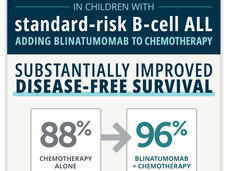
Following positive results from a clinical trial, the immunotherapy drug blinatumomab (Blincyto) is expected to become part of the standard initial treatment for many kids with B-cell acute lymphoblastic leukemia, the most common form of childhood cancer.
Researchers at Memorial Sloan Kettering Cancer Center have developed a training program to help health providers reduce lung cancer stigma. In this interview, they discuss an ongoing NCI-funded nationwide clinical trial to test the training.
The Food and Drug Administration (FDA) approved injectable daratumumab (Darzalex Faspro) and isatuximab (Sarclisa) for people with a new diagnosis of multiple myeloma. FDA’s approvals should change the initial treatment of newly diagnosed multiple myeloma, including for patients who can’t get a stem cell transplant.
In a small clinical trial, an experimental CAR T-cell therapy that targets the protein GD2 on cancer cells shrank tumors and improved symptoms in young people with diffuse midline glioma.
Clinical Trials Information for Patients and Caregivers
NCI’s cancer research news blog, Cancer Currents, reports on findings from cancer clinical trials, with commentary from leading researchers on how the trial results will affect patient care.
Clinical trials are research studies that test how well new medical approaches work in people. This page discusses what trials are, why they are important, and what types of clinical trials are available for people with cancer.
This phase 2 trial will test obeticholic acid (Ocaliva) in people with Barrett esophagus, a condition that leads to damage of the esophagus that might progress to cancer. Obeticholic acid can reduce the amount of bile acid and inflammation in the esophagus. Doctors want to see if giving obeticholic acid to people with Barrett esophagus can prevent further damage that could lead to cancer.
This clinical trial will compare two surgeries to see how well they work in reducing the risk of ovarian cancer. People with mutations in their BRCA1 gene will undergo surgery to either remove both their ovaries and fallopian tubes or just their fallopian tubes. Doctors want to see if removing only the fallopian tubes will be as effective at preventing ovarian cancer while preserving some ovarian function.
This phase 3 clinical trial will test an online program to help adults with cancer cope with pain. People in treatment or who have finished cancer treatment but are still having pain will be randomly assigned to receive the internet-based program along with standard pain care or standard pain care alone. Doctors want to see if the program reduces the pain and the amount of interference in daily life it causes.