|
A Message from Leadership

As the growing season nears its end across the Mountain Plains Region, we look forward to the harvest and being rewarded for the seeds that were planted many months ago. In our nutrition security work, we recognize that the impact of small actions we take today may take many years or even generations into the future to be realized, but we continue to plant seeds to one day reap the rewards of a more equitable food system.
In this edition of At the Table, we especially celebrate and honor the work of our tribal partners as November ushers in Native American Heritage Month. You will read more about my recent visit to Nebraska – highlighting the work of the Winnebago Tribe of Nebraska and the Omaha Tribe of Nebraska in their WIC and FDPIR programs – as well as events to celebrate Farm to School Month and National School Lunch Week.
I encourage you to share this newsletter far and wide among your contacts, and we can continue to build a network of partners to nurture the seeds we are planting together.
Cheryl Kennedy
USDA FNS Mountain Plains Regional Administrator
|
|
|
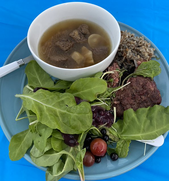
FNS Honors Traditions and Supports the Sovereignty of Tribal Nations
By Alison Hard, Senior Policy Advisor for the USDA Food and Nutrition Service
Tribal nations across what we now consider the Great Plains relied for millennia on their buffalo relatives for food, medicine, clothing, tools, and shelter. Yet today, it is hard to find buffalo meat on school meal trays in the very areas where they once sustained Native communities. The Food and Nutrition Service is working with tribal partners to figure out why and how to remove the barriers we can.
The Biden-Harris Administration and Secretary Vilsack have made it a priority to better meet our federal trust and treaty responsibilities. Historically, the U.S. government played a significant role in the decimation of the buffalo population in the North American continent, with a policy of destroying buffalo in order to starve Native Americans into submission. We recognize the weight of these actions and our obligation to better support tribes in restoring buffalo across their lands.
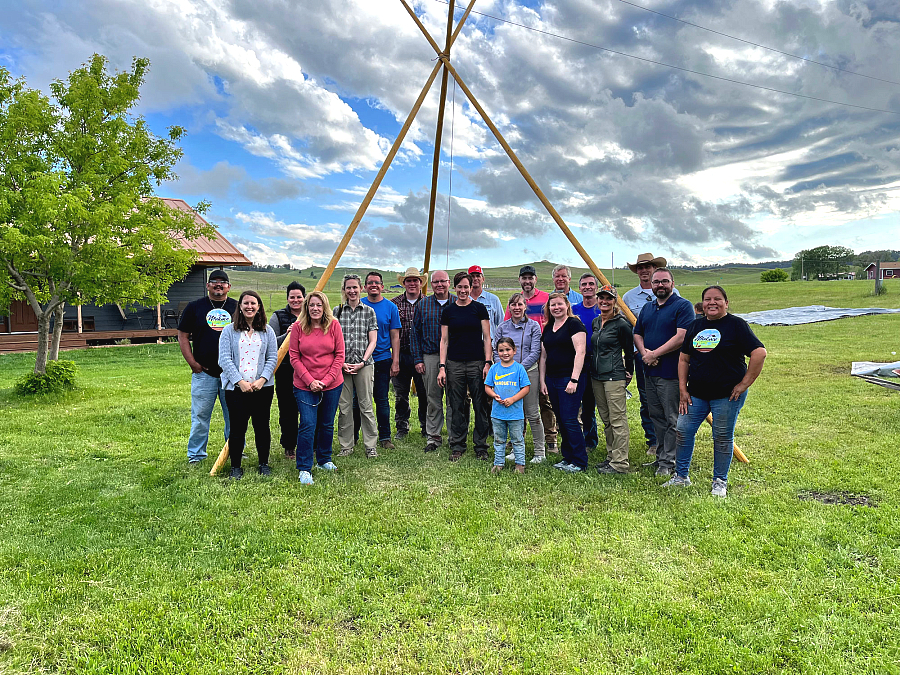
On June 6, my colleagues at FNS, Food Safety and Inspection Service (FSIS), Rural Development, Agricultural Marketing Service, and the USDA Office of Tribal Relations, and I were honored to be invited by the InterTribal Buffalo Council (ITBC) and members of the Oglala Sioux Tribe on the Pine Ridge Indian Reservation to participate in a traditional buffalo slaughter and field harvest. ITBC is a coalition of 69 federally recognized tribes that has led the work to restore buffalo to Indian Country since 1992. Our traditional harvest was led by Lisa and Arlo Iron Cloud who work with Makoce Agriculture Development, an Indigenous agriculture organization led by Nick Hernandez on Pine Ridge. Ms. Iron Cloud also partners with USDA’s Indigenous Food Sovereignty Initiative to help create resources on sustainable, Indigenous food foraging practices.
This “hands-on” experience was a once-in-a-lifetime opportunity for which we are so grateful to Lisa, Arlo, the ITBC, and the Oglala Lakota Nation Tribal leadership to have a glimpse into the cultural, spiritual, and practical contributions of buffalo to the Lakota people.
We saw the importance of providing opportunities for American Indian children to engage in hands-on nutrition education about buffalo and to be able to taste and regularly eat buffalo as part of their school meals. FNS has worked to address some of the barriers that make it challenging for schools to serve buffalo, but we recognize that we must do more. We look forward to continuing to partner with ITBC and tribal leaders to advance Indigenous food sovereignty priorities and restore buffalo in Indian Country.
Learn more about USDA Food and Nutrition Service demonstration projects in tribal communities and USDA’s Indigenous Food Sovereignty Initiative.
|
Omaha Nation Supports Nutrition Education
By Cheryl Kennedy, USDA FNS Mountain Plains Regional Administrator
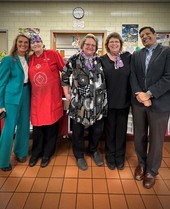
Last month, I had the honor of visiting the WIC clinic of the Omaha Tribe of Nebraska and meeting WIC Director Jessika Free-Bass. While there, we discussed the Tribe's WIC garden, which they use to grow produce for use in nutrition education efforts for their clients. At the Omaha WIC clinic, nutrition education is a community effort.
Free-Bass says that the Omaha Nation WIC program recognizes the importance of incorporating indigenous foods and traditional cooking practices into the WIC experience to form a holistic approach to nutrition education. Over the past few years, the program has taken extra steps to shine the spotlight on foods that are indigenous to their area, as well as dishes and cooking methods traditionally used by the Umóⁿhoⁿ people.
This year, the WIC garden grew tomatoes, and WIC clients made tomato sauce. The garden also produced carrots, which the program uses to teach how to make baby food. The WIC garden is small, so the clinic partners closely with several community organizations to further its nutrition education efforts. The nearby Umóⁿhoⁿ school garden donates squash and indigenous corn to the program. Omaha WIC also partners with the Nebraska Indian Community College, using its kitchen facilities to provide nutrition "lunch and learns" and cooking demonstrations.
The WIC program aims to safeguard the health of low-income women, infants, and children up to age 5 who are at nutrition risk by providing nutritious foods to supplement diets, information on healthy eating, and referrals to health care. As we celebrate Native American Heritage Month, I applaud the Omaha Nation on its outreach to mothers, young children, and the community in general for connecting people with healthy foods.
It was a pleasure to see these efforts, and I take great pride in the role that USDA has in funding the WIC program to bring greater equity in healthy food access.
Tribal Consultations Offer Government-to-Government Relationship
The USDA Food and Nutrition Service (FNS) along with tribes and Supplemental Nutrition Assistance Program (SNAP) state agencies share the goals of improving nutrition and health through nutrition assistance and nutrition education. As partners, these stakeholders must work cooperatively to ensure that American Indians and Alaska Natives have full access to SNAP.
USDA Departmental Regulation 1350-002, entitled Tribal Consultation, Coordination and Collaboration, “directs the USDA and its agencies to provide Federally recognized Tribes the opportunity for government-to-government consultation and coordination in policy development and program activities which have direct and substantial effects on their Tribe.”
To support enhanced consultation between state agencies and tribes, FNS released two new guidance memos in September: Memorandum on Tribal Consultation and SNAP Tribal Consultation Guiding Principles. These memos detail not only the regulatory requirements, but also offer suggestions and best practices to encourage ongoing, timely, and meaningful dialogue between state agencies and tribes.
FNS Seeks to Advance Tribal Sovereignty through FDPIR Self-Determination Projects
USDA Food and Nutrition Service invites tribes to apply for a second round of Food Distribution Program on Indian Reservations (FDPIR) Self-Determination Demonstration Projects. Through these projects, tribes administering FDPIR can enter into self-determination contracts with USDA to directly purchase food for the food packages distributed to their tribe.
FDPIR provides USDA Foods to income-eligible households on tribal reservations and Native American households in approved areas near reservations or in Oklahoma. USDA distributes both food and administrative funding to participating tribes to operate FDPIR. The FDPIR Self-Determination Demonstration Project empowers tribal nations by allowing them to select and purchase foods for their food package. This better aligns their FDPIR food package with culture and traditions and also supports indigenous agricultural communities.
Eligible tribes are encouraged to apply for FDPIR Self-Determination Demonstration Project funding by submitting a proposal for participation by January 31, 2023. Information about eligibility, the criteria for participation and the process for submitting a proposal is available at https://www.fns.usda.gov/fdpir/fr-101822.
|
|
 Have you explored the USDA Food and Nutrition Service FDPIR sharing gallery? The site contains cookbooks and recipes specifically for participants of FDPIR. Resources come from tribes and Indian Tribal Organizations, non-profit organizations, and the USDA. Cookbooks and recipes can be used to provide participants with ideas on how to utilize foods found in their FDPIR food package.
FNS Visits Nebraska and Tribal Food Programs During National School Lunch Week
Regional Administrator Cheryl Kennedy and Special Nutrition Programs Director Mario Ramos visited Nebraska last month to highlight National School Lunch Week and National Farm to School Month. The trip also included visits to a variety of FNS programs and partners, including the Lincoln-Lancaster County WIC clinic, the Winnebago Tribe of Nebraska WIC Program, and the Omaha Tribe of Nebraska WIC and Food Distribution on Indian Reservations (FDPIR) Programs.
Across the visits, FNS leadership was impressed with the creative adjustments of operations made in response to the COVID-19 pandemic and supply chain issues, as well as the innovations and partnerships that continue to drive the programs forward. Most of all, FNS leadership noted the impact of program staff when assisting clients -- serving as a valuable connection to the community and its resources.
|
|
 RA Cheryl Kennedy with Oak Valley Students
|
|
Oak Valley Nutrition Staff and Omaha Public Schools, Nutrition Services Director Tammy Yarmon
|
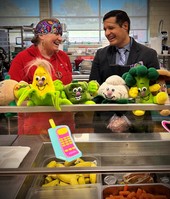 SNP Director Mario Ramos with Oak Valley Nutrition Staff
|
|
Oak Valley Elementary was serving up smiles for National School Lunch Week. School food service staff showed dedication to the students, providing not just healthy meals, but genuine care and welcome. FNS staff served lunch and joined kindergartners for good food and good company. |
|
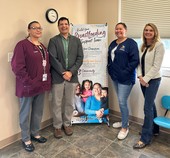 Winnebago Tribe of Nebraksa WIC
|
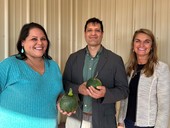 Omaha Tribe of Nebraska WIC
|
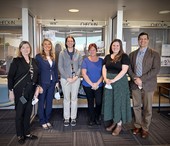 Lincoln Lancaster County WIC
|
|
WIC clinics across the Mountain Plains Region remained a steadfast community resource despite the past challenging years. Many programs adapted service delivery in response to COVID-19 to offer over the phone client visits and, in some cases, mobile visits. Programs also served as resources during the infant formula shortage. During this challenging time, some programs transitioned to Electronic Benefit Transfer (EBT) as a way to provide WIC benefits. The Winnebago Tribe of Nebraska WIC team is most proud of accomplishing this transition despite also adjusting to pandemic and supply chain issues. The Omaha Tribe of Nebraska bolstered breastfeeding promotion as well as nutrition education efforts with an on-site garden. Serving as a community resource for health referrals, the Lincoln-Lancaster County WIC clinic served as an access point for a population of clients with diverse language needs, while also earning the distinction of the Gold Breastfeeding Award of Excellence. |
|
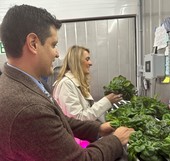 Freight Farm at The Bay
|
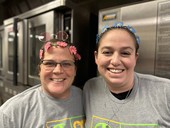 Gretna High School Nutrition Services Staff
|
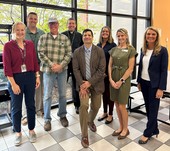 Pius X High School - Farm to School
|
|
|
National Farm to School visits were about partnerships and innovation.
At the "Freight Farm," a partnership between Beyond School Bells and The Bay in Lincoln, Nebraska, students grow nearly two acres worth of leafy greens through a vertical hydroponic system to provide produce to local schools, food banks and restaurants year-round. The Bay, an alternative high school where the farm is located, maintains the farm and provides on-site job training--all led by the students.
Gretna High School provided an array of healthy food options for students--from daily homemade pizza to vegetarian grab-and-go options, with best efforts to highlight local foods through Nebraska Thursdays.
Pius X High School showcased the importance of partnerships for a successful farm to school program. Joined by local farmer, Gary Fehr of Green School Farms, staff explained their efforts to problem solve procurement needs by prioritizing local food purchases, adding flexibility into their meal schedule and working effectively through well-developed partnerships.
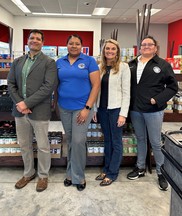
A visit to the Omaha Tribe of Nebraska Food Distribution Program provided an opportunity to tour the newly renovated warehouse facility and meet with program staff to learn about program operations including the distribution modifications made in response to COVID-19. With a well-designed building and kitchen for nutrition education, staff look forward to an upcoming grand re-opening.
Omaha Tribe of Nebraska FDPIR
|
|
|
|
FY2023 Farm to School Grant Request for Applications Opens; Tribes Thrive on Past Grants
Each fiscal year, USDA awards competitive Farm to School grants that support planning, developing, and implementing farm to school programs. USDA's Farm to School grants are an important way to help state, regional, and local organizations as they initiate, expand, and institutionalize farm to school efforts.
The fiscal year (FY) 2023 Farm to School grant program request for applications (RFA) is now open for submissions until January 6, 2023. To apply, visit Grants.gov and follow the instructions found in the FY2023 RFA. Be sure to visit the grant applicants resources page to access other helpful resources, including links to webinars that provide specific assistance on applying for a Farm to School Grant.
In the Mountain Plains Region, grant recipients include a wide spectrum of types of organizations, ranging from schools to local non-profits to tribes. In the last several years, several tribal organizations have received a number of significant grants. They include:
In FY 2022, The Cheyenne River Sioux Tribe received a $91,554 implementation grant that seeks to provide locally sourced beef and buffalo to the five school lunch programs located on the Cheyenne River Sioux Reservation. Schools and the estimated 2,200 students on the Reservation will have the opportunity to experience the benefits of eating a locally sourced protein as well as learn about where the food comes from and its cultural importance. Producers and processors will also be impacted by a new institutional market that previously did not exist.
In FY 2021, South Dakota Little Wound School Board, Inc. received a $99,906 implementation grant. The Little Wound School District (a K-12, tribal community-serving school, located on the Pine Ridge Indian Reservation) in cooperation and with support from the South Dakota State University Extension Office and two local farms, Rebel Earth Farms and Homegrown Pork and Poultry, serves 400 students through agricultural education efforts and in-depth professional development for teachers to systemically incorporate use of farm learning in classroom curriculums. The farm includes a focus on both commercial crops of regional importance alongside traditional plants that have been historically used and consumed by the Lakota and Great Plains Tribes.
In FY 2020, First Nations Development Institute, based in Colorado, received a $50,000 training grant. First Nations Development Institute is a Native American-led, national nonprofit with the mission to strengthen American Indian economies in support of healthy Native communities. First Nations hosted a Farm to Tribal School training for Native communities seeking to develop and expand new/existing farm-to-school initiatives. The training’s goals included connecting Native farm to school initiatives with a majority Native audience, showcasing best practices for existing models, sharing available resources, and providing an open forum for discussion
Also in FY 2020, the Tribal Nations Research Group in North Dakota received a $43,511 planning grant. The Tribal Nations Research Group has worked to implement a farm to school program in collaboration with the Turtle Mountain Community High School (TMCHS), which is located on the Turtle Mountain Band of Chippewa Indians Reservation (TMBCI) in north central North Dakota. Some of the completed goals of the project include: assessing local food availability and identifying more than 10 crops that are suitable for production in the community and with local producers; conducting food tasting events at the local schools; and completing an agriculture curriculum for the school and submitting it to the state Career and Technical office for approval. The students have been the main driving force behind the project, not only because of Career and Technical Education (CTE) guidelines, but primarily creating intrinsic value to the program to make it last beyond the students’ high school years.
|
|
SNAP Grant Awards Improve Customer Service and Program Integrity
|
Over the past few months, as part of two separate grant programs, FNS awarded the states of Colorado, Montana and Wyoming nearly $3 million in funding to improve Supplemental Nutrition Assistance Program (SNAP) operations and integrity.
The Wyoming Department of Family Services was awarded a SNAP Fraud Framework Implementation Grant - this investment will help the state improve its recipient fraud prevention, detection, and investigation efforts by implementing principles from the SNAP Fraud Framework, a toolkit designed to help states prevent and detect fraud and sharpen their investigative techniques.
The Wyoming Department of Family Services will receive $750,000 to develop a Front-End Eligibility (FEE) Investigation process utilizing various tools including Accuity Asset Verification Services (AVS). The FEE Investigation process will allow state staff to quickly review questionable cases to verify information provided by applicants and/or identify undeclared assets.
Montana and Colorado each received multi-year SNAP Process and Technology Improvement Grants to improve the experience of SNAP participants by enabling grantees to update inefficient or ineffective processes and use technology to streamline operations and provide better customer service.
The Montana Department of Public Health and Human Services will receive $1,530,000 to design and implement infrastructure and functionality that integrates with the state's eligibility system to automate SNAP Employment and Training (E&T) data processing. The project will improve internal workflow by reducing manual SNAP E&T recording, tracking, and reporting and will allow the state to improve E&T services for clients, including expanding services to more counties.
Colorado’s Department of Human Services will direct its $517,961 investment to build an Interactive Voice Response (IVR) system to handle recurring inquiries and provide personalized information and general frequently asked questions responses via call or text. The project will improve customer service by reducing long call-back and hold times and will provide the foundation for a single statewide contact center for all counties in Colorado.
The FNS Mountain Plains Regional Office applauds all our state partners for commitment to ongoing innovation in SNAP program operations and integrity.
|
|
PRESS RELEASES/BLOGS
 In Case You Missed It...
|
ADDITIONAL RESOURCES
Upcoming Webinar: November 8, 2022| 2:30pm ET– Getting Familiar with the FY 2023 Farm to School RFA. This webinar will provide an overview of the FY 2023 Farm to School Grant Program RFA, including updates to eligibility, turnkey programs, and how to submit a completed application on grants.gov.
Upcoming Webinar: November 9, 2022 | 2:30pm ET– Getting Your Grant Package Together. This webinar will explore the key characteristics of a competitive Farm to School Grant application.
Upcoming Webinar: December 7, 2022 CACFP National Sponsors’ Association’s (NCA) webinar “Power of the Food Program” and Scholarship Application information.
Upcoming Webinar: Dec. 13-14, 2022 SNAP E&T National Forum. The USDA-FNS SNAP Office of Employment and Training (E&T) hosts the second SNAP E&T National Forum on building better SNAP E&T programs that lead with equity, create economic opportunity, and meet local workforce needs.
Funding Opportunity: Advancing Tribal Sovereignty through Self-Determination Projects for FDPIR (deadline Jan. 31, 2023)
|
|
|
|
|