|
WASHINGTON,
DC– The Federal Mediation and Conciliation Service (FMCS) hosted 14 newly
commissioned mediators Mar. 19-23 in its Washington, DC headquarters as part of
an annual training program designed to prepare new mediators to help FMCS labor
and management customers better manage disruptive contract and workplace disputes.
The five-day
program, led by senior FMCS staff, introduced a variety of professional topics
including administrative procedures, mediator code of conduct and ethics, the
history of FMCS, the National Labor Relations Act and alternative dispute
resolution.
FMCS Deputy
Director Scot Beckenbaugh welcomed the new mediators as “the newest members of
the FMCS family,” he said. “Our primary goal throughout this week is to provide
our mediators with the highest levels of training, allowing them to best
support labor-management negotiations in the field and support the institution
of collective bargaining.”
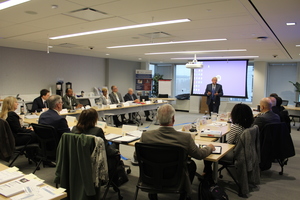 WASHINGTON, DC
(March 20, 2018) Federal Mediation and Conciliation Service (FMCS) Deputy
Director, Scot Beckenbaugh, welcomes a group of new federal mediators from
around the country at the FMCS headquarters. The mediators were at the headquarters
to attend a five-day training program to prepare them for their role in helping
to resolve labor-management conflicts, build better relationships, and create
more effective organizations. (FMCS Photo/Heather Brown)
|
Mediators from
FMCS provide a multitude of services to both the public and private sector to
build labor-management partnerships, manage conflict, and avert or mitigate the
damaging effects of workplace disputes. Many
of the new mediators are already experienced labor-relations professionals, with
expertise in resolving labor-management disputes, building labor-management
relationships, and alternative dispute resolution for government agencies. FMCS equips them to help build better
relationships through joint problem-solving and by advocating constructive
responses to inevitable conflict. Organizations
that reduce conflict become more efficient, creating more value for customers,
shareholders and employees alike, and substantially benefit the national
economy.
“This was very
helpful training,” said Antionette Turner, one of the new mediators attending
the course. “The best part was that I learned a lot of techniques from very experienced
mediators that help shed light on how to be most effective and value-added to
the parties I will be assisting in negotiations.”
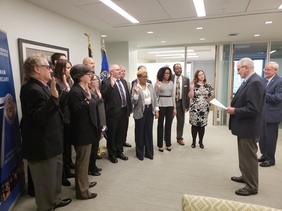 WASHINGTON, DC
(March 20, 2018) John Pinto, director of field operations for the Federal
Mediation and Conciliation Service (FMCS), administers the oath of office to a
group of new federal mediators from around the country at the FMCS
headquarters. The mediators were at the headquarters to attend a five-day
training program to prepare them for their role in helping to resolve
labor-management conflicts, build better relationships, and create more effective
organizations. (FMCS Photo/Greg Raelson)
|
Mediators arrived in Washington from across the country, representing some of the more than 60 FMCS field offices and 10 regional offices. Although new to federal mediation, all the mediators are experienced in labor-management negotiations whether on the labor side or the management side.
“With my previous background as a union representative, I wanted to take my experience into another level of development,” said Tim Healy, a new mediator based out of Chicago. “I’ve used FMCS in the past and respect their mission statement. I’m grateful to be aboard.”
At the end of the training, the new mediators returned to their respective field locations to continue working alongside more seasoned FMCS mediators until they begin working their own cases.
“I’m excited to develop this skillset and use my position as a neutral to help facilitate better relations among disputing parties to hopefully avoid strikes or lockouts and get everyone to a place they are equally comfortable with,” said Healy.
FMCS, created in 1947, is an independent agency whose mission is to preserve and promote labor-management peace and cooperation. Headquartered in Washington, DC, with ten regional offices and more than 60 field offices, the agency provides mediation and conflict resolution services to industry, government agencies and communities.
|