In this issue ...
Hon. D. Brooks Smith gives commencement speech at Waynesburg University
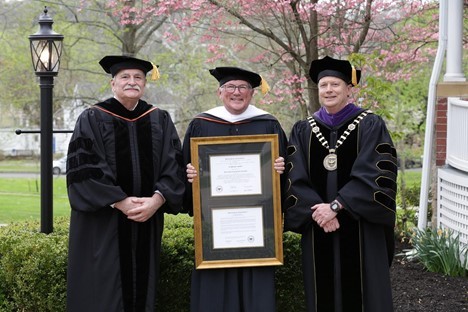
(Excerpts and photo reprinted with permission from Ashley Wise, Director of University Relations, Waynesburg University News)
WAYNESBURG, PA— Waynesburg University honored the Class of 2022 during Commencement Exercises on Saturday, April 30, and Sunday, May 1, on the Lawn of Miller Hall, honoring more than 400 undergraduate, graduate and doctoral students.
The Honorable D. Brooks Smith, Senior Judge of the United States Court of Appeals for the Third Circuit, and Laural Ziemba, Director of Public Affairs at Range Resources, addressed the Class of 2022 as the Commencement speakers, and Marilyn West, Owner and Chief Executive Officer of M.H. West and Co., served as the Baccalaureate speaker.
Ziemba spoke at the Graduate and Professional Studies ceremony at 4 p.m. on Saturday, and Smith spoke at the undergraduate ceremony at 2 p.m. on Sunday. The Baccalaureate Service was held at 11 a.m. in Roberts Chapel.
Smith spoke on the need for engaged leaders and inspired citizens in society, during his speech, titled “Your Calling to Inspired Citizen Engagement.”
“Your years here have not been spent marking time,” he said. “They have been as purposeful and as imbued with meaning as anything you will ever do. You will probably come to see the truth in that even more as you look back. Here at Waynesburg, you have absorbed not only academic substance, you have been exposed day-to-day to the endearing human values that make life worth living.”
Smith and West were awarded honorary Doctor of Humane Letters degrees, and Ziemba was presented the Timothy & Carolyn Thyreen Service Leadership Award, which celebrates Timothy and Carolyn Thyreen’s legacy of serving others and is presented to those who exemplify servant leadership in their daily lives, resulting in a transformational effect on their area of focus. Read more here.
The following citation was read:
D. Brooks Smith, in recognition of your steadfast dedication and leadership to the administration of law and justice, Waynesburg University honors you.
Making history as the only person to have served as a United States Chief District Judge and a Chief Judge of the United States Court of Appeals for the Third Circuit, in addition to your service as a Judge on the Pennsylvania Courts of Common Pleas, you have proven yourself to be a distinguished public official, leading with ethics, sound judgement and goodwill in the fulfillment of your duties. Your efforts at improving public understanding of the role of the judicial process in the administration of our constitutional system of government is a model for others to follow. Through your commitment to educating and inspiring students in the field of law, tomorrow’s leaders learn not only from your instruction in the classroom, but from your exemplary career. For these attainments and for your deep and abiding faith, we are well pleased to recognize you. In gratitude and respect for your accomplishments and for the ways in which you parallel the Waynesburg University mission, it is with great honor that we confer upon you our degree of Doctor of Humane Letters.
Links with photos:
https://www.waynesburg.edu/news/smith-west-ziemba-honored-waynesburg-u-commencement
https://www.waynesburg.edu/news/waynesburg-u-honors-class-2022-commencement-exercises
In The News
Recent articles about the courts and people in the Third Circuit. For more about this weekly service, click here
Judge Smith receives Judge Justin Johnson Award
The Hon. D. Brooks Smith was honored last Tuesday for his commitment to judicial independence by the nonprofit Pennsylvanians for Modern Courts. Former Chief Judge Theodor McKee spoke at the gathering saying of his colleague, “[Judge Smith] has consistently demonstrated a true commitment to an independent judiciary… [I] appreciate even more how much we need people like you [Judge Smith] on the judiciary.”
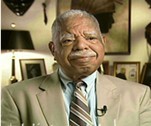
Judge Justin M. Johnson (pictured above) for whom the award was named was the second African American judge appointed to Pennsylvania’s Superior Court (1980).
Justin Morris Johnson was born August 19, 1933, in Wilkinsburg, PA to Oliver and Irene Johnson (nee Morris). His maternal grandfather was the son of a Civil War veteran. His parents met while attending Braddock High School near Pittsburgh. They were two of only three black students who attended the high school. His mother worked a teacher for a few years before marrying Oliver Johnson. Oliver Johnson was admitted to Harvard Law School and his family sold their land new White Hall, VA to pay his tuition. During his studies, Oliver Johnson was drafted into service during WWI and fought in the Meuse-Argonne Offensive. Due to his time in the service, he could no longer afford tuition at Harvard so after the war, he transferred to and graduated from University of Pittsburgh Law School (1922).
Judge Johnson grew up in Wilkinsburg, PA where he sang in the choir at St. Mark A.M.E. church. He enjoyed playing softball in an alley near his home and watching films at the Warner and State Theaters. Judge Johnson was the only black student in his class at Wilkinsburg High School. Although was active in band and choir he was excluded from social events at the school. Despite this discrimination, his Latin teacher Irma Hamilton and a guidance counselor, Gwen Mothersbaugh, encouraged him to apply to the University of Chicago.
“I’ll always remember…Gwen Mothersbaugh was one of very few people in the high school who saw me as an individual, and who saw that I had potential. And she may have come to me to apologize about my not gong to the dance. She may have, I, know that it was clear to me she saw me differently than other members of the faculty, and I’ll always remember her as being a genuine person.”
He received a B.A. from the University of Chicago after only three years of study (1954). He was awarded the Bond Medal at graduation. His attorney father pushed him to study the law, but Judge Johnson instead wanted to be a tap dancer like Bill “Bojangles” Robinson. His father prevailed and he entered law school but left after one year to join the U.S. Air Force, training at Vance Air Force Base in OK. He then began a three-year tour at Hickam Air Force Base in HI (1956-1959) as an aircraft commander. He eventually received a J.D. from the University of Chicago (1962). During law school Judge Johnson worked at the post office to support his family. He and his wife Florence (nee Lester) wed in 1961 and raised three children William Oliver Johnson, Justin Llewellyn Johnson, and Elizabeth Johnson Barnes. During 14 years of active and reserve duty, he reached the rank of major (1963-1973). His service included two active-duty flights into Vietnam.
Johnson worked for the law firm of Johnson, Johnson, & Johnson as partner with his father Oliver and brother the Hon. Livingston Morris Johnson. He became the assistant solicitor for Pittsburgh and assistant secretary for Pittsburgh- Mt. Oliver board of education. He also served as an adjunct professor at Duquesne University Law School. The PA Supreme Court appointed Justin Johnson to the PA Board of Law Examiners (1969) making him the first African American to hold this position. He served the Board of over 20 years including 6 years as its Chairman.
Judge Justin M. Johnson retired from the bench in 2007. He was a “fearless advocate for justice and equal rights and was in the forefront of many important civil rights battles in Western, PA.”
Johnson received numerous honors and awards including the Martin Luther King Jr. Citizen’s Award; Top Hat Award for distinguished judicial services; Homer S. Brown Service Award; Presidents Award from the PA Trial Lawyers Association; Award of Merit from the Pittsburgh Young Adult Club; and the Many of the Year Award from Bethesda Presbyterian Church.
Judge Johnson passed away October 29, 2021, at the age of 88.
Sources:
A2008_101_EAD.pdf (thehistorymakers.org)
Oral History interview transcript
Obituary- Pittsburgh Post Gazette
Third Circuit Chambers attend Pirates’ game
In honor of the Third Circuit sitting in Pittsburgh on April 27, 2022, the West Wing of the Mighty Third (represented by the Chambers of Judges Hardiman, Phipps, Nygaard, and Fisher) took in a Pittsburgh Pirates Game with Judge Rendell’s Chambers. Despite the 35 degree outing in the ‘Brrrgh, a good time was had by all (well, except the Pirates, who fell 3-1 to the Milwaukee Brewers).

Pictured from Left to Right:
Front row-Michelle Pierson, Judge D. Michael Fisher, Judge Marjorie Rendell, Judge Arthur Tilson (Montgomery County, Pennsylvania CCP), Judge Thomas Hardiman, Jeff Forster, and Paige Forster.
Second row-Laura Ruppalt, Fr. Patrick Reidy, Emily Clarke, Kelly Lamantia, Zachary Johnson, Caitlin Daday, Matthew Tom, and Samuel Lazerwitz.
Third row-Alden Fletcher, Michael McCune, Erwin Reschke, Ian Postman, Peter Torstensen, Jr., Matthew Ryan Kearney, and Matthew Linsley.
Attending but not pictured-JC Wilt and Joshua Hanley.
Photo and story courtesy of Michelle S. Pierson, Law Clerk/ J.A. to Judge Thomas Hardiman
Website of the Week
AmericanLawyer.com takes the award-winning magazine, The American Lawyer, and brings it to life online with up-to-the-minute news and analysis as well as resources and tools. Featuring deep industry insight and The American Lawyer's signature surveys and rankings — including The Am Law 100, The Am Law 200, The Global 100 and The A-List. It also can be accessed on Third Circuit Libraries' Website under Databases.
Off the Shelf
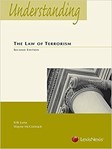
Understanding the Law of Terrorism by: Erik Luna
Call #: KF9430.M33 2015
This Understanding treatise provides a compact review of the major areas of law concerned with or affected by terrorism. Thoughtfully organized and clearly written, Understanding the Law of Terrorism examines various subject matters - such as criminal law and procedure, constitutional law, the law of evidence, national security law, and the law of armed conflict - as the underlying legal doctrines and polices are influenced and at times distorted by counter-terrorism efforts in law enforcement, intelligence gathering, and military action. The topics include:
• the difficulties in defining terrorism, the principal federal statutes and bases for jurisdiction, the role of conspiracy doctrine in terrorism investigations and prosecutions, and the resulting concerns related to political freedom;
• the crimes implicated by encouraging or assisting terrorism, especially the provision of material support for terrorist activity or foreign terrorist organizations, as well as the prospect of civil liability for terrorist activity;
• the doctrinal impact of terrorism-related searches, the issues of profiling in terrorism investigations, and the detention and deportation of terrorism suspects;
• the use of intelligence surveillance for counter-terrorism purposes, the history and development of the Foreign Intelligence Surveillance Act, and the problems of terrorism-related mass surveillance both before and after the Snowden revelations;
• the interrogation of terrorism suspects at home and abroad, and the background and legal issues raised by the use of torture and extraordinary rendition in the war on terror;
• the state secrets privilege and defense rights in terrorism cases, the application of the Classified Information Procedures Act and related processes, and the problems of public trials and courtroom security in terrorism prosecutions;
• the history and development of the law of armed conflict and U.S. war powers, the deployment of armed forces against terrorist organizations, and the use of military force against foreign nations in response to terrorist attacks or to preempt terrorism;
• the background of military detention and trial as an incident of war, the evolving law of military detention for terrorism suspects and its application to Guantánamo, and the use of military commissions to try alleged terrorists; and
• the use of targeted killings as a counter-terrorism policy and the legal implications in the war on terror.
Precedential Opinions
From the Court of Appeals for the Third Circuit are available here.