In this issue ...
Virgin Islands History: Indigenous Peoples of the Virgin Islands and the Caribbean
By Aesha Duval, Branch Librarian, Virgin Islands
Long before the arrival of Christopher Columbus in 1492 and European settlements and colonization, the Caribbean islands were inhabited by indigenous peoples – the most dominant in the region being the Tainos, an Arawak people, and the Caribs.
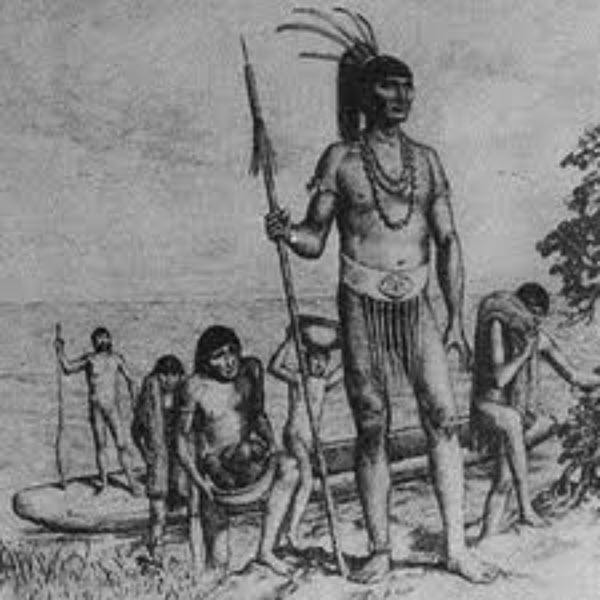
Historians agree that the earliest aboriginal people of the Virgin Islands were Ciboneys, Arawakans, Tainos, and Caribs. The Arawaks were displaced by the Caribs and the Tainos either migrated from or were brought from Puerto Rico by the Caribs around the 1300s to 1400s. The Tainos are described as a friendly people who were skilled craftsmen and were also experts at farming, making cloth designs from cotton and they traded their products with other tribes in neighboring islands and later with European explorers.
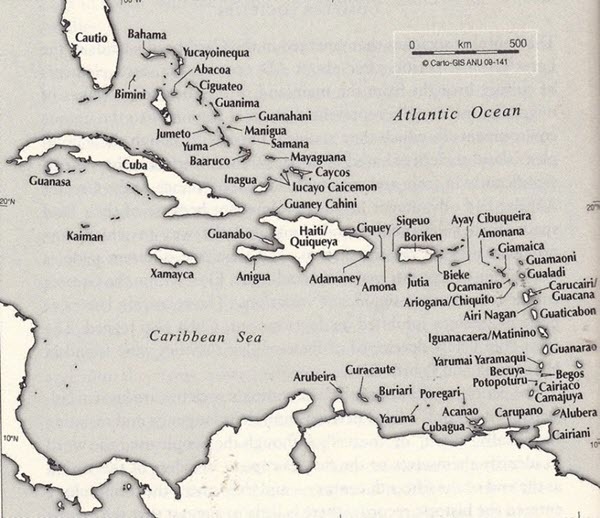
The Taino names of the Caribbean islands based on Jalil Sued-Badillo (ed.), ‘General History of the Caribbean, vol. 1: Autochthonous Societies’ (Paris: UNESCO Publishing/London: Macmillan 2003).
Despite being a peaceful people, the Tainos frequently fought the more aggressive Caribs, however, they only waged wars for specific reasons and often used more strategic battle designs instead of hostile tactics. The hostility between the Tainos and Caribs, waned once the Spanish colonists arrived, and an alliance between the enemy tribes was formed.
The Caribs are believed to have migrated from the Lower Xingu River Basin in South America to northern South America and the Caribbean. This migration resulted in two kinds of Caribs: the “Carib Proper,” who remained in South America and spoke their Carib language and the “Island Carib,” who migrated into the Virgin Islands, Cuba, Puerto Rico, Trinidad, Hispaniola, etc. and adopted the Arawakan language as their own, but held on to their Carib culture and customs.
According to William W. Boyer, the indigenous people in the Virgin Islands encountered Columbus on his second voyage in 1493. Columbus landed at “Santa Cruz,” which was later renamed “Saint Croix” by the French, and when a boat carrying his men came ashore, it was fiercely attacked by Caribs. The landing site is believed to be Salt River on St. Croix’s north shore. Columbus wrote of the violent skirmish in his diaries. One soldier was killed, and another was wounded; and Columbus captured several Caribs, including two women. Columbus was repelled, and later he named the spot Cabo de Flechas, or “Cape of the Arrows.”
The immediate impact of colonization was the decimation of native peoples from disease carried by the Europeans and their animals, and brutal enslavement. This was most evident in the Caribbean, where certain islands lost entire native populations in a short amount of time.
Early Spanish colonialism was governed by the encomienda system, which essentially gave conquistadores, usually soldiers or government officials, land, and the authority to enslave the native peoples who lived on those lands. The Tainos were unaccustomed to the brutal slave labor and died in great numbers; those that survived either retreated to the hills or left the island. It was believed that the Tainos disappeared from Puerto Rico, but their cultural contributions and influences prevailed. The names and words for trees, fruits, vegetables, and other items in Puerto Rico and the other Greater Antilles are Arawakan. Many English words, such as tobacco, barbecue, canoe, hammock, and many Spanish words are Taino in origin.
European settlement of the Virgin Islands began during the 17th century and by that time, few indigenous people were remaining, according to Boyer. He wrote that there were various explanations to include being captured by the Spanish to replace the rapidly dying workers in Spanish mines or the Greater Antilles; or others may have fled to the Lesser Antilles. Whatever the reasons, their absence when the Virgin Islands were colonized spurred the early introduction of African slavery into the islands.
By the 1590s, European explorers reported seeing sparse native settlements on St. Croix. The first colony on St. Croix was established by the English and the Dutch around 1625. Quarrelling, piracy, religious conflicts and violence ensued as the different European powers (English, Dutch, French, Spanish and Knights of Malta) grappled for control of St. Croix. By 1700, the French had established many sugar plantations on virtually all of their islands, including Martinique, Guadeloupe, Grenada, St. Croix, and Saint-Domingue (present-day Haiti).
A second attempt at colonizing St. Thomas by Denmark was more successful in 1671 and in 1733, France sold St. Croix to the Danish West India and Guinea Company, thus beginning Danish rule of the islands until 1917.
References
Amerindian Tribes of Guyana. (2010, September 17). Guyana Chronicle.
Boyer, William W. (2010). America’s Virgin Islands – A History of Human Rights and Wrongs, 2d ed.
Feyrer, J., & Sacerdote, B. (2009). Colonialism and modern income: islands as natural experiments. The Review of Economics and Statistics, 91(2), 245–262.
Monge, J. T. (1997). Puerto Rico: The trails of the oldest colony in the world. New York Times Online,
Roopnarine, L. (2008). UNITED STATES VIRGIN ISLANDS MIGRATION. Social and Economic Studies, 57(3/4), 131–156.
Willocks, H. (1995) The umbilical cord – The history of the United States Virgin Islands from pre-columbian era to the present.
In The News
Recent articles about the courts and people in the Third Circuit. For more about this weekly service, click here
Diversity Speaks: Distinguished Speaker Series featuring the Hon. Joseph A. Greenaway Jr.
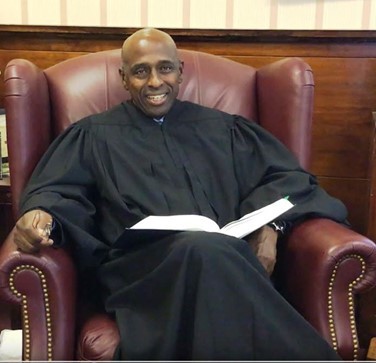
Seton Hall Law School's Office of Equity, Justice & Engagement welcomes the sixty-second jurist appointed to the United States Court of Appeals for the Third Circuit: The Honorable Joseph A Greenaway, Jr. Judge Greenaway has a trailblazing legal career, spanning four decades. His career has included positions as a litigator, prosecutor, in-house legal counsel, legal scholar, and professor of law.
Diversity Speaks is one of Seton Hall Law School’s signature events of the year. The Diversity Speaks distinguished speaker is a leader who prioritizes the principles of equity and inclusion in their work. The lecture series was established in 2008 and is part of the Law School’s overall effort to promote a diverse and inclusive academic environment.
WHEN
Monday, March 14, 2022 from 4:00 - 5:00 p.m. EST.
Followed by a Reception
WHERE
Seton Hall Law School's
Larson Auditorium, Newark, New Jersey.
Registration required
Website of the Week- HeinOnline Serial set
Need to pull up a House or Senate report? Navigate to the U.S. Congressional Serial Set homepage in HeinOnline to find the Serial Set Lookup Tools.
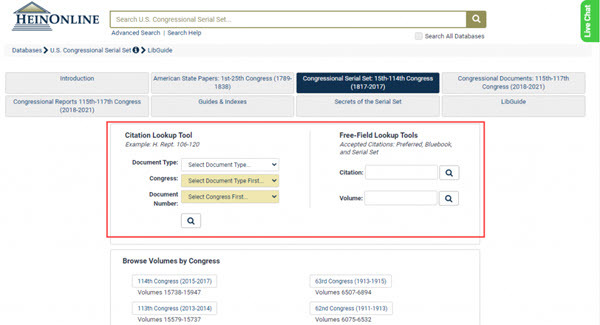
Use the series of drop-downs within the Citation Lookup Tool to select the document type, Congress, and document number. This tool will pull up the full listing of the document. Simply click on the hyperlinked title to open the document.
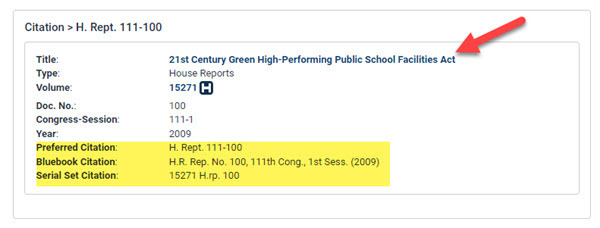
Also included are the preferred citation, the Bluebook citation, and the Serial Set citation.
PRO TIP: All of these citation formats can also be used within the one-box search using the citation option from anywhere in HeinOnline.
Simply click on the hyperlinked title to open the document.
Off the Shelf
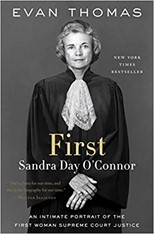
First: Sandra Day O'Connor by: Evan Thomas
Call #: KF8745 .O25 T46
She was born in 1930 in El Paso and grew up on a cattle ranch in Arizona. At a time when women were expected to be homemakers, she set her sights on Stanford University. When she graduated near the top of her law school class in 1952, no firm would even interview her. But Sandra Day O’Connor’s story is that of a woman who repeatedly shattered glass ceilings—doing so with a blend of grace, wisdom, humor, understatement, and cowgirl toughness.
She became the first ever female majority leader of a state senate. As a judge on the Arizona Court of Appeals, she stood up to corrupt lawyers and humanized the law. When she arrived at the United States Supreme Court, appointed by President Ronald Reagan in 1981, she began a quarter-century tenure on the Court, hearing cases that ultimately shaped American law. Diagnosed with cancer at fifty-eight, and caring for a husband with Alzheimer’s, O’Connor endured every difficulty with grit and poise.
Women and men who want to be leaders and be first in their own lives—who want to learn when to walk away and when to stand their ground—will be inspired by O’Connor’s example. This is a remarkably vivid and personal portrait of a woman who loved her family, who believed in serving her country, and who, when she became the most powerful woman in America, built a bridge forward for all women.
Precedential Opinions
From the Court of Appeals for the Third Circuit are available here.