|
Back to TOP

FDA to India: Adhering to Good Clinical Practice and Data Integrity in Generic Drug Studies Is Critically Important
To strengthen India's regulatory understanding of data integrity and human subject protection in the development of generic drugs and particularly complex generics, the FDA's India Office partnered with the Indian Society for Clinical Research and their regional chapters to put on the FDA Bioavailability (BA)/Bioequivalence (BE) Roadshow in mid-September. Fourteen FDA experts from the Offices of Generic Drugs, Translational Science, and Regulatory Affairs (now the Office of Inspections and Investigations) traveled to India to participate in the roadshow's meetings and workshops that took place over 10 days in three cities.
The event took place at a critical time, with data integrity issues threatening to disrupt the generics market in the United States and EU. Over the last three years, the FDA has issued changes to the therapeutic equivalence codes of 72 medicines, meaning they are no longer substitutable at the pharmacy level, while the EU has pulled 400 medications off the European market, all due to data integrity issues.
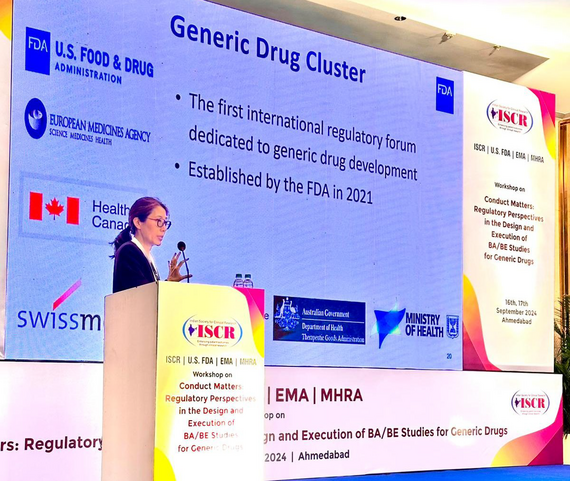
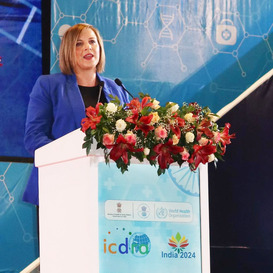
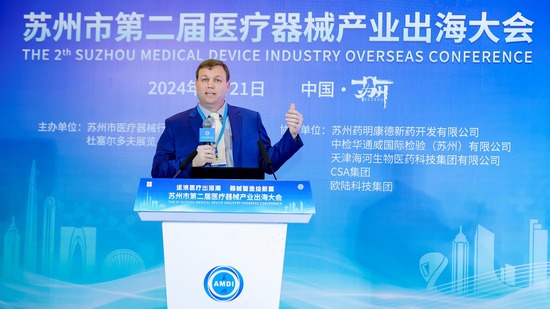
Presenting is Dr. Iilun Murphy, director of the FDA’s Office of Generic Drugs.
BA/BE studies are generally necessary to demonstrate that generic drugs are substitutable for the branded drug, as part of the generic drug approval process. BA/BE studies may involve healthy human subjects or be patient-based outcomes studies, and also laboratory-based investigations. Ensuring Good Clinical Practice and data integrity are essential components of such studies.
The FDA estimates that India accounts for around 80% of the BA/BE studies for generic applications since research costs are lower in the country and there is a large pool of qualified professionals, including those in contract research organizations and pharmaceutical companies. And yet, the rapid rise of this industry has been marred by uneven compliance, with FDA investigators consistently finding an array of compliance issues in this sector. They include instances of data manipulation in lab-based studies, evidence of falsified data, and failure to conduct the clinical study in accordance with Good Clinical Practice — by providing inadequate informed consent, underreporting adverse events, ignoring conflicts of interest, and falsifying study participants.
FDA Commissioner Dr. Robert Califf repeatedly raised data integrity and human subject protection issues when he led an FDA delegation to India in September 2023.
“Not only is sound, ethical, clinical practice required by FDA regulations, it is our shared responsibility to research study participants and future beneficiaries of therapeutics that clinical studies be conducted in a way that ensures the integrity of the data and the protection of participants,” he said after the trip.
Last month’s roadshow was the FDA’s latest effort to address these issues. It began in New Delhi where the FDA exchanged practices and shared ideas with India's central regulator, the Central Drugs Standard Control Organisation. Though Indian regulators require BA/BE study data for some generic drugs in India, many generic products whose brand version was on the Indian market longer than four years are not required to do so. Manufacturers of these latter products conduct BA/BE studies if they want to export their drugs, but that leaves oversight of this sector largely up to foreign regulators like the FDA that require this data in generic drug applications.
After New Delhi, the FDA officials went on to the cities of Ahmedabad and Hyderabad where they conducted separate two-day workshops that included presentations by regulatory counterparts from the European Medicines Agency, Health Canada, and the U.K.'s Medicines and Healthcare products Regulatory Agency. While in Hyderabad, the FDA delegation met with company leaders from the Indian Pharmaceutical Alliance and the Indian Drug Manufacturers Association to discuss continuous improvement efforts in data quality and future planning. "Quality data and well-run studies are vital for generic and complex generic drug approvals,” they all agreed. More than 300 people — regulators, sponsors, contract research organizations, clinical scientists, trial experts, and more — participated over the course of the roadshow to discuss best practices and regulatory expectations.
In perhaps coincidental timing, immediately after the FDA’s roadshow, India’s government also publicly declared new rules better defining contract research organizations and their obligations, with new requirements for reporting to the central drug regulator CDSCO. This change, long requested by industry watchers, is intended to increase oversight of the clinical research sector, and a sign of hopeful change in this rapidly growing but currently underregulated industry in India.
FDA staff in India and at headquarters intend to continue to work with India to advance access to safe and effective generic medicines, while upholding rigorous standards for evidence generation and clinical research.
FDA Promotes Quality Management Maturity in India
Experts from the FDA’s India Office (INO) and Center for Drug Evaluation and Research (CDER) recently promoted Quality Management Maturity — also known as QMM — at a conference in Bangalore, India, from September 18-20. The event, organized by the Parenteral Drug Association’s (PDA) India chapter, brought together 200 representatives from a wide range of Indian medical product industries, including pharmaceuticals, biologics, vaccines, and cell gene therapy. Attendees included senior leaders such as chief quality officers, chief operations officers, chief human resource officers, supply chain heads, and vice-presidents.
QMM is the status a company attains by having consistent, reliable, and robust business processes to achieve quality objectives, promote continual improvement, and enhance supply chain resilience. Pharmaceutical companies that integrate business and manufacturing operations with quality practices and technological advancements can achieve higher levels of maturity. More importantly, adherence to mature quality management practices helps ensure the availability of quality medical products and reduces the likelihood that quality issues would contribute to drug shortages that negatively impact patients and consumers. In short, many global supply chain disruptions may have been caused by gaps in the maturity of existing quality systems.
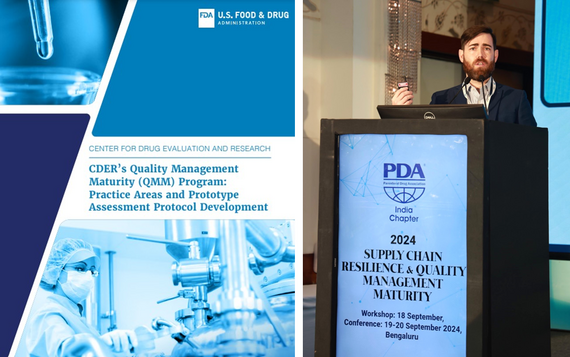
Greg Smith, director of FDA’s India Office, discussed the current landscape of pharmaceutical manufacturing in India and the ongoing efforts by the INO to enhance pharmaceutical quality. CDER has accepted industry volunteers to participate in its 2024 voluntary QMM Prototype Assessment Protocol Evaluation Program and plans to complete QMM assessments at nine manufacturing establishments this year.
The FDA routinely collects data using a wide range of quality surveillance systems and is therefore uniquely positioned to promote QMM practices. To that end, CDER is currently establishing its QMM Program with the goal of encouraging pharmaceutical manufacturing establishments to adopt quality management practices that go beyond current good manufacturing practice requirements. CDER has already accepted industry volunteers to participate in its 2024 voluntary QMM Prototype Assessment Protocol Evaluation Program and plans to complete QMM assessments at nine manufacturing establishments this year. The assessment protocol covers five practice areas: Management Commitment to Quality, Business Continuity, Advanced Pharmaceutical Quality System, Technical Excellence, and Employee Engagement and Empowerment.
The conference in Bangalore provided FDA presenters with a unique opportunity to both spark interest in CDER’s emerging QMM program and encourage India’s pharmaceutical manufacturers to adopt a robust quality culture. Greg Smith, director of the FDA’s India Office, opened the session by discussing the current landscape of pharmaceutical manufacturing in India and the ongoing efforts by the INO to enhance pharmaceutical quality. Dr. Jennifer Huntington, from the FDA’s Office of Pharmaceutical Quality (OPQ), followed by offering an in-depth overview of the QMM program, highlighting significant milestones and outlining its five key practice areas.
Dr. Nandini Rakala, also with OPQ, presented on the business continuity practice area, explaining how having a robust business continuity plan helps to minimize the risks of product availability to patients and helps ensure a reliable market supply. In addition, Eric Twum of OPQ presented on knowledge management from a QMM perspective. Twum explained how an effective knowledge management strategy can help a company to eradicate inefficiencies, create a competitive market edge, and promote a quality culture within the organization. Following their presentations, the FDA speakers participated in a panel session to respond to audience questions.
Case studies and lessons learned were also discussed in depth, providing industry leaders and other stakeholders a platform for an in-country dialogue on charting a path forward. Participants identified action items, including creating an India-based cross-industry interest group on QMM and convening a follow-up meeting in 2025 for industry to present QMM case studies and experiments. India’s production of quality pharmaceuticals is vital to the global supply chain, with manufacturers in India producing approximately 40% of the U.S. generic drug supply.
FDA Holds First-Ever Produce Safety Engagement with Colombia Fresh Produce Sector
Since the FDA first opened its Latin America Office in 2009, engaging with regional stakeholders on food safety issues has accounted for a significant portion of the staff’s work portfolio.
After all, about 60% of the fresh fruit and 39% of the vegetables consumed by volume in the United States are imported, and 95% of the imported fresh fruit and 80% of the imported fresh vegetables come from Latin America.
One of the region’s major importers of fresh herbs, fresh fruit, and coffee is Colombia, and yet the FDA never had the opportunity to meet with Colombia's fresh produce sector until late last month when agency officials co-sponsored two separate produce safety symposiums there. As part of the learning, they conducted an “Educational Farm Visit” (one type of FDA outreach to growers) at an organic basil farm; and toured the government-run Nataima Research Center, which focuses on foodborne pathogens.
Co-sponsoring the Symposium on the Safety of Fresh Agricultural Produce on September 24 in Bogotá and a similar event on September 26 in the town of El Espinal (in the heart of the country’s fresh produce region), were the Colombian Agricultural and Livestock Institute (ICA), which regulates Colombian fresh produce, and the Inter-American Institute for Cooperation on Agriculture (IICA), a nonprofit.
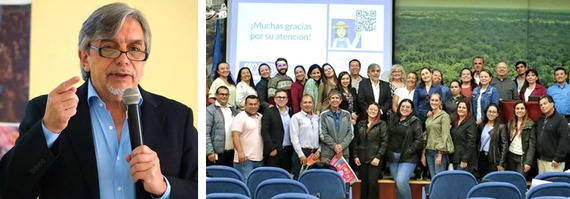
Left: FDA International Regulatory Analyst Gonzalo Ibanez speaks at the symposium held in the town of El Espinal. Right: Symposium attendees in Bogotá.
Updating and deepening what attendees already know about the FDA’s requirements under the Food Safety Modernization Act of 2011 was the primary intent of the symposia, according to Gonzalo Ibanez, who is based in the FDA Latin America Office’s post in Santiago, Chile. The topics included the Produce Safety Rule, the Foreign Supplier Verification Program, the Agricultural Water Rule, and the Food Traceability Rule. The latter rule, which goes into effect in January 2026, requires that companies that manufacture, process, pack, or hold certain kinds of food for consumption in the United States (including basil) comply with new recordkeeping requirements. Such recordkeeping is intended to help the FDA follow the movement of a food product and its ingredients throughout the supply chain so the agency can rapidly find the source of an outbreak of a foodborne illness or a food contamination event.
FDA and IICA officials also used the symposia to highlight their Growing Safe Produce web platform, which growers of fresh agricultural produce can access for supplementary training material to improve their understanding and subsequent implementation of the FDA's food safety requirements. The platform includes videos, interactive web applications, infographics, and posters.
A motivating factor for the timing of these on-the-ground meetings was the work the FDA has been doing with ICA as part of the Cyclospora Prevention, Response and Research Plan developed in 2021 by the Cyclospora Task Force (a collaboration between the FDA and the Centers for Disease Control and Prevention.) That plan emphasized three priority areas: improving prevention; enhancing response activities; and filling knowledge gaps in countries with a history of contamination with the cyclospora parasite, which can cause intestinal illness two days to two weeks after consuming contaminated produce. Fresh basil from Colombia has been linked to contamination events with cyclospora, and the FDA has been meeting with ICA since February 2024 to try to better understand the root causes of the contamination, informed by the FDA’s sampling and testing traceback activities.
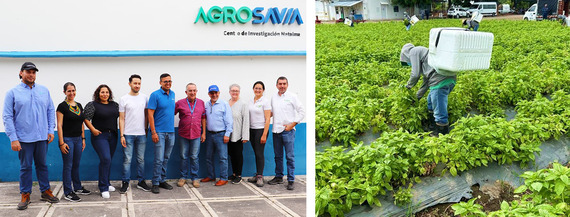
Officials from the FDA, ICA, and IICA visit the Nataima Research Center, as well as a basil farm.
Both symposia featured a video — recorded by Dr. Alexandre DaSilva, a parasitologist in the FDA's Senior Biomedical Research and Biomedical Product Assessment Service — which refers to the work being developed by the FDA regarding the parasite. Speakers also explained how, should there be a contamination event, imported fresh produce may be placed on Import Alert 99-35 (detention without physical examination) for the appearance of having been prepared, packed, or held under insanitary conditions — and also explained how firms can submit evidence to the FDA for removal from such an alert.
The Nataima Research Center in El Espinal is part of the Colombian Agricultural Research Corporation (AGROSAVIA), a government entity that strives to improve the productivity and competitiveness of national agriculture through science, technology, and innovation. During their visit to Nataima, the FDA team was briefed on the institute’s research on the origin and prevention of fresh basil’s contamination with foodborne pathogens, particularly cyclospora, and its studies on alternative approaches to the food safety management of basil production. Nataima researchers have sampled and tested water, soil, and basil and have met with growers to talk about controls for the parasite. No definitive source of contamination has been identified to date.
Educational Farm Visits have long been a part of the FDA’s rollout of its Produce Safety Rule, allowing FDA staff to interact with growers and hear their perspective about their unique growing conditions, practices, and compliance challenges. During the visit to the basil farm in Colombia, the FDA delegation watched as drones sprayed the field with a spicy chili and distilled water mixture intended to serve as a pest deterrent in place of a pesticide. Workers carry coolers on their backs to the fields where they store their picked basil. Once full, the coolers are sent to a packing house where the basil is separated into plastic bags and stored in a box that is chilled to 10 °C. The farm also features a laboratory area where tests are conducted to detect pathogens.
Besides Ibanez, the other FDA official who traveled to Colombia was Crystal McKenna from the FDA’s Center for Food Safety and Applied Nutrition (now the Human Foods Program.)
FDA Explores Food Traceability Practices in India Ahead of New Rule
The FDA’s Food Traceability Rule is currently scheduled to go into effect less than 18 months from now, requiring both international and domestic companies that manufacture, process, pack, or hold certain kinds of food for consumption in the United States to comply with new recordkeeping requirements.
Such recordkeeping is intended to help the FDA follow the movement of a food product and its ingredients throughout the supply chain so the agency can rapidly find the source of an outbreak of a foodborne illness or a food contamination event.
But educating the estimated 62,000 international companies that are expected to be affected by the rule by its January 20, 2026, compliance date is a significant undertaking.
One of the food items subject to the rule, as identified on the FDA’s Food Traceability List, is shrimp, and since India is the number one shrimp exporter to the United States, it offers a microcosm of what the FDA can expect as it prepares international stakeholders for the upcoming rule.
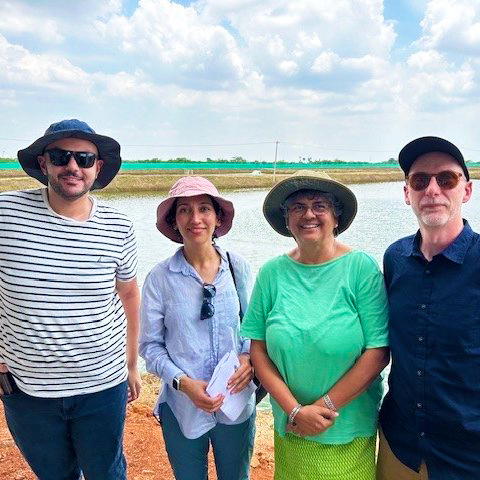
With that in mind, four FDA experts in traceability and international engagement recently traveled to Chennai, India, from August 14-27, to explore the current traceability practices of its aquacultured shrimp industry there.
FDA delegation from left to right: Anthony Rizkalla, Selma Pourzal, Pankaja Panda, and Chris Waldrop.
The FDA delegation was led by Pankaja Panda from the FDA’s India Office. Chris Waldrop, Selma Pourzal, and Anthony Rizkalla from the Center for Food Safety and Applied Nutrition (now the Human Foods Program) were the other participants. During their time in Chennai, the group visited three shrimp aquaculture farms and three processing companies that export shrimp to the United States. At each stop, the group interviewed both owners and personnel to understand their current traceability practices, how their records are kept, and their current familiarity with the FDA’s traceability rule.
Panda planned and implemented the trip, including identifying places to visit in only a few months. “I said, we are here to learn from you and study your traceability process from farm to firm,” she said. “They were so gracious.”
In addition to visiting the farms and facilities, the group met with officials from five Government of India food safety agencies — the Coastal Aquaculture Authority (CAA), Marine Products Exports Development Authority, Food Safety and Standards Authority of India, Export Inspection Council, and the Spices Board of India — to raise awareness about the rule and to promote adoption and harmonization with FDA policy. The meeting was hosted by the CAA in Chennai and included over 80 participants in person and online.
Knowledge from this study will aid the FDA India Office as it conducts outreach and engagement with the local shrimp industry on the upcoming rule. It will also help the FDA address and clarify the industry’s concerns or misconceptions; gain a better understanding of the realities that international industry, as a whole, faces as it complies with this rule; and how traceability practices may look like in certain food supply chains.
FDA a Key Voice at Dietary Supplement Workshops in China
In September, FDA officials presented at workshops on dietary supplement quality and safety in Shenzhen and Beijing, the first time a forum in China addressed the United States’ regulatory, quality, and trade approaches to these products. Co-hosted by the U.S. Pharmacopeia (USP) and the China Chamber of Commerce for Import & Export of Medicines & Health Products (CCCMHPIE), the workshops attracted nearly 300 attendees from across China’s dietary supplement industry, contract research laboratories, and trade, academic, scientific, and regulatory sectors.
At the workshops, the FDA discussed the U.S. regulatory requirements relating to facility registration, new dietary ingredient notifications, current good manufacturing practices (cGMP), product labeling, and compliance and enforcement approaches.
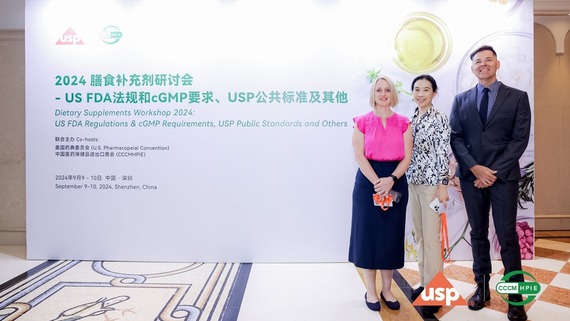
FDA China Office staff attending the event. From left, Director Sara McMullen, Medical Research Scientist Lixia Wang, and International Relations Specialist Clinton Priestley.
“China is one of the most active regions in the global dietary supplement industry, serving as both a major producer and supplier of raw materials and a consumer market with enormous development potential,” with nearly 1,700 licensed health food production enterprises at the end of 2023, according to the CCCMHPIE.
Due to an aging populace and modern lifestyle, the market for vitamins, sports nutrition and herbal and other specialized dietary supplements has expanded exponentially. In 2008, China’s total global import and export value of dietary supplements was $720 million. Last year it was $10.76 billion, the CCMHPIE estimates, with more products coming into China than are exported — $6.74 billion in imports compared to $4.02 billion in exports. In the first half of 2024, the United States was China’s top dietary supplement export market, to the amount of $320 million.
The FDA and USP officials both explained that quality standards are different for dietary supplements as compared to those for pharmaceuticals. Although pharmaceuticals are required by U.S. law to meet (as shown through laboratory analysis) specific quality standards set by the USP, such requirements don’t apply to dietary supplements.
The USP, in its role as a standard-setting organization, has established quality standards for various dietary ingredients (and created a verification program specifically for dietary supplements). Many manufacturers voluntarily use these standards to ensure the quality of their products.
The FDA has found that imported dietary supplements can present specific challenges because the definition and scope of product categories can differ between countries. For example, many Chinese exporters may seek to market their products as dietary supplements in the United States; but in China, the same product may be classified as a food, drug, or Traditional Chinese Medicine.
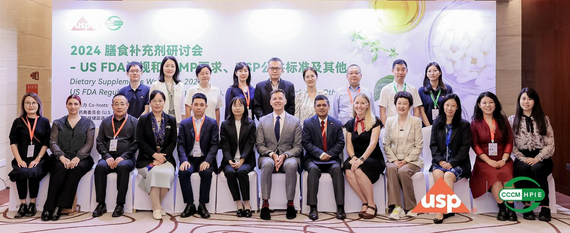
“These workshops provided an important opportunity for the FDA to engage directly with Chinese dietary supplement firms and provide information to help them determine what FDA requirements apply to their products. The FDA is committed to working collaboratively with all of our stakeholders to help ensure that the U.S. marketplace has safe, well-manufactured, and accurately labeled dietary supplements,” according to Dr. Haijing Hu, of the Office of Dietary Supplement Programs within the FDA’s Center for Food Safety and Applied Nutrition (now the Human Foods Program).
Many participants were eager to learn about the FDA’s process for New Dietary Ingredient Notification and the “when and how” of submitting a notification. The session on structure/function claims for a dietary supplement also drew a lot of interest. The audience benefited from, and were amused by, real-world examples of label claims translated from Traditional Chinese Medicines that would not be acceptable in the United States. The audience also benefited from examples of cGMP violations taken directly from FDA inspections at Chinese facilities.
Speakers from the FDA included Dr. Sarah McMullen, director of the FDA China Office, who gave opening remarks; and Dr. Haijing Hu, chief of the Regulatory Implementation Branch of the FDA’s Office of Dietary Supplement Programs, who spoke in multiple sessions on cGMP and regulatory insight. Experts from the Foreign Commercial Service (FCS) within the U.S. Department of Commerce’s International Trade Administration provided the U.S. trade perspective, and the USP provided technical insights on Dietary Supplements Compendium monographs, highlighting the level of effort required to develop quality specifications that are quantifiable and verifiable and how these standards can help manufacturers meet regulatory requirements.
Overall, the audiences at these workshops were highly interested and eager to engage with the FDA, USP, FCS, and CCCMPHIE subject matter experts. The FDA’s China Office benefited as well, coming away with a better understanding of the dietary supplement landscape in China, and the office looks forward to further engagements on the topic, which it hopes will lead to greater compliance with FDA regulations.
New FDA Video on Importing Seafood
On September 24, the FDA released the video “Importing FDA-Regulated Products: Seafood” on YouTube. The video provides basic information for importers, foreign suppliers/exporters, and customs brokers on what steps to take to successfully import safe and compliant seafood products into the United States. (Spanish and Chinese language versions will be available soon.)
Importers need to know many things to navigate this process, including answers to such basic questions as what’s in the product, how it is made, and how it is packaged, as well as the biological, physical, and chemical hazards associated with it. Also important is being familiar with FDA seafood rules and regulations and verifying that the supplier is in compliance with them. These topics — and more — are addressed in the video.
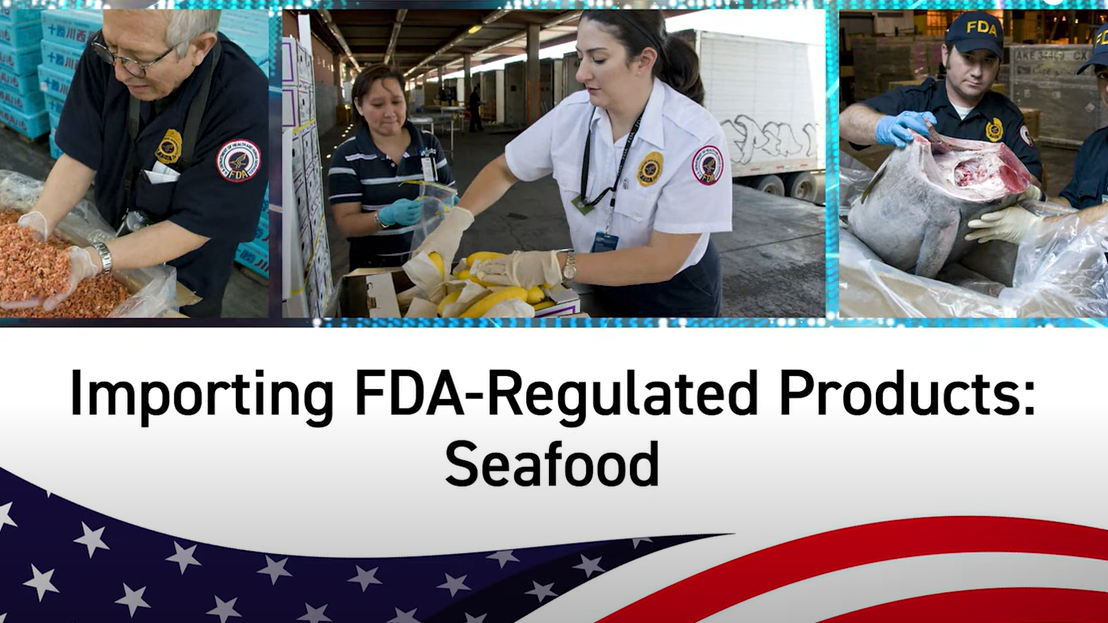
The 16-minute seafood video is the third in a series that is intended to address a gap in the available information about the FDA’s import admissibility process, as initially identified by the agency’s India Office. At the time, information on this topic was only available through public websites or occasional webinars, industry trainings, and individual communications.
The first video, outlining the general FDA admissibility process for imports, has been viewed over 48,000 times on the YouTube platform since debuting in March 2022; while the second video, on importing human foods, has received over 25,000 views since its debut in September 2023.
Several FDA offices collaborated on the video project. The Office of Regulatory Affairs’ (now the Office of Inspections and Investigations) Division of Import Operations provided subject matter experts, its Technical Assistance Branch worked with the Office of Global Policy and Strategy’s (OGPS) Communications Team on the scripts, OGPS provided the funding, and the CDRH Studio provided technical production.
Additional expertise for the seafood video project was provided by the Division of Seafood Safety within the FDA’s Center for Food Safety and Applied Nutrition (now the Human Foods Program). They plan to include this video on the FDA's public Seafood webpage, as well as in the seafood training courses that are targeted to importers.
Stay Tuned! Videos on other commodities are in the works…
|