|
|
Back to TOP
 FDA and EMA’s Parallel Scientific Advice Program Yields Benefits
Companies are showing increasing interest in a program in which FDA and European Medicines Agency (EMA) officials together meet with a sponsor to provide scientific advice during the development phase of new medicinal products (i.e., new human drugs and biologics).
When the Parallel Scientific Advice Program was first launched in January 2005, it was heralded as a way to save sponsors time and resources. But uptake was slow as regulators and developers worked their way through the new process, according to news reports at the time.
New data, presented at a March 16 webinar sponsored by the FDA’s Small Business and Industry Assistance program, suggests that developers are giving the program another look.
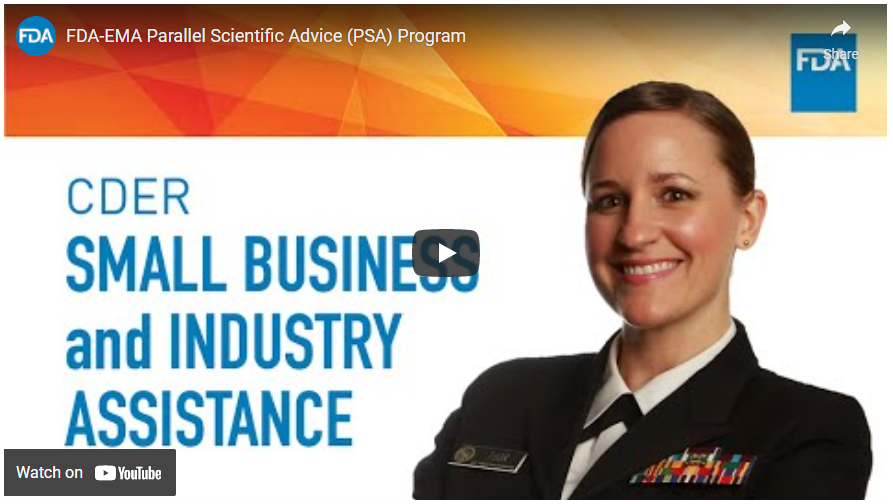
The PSA program received 10 requests in 2021 and accepted seven. Both were highs since 2016, according to Lt. Cmdr. Shannon Thor, Pharm.D., international policy analyst in the OGPS Europe Office and manager of the FDA’s PSA program.
Over a 5-year period, from 2016-2021, the agency received 37 requests to participate in the program, accepted 26 requests and denied 11, a 70% acceptance rate.
Sponsors of gastroenterology drugs or treatments for rare diseases were most likely to seek scientific advice through the program, Lt. Cmdr. Thor said.
Requests were denied for multiple reasons including being too early in the development process.
Click the image to go to YouTube recorded webinar featuring the FDA's Europe Office and EMA staff.
Lt. Cmdr. Thor sought to debunk a common myth that the PSA process is long and unpredictable. In 2020, the average time from request to acceptance was 13 days. That is faster than the 21-day response goal for an FDA Type B meeting (routine meetings occurring at pre-defined endpoints between the FDA and a sponsor, typically right after or right before the submission of clinical data or a new drug filing — similar to a PSA request). The average time to receive an EMA final advice letter was 79 days, she said, which is shorter than the 90-day timeline for a Type B meeting.
There are many benefits to the PSA program, according to Anabela Marcal, EMA Liaison Official to the FDA. The process may:
- Increase dialogue early in the product lifecycle.
- Deepen understanding of regulatory decisions.
- Optimize development.
- Avoid unnecessary testing.
Both agencies are hoping to see even greater use of the PSA program, believing it will to cut down on confusion. “Historically, sponsors tend to visit one agency before the other and when that happens, they carry a message on the agency’s views to the second review. Often, those views are not very accurately captured, and this can often create confusion. Our experience is that a PSA, while intensive, provides a mechanism to bring EMA and the FDA to the table at the same time,” said Dr. Sandra Kweder, M.D., the deputy director of the FDA’s Europe Office.
The webinar was recorded and was intended as a tutorial on the PSA program, including how to apply, the best types of candidates, and tips/best practices for future applicants.
FDA Renews Five-Year Agreement with Brazilian Health Regulatory Agency
The FDA and the Brazilian Health Regulatory Agency (ANVISA) recently signed a Statement of Cooperation, renewing for five years their existing agreement to exchange inspection reports and obtain information from the FDA supporting decision making on drug applications. To highlight the importance of the signing, Dr. Antonio Barra Torres, Director-President of ANVISA, and Mark Abdoo, FDA Associate Commissioner for Global Policy and Strategy, held a brief videoconference in lieu of an in-person meeting.
ANVISA’s mission is to protect the Brazilian people. That includes overseeing sanitary control of the production, marketing, and use of products and services that are subject to health regulation. With the second largest pharmaceutical market in purchase power among emerging countries, Brazil has the most mature regulatory system in medical products in Latin America. Brazil has also recently been a country of interest for the manufacturing of vaccines under a broader initiative by the Pan American Health Organization to bring vaccine production capacity to Latin America.
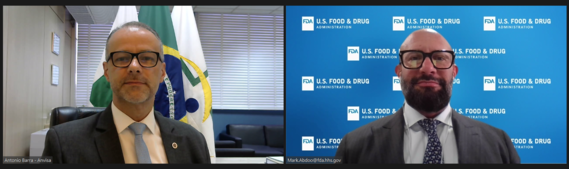 Dr. Antonio Barra Torres, Director-President of ANVISA, and Mark Abdoo, FDA Associate Commissioner for Global Policy and Strategy, met by videoconference to celebrate signing of a Statement of Cooperation.
“We see ANVISA as a leader in Latin America,” said Abdoo, touting the Brazilian agency’s prominent role in the region and its commitment to continue participating in Project ORBIS, which provides a framework for concurrent submission and review of oncology products among international partners. Additionally, the FDA and ANVISA co-lead a medical device convergence project under the Pan American Network for Drug Regulation Harmonization.
The FDA’s collaborative relationship with ANVISA has been important during the pandemic, Abdoo said. “During the crisis, timely exchange of information and reliance on our regulatory decisions helped reduce barriers and allowed access to critical products.”
Torres acknowledged the long-lasting collaboration between the two organizations, as well as the similarity of the challenges they face in safeguarding public health. “International cooperation in global health can really benefit the work of regulatory authorities,” he said.
In his closing remarks, Torres voiced interest on behalf of ANVISA in a World Health Organization initiative to mitigate public health risks posed by distribution of falsified products in illegal markets.
Held on March 8, which was International Women’s Day 2022, the meeting also gave the two leaders an opportunity to laud the achievements of dedicated women who have been advancing public health and regulatory efforts in both Brazil and the U.S. “They are trying to make the world a better place,” said Torres.
AquaSur: FDA’s Santiago Staff Immersed in Salmon
Chile, as one of the world leaders in farmed salmon production, provides half of the salmon consumed in the U.S. The Latin American country is also the host of a biennial aquaculture exposition and international congress, AquaSur, held in the port city of Puerto Montt, considered the capital of Chile’s salmon industry.
This year’s meeting, which attracted exhibitors from 35 countries and drew more than 12,000 visitors, provided an ideal opportunity for U.S. officials to learn more about this important industry. The Chilean Undersecretary of Fisheries and Aquaculture, Alicia Gallardo, kicked off the opening ceremony on March 2, along with regional officials and key representatives of salmon associations. Richard Glenn, the Chargé d’affaires, at the U.S. Embassy in Santiago, and representatives from the FDA’s Latin America Office (LAO), USDA’s Foreign Agricultural Service, and the Commerce Department’s Foreign Commercial Service, also attended AquaSur’s inaugural events.
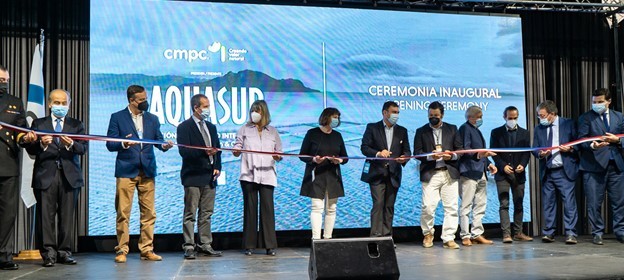 AquaSur opening ceremony. (Image courtesy AquaSur.)
The industry’s current and future challenges, equitable and sustainable development, and food security were some of the topics addressed during the international congress. Speakers included deputy directors from the Food and Agriculture Organization (FAO) of the United Nations and officials from the Bill and Melinda Gates Foundation, in addition to Undersecretary Gallardo.
According to FAO estimates, an additional 19 million tons of aquaculture products are expected to be produced globally for human consumption over the next decade. This would increase the aquaculture industry’s contribution to seafood destined for human consumption from the global average of 53% in the 2018-2020 period to 57% by 2030.
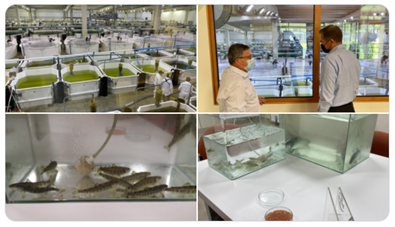
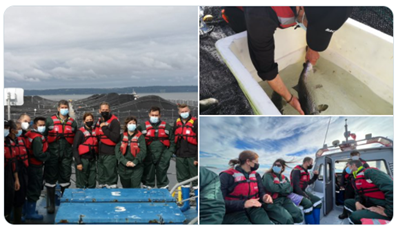
To maximize the experience of regulatory colleagues attending AquaSur, and to gain additional insight about aquaculture in Chile, U.S. Mission officials toured nearby salmon hatcheries, farms, labs, and processors — an event organized by Chile’s National Aquaculture and Fisheries Service (SERNAPESCA), together with the Santiago-based staff from the FDA’s LAO. This exchange provided an opportunity for Chilean stakeholders to explain the details of Chile’s specialized regulatory framework and the importance of the U.S. consumer to their industry.
Tour photos of salmon hatchery and boat trip out to floating sea pens. (Images courtesy U.S. Embassy Santiago.)
The FDA and SERNAPESCA have been collaborating for years, culminating in the signing of a confidentiality commitment in 2018 that allowed for the timely exchange of information and early notification of events that could potentially have an effect on products regulated by SERNAPESCA. The FDA’s LAO also has sponsored a series of webinars to help the Chilean seafood industry navigate the FDA’s regulatory requirements for seafood exported to the U.S. and has joined with the Joint Institute for Food Safety and Nutrition, headquartered in College Park, Maryland, in offering intensive online training to 42 SERNAPSECA inspectors.
Foreign seafood processers, like domestic processors, must identify food safety hazards that are reasonably likely to occur, and develop plans for the control of those hazards, a concept known as Hazard Analysis Critical Control Point or HACCP. However, seafood HACCP was established by the FDA prior to the Food Safety Modernization Act, which gave the FDA new authority to regulate the way foods are grown, harvested, and processed. Since HACCP bears some similarities to certain FSMA requirements, seafood has been exempted from several FSMA rules, but not all. In December 2021, the FDA issued a guidance document to help the seafood industry sort this out.
For the FDA to fulfill its mission to ensure the safety of imported food, engagement in partnerships with foreign governments and other foreign stakeholders is critically important. That requires understanding the local and regional industry and the local and regional regulatory environment; such knowledge and insight has immense value. The work of the FDA’s Latin America Office in Chile will continue to serve this purpose.
FDA Makes Low-Risk Determination for Marketing of Products from IGA Beef Cattle
In March, the FDA announced that two beef cattle with genomic alterations and their offspring are safe for consumers to eat.
The intentional genomic alteration (IGA) in the cattle, using a genome-editing technique best known by its acronym CRISPR, resulted in a genetic makeup and short-hair coat trait seen in some conventionally bred cattle with natural mutations.
CRISPR gene editing. (Retrieved from: http://www.crisprtx.com/gene-editing/crispr-cas9)
For the IGA cattle, the genetic makeup and short-hair coat trait also matches DNA in some conventionally bred cattle with natural mutations. The IGA can be passed on to offspring, allowing the trait to be shared through conventional breeding. The food from the IGA cattle, called PRLR-SLICK cattle, is the same as food from conventionally bred cattle that have the same extremely short, slick-hair trait.
This was the FDA’s first “low-risk determination” for an IGA in an animal for food use because it is low risk to consumers, the animals, and the environment. Generally, sponsors are required to have an approved application prior to marketing. But the FDA may use enforcement discretion and not expect sponsors to seek approval when the risk is low for all three categories and the IGA is functioning as the sponsor said it would.
The FDA reviewed genomic data and other information confirming that the IGA in genome-edited PRLR-SLICK cattle is equivalent to naturally occurring mutations in several breeds of cattle as an adaptation to being raised in tropical or subtropical environments.
Although PRLR-SLICK cattle have an equivalent trait to those cattle with a natural short hair coat, they are not currently in commerce. The product developer plans to use the genetic products from these two animals with select customers in the global market soon and anticipates meat products will be available for purchase by general consumers in as early as two years.
Brazil's CTNBio agency also reviewed these genome-edited cattle and determined food from them could be marketed under their law. Japan has made similar determinations for two fish: a puffer fish and a sea bream.
To date, the FDA has made low-risk determinations for enforcement discretion for many other IGAs in animals for non-food uses and has approved applications for five IGAs: in groups of goats, chicken, salmon, rabbit, and most recently in a line of pigs.
Additional Resources:
|
|
|
Back to TOP
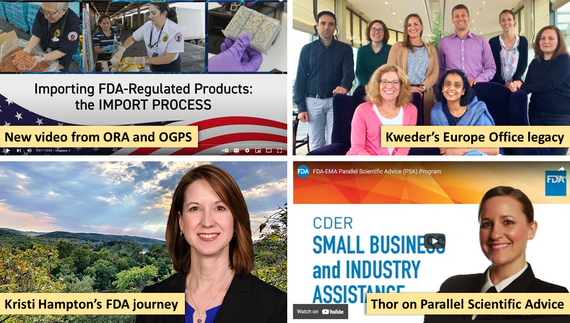
 Sandy Kweder’s European Legacy
The time has come for Dr. Sandy Kweder, M.D., to park her bicycle, scoop up her last armload of tulips from the market, and take a goodbye walk along the canals of Amsterdam. In early April, she finished her tour as deputy director of the Europe Office and returned to OGPS headquarters at White Oak to serve on a detail in the Immediate Office of Associate Commissioner Mark Abdoo. Here, she will lead and coordinate work on health equity, combating misinformation, and drug safety.
“[Sandy] has been the face and voice of FDA at EMA [the European Medicines Agency] and throughout the European region, advancing FDA’s public health mission and embodying the ultimate in professionalism, competence, integrity, and energy,” said Europe Office Director Ritu Nalubola in announcing Sandy’s departure to OGPS staff. “She’s been such a strong advocate for the value of engaging with our global partners and building those working relationships, even where we may not always reap those benefits till much later.”
“Kweder’s commitment and steady leadership was invaluable in strengthening the Europe Office’s strong profile and significant body of medical products work, both tangible and otherwise,” Nalubola said. “I will miss her sound counsel and guidance and, most of all, the lighthearted spirit, enthusiasm, and humor she brings to every conversation! I recall my first encounter with Sandy at [an international pharmaceutical meeting] where she joined, impromptu, our Irish counterparts on the stage in an Irish dance … she hasn’t failed to surprise me with her many talents on other occasions since then.”
 Europe Office staff together after the pandemic: Sandy Kweder (front left) and Ritu Nalubola (front right) are supported by (in back, left to right) Alessandro Fiorelli, Heather Messick, Shannon Thor, Matthew Scherer, Claudia Louati, and Lucy Gherasa.
Dr. Kweder brought a depth of experience with drug development to her dual roles as the Europe Office deputy director and as the FDA’s liaison with the EMA (first in London and later in Amsterdam, when EMA had to move following Brexit). She had previously served as the deputy director of the Office of New Drugs in the FDA’s Center for Drug Evaluation & Research where she actively led several initiatives including improvements in the drug review process, modernizing nonprescription drug review, building a systematic drug shortage prevention and management program, patient-focused drug development and clinical outcomes assessment, and the growth and development of pediatrics and maternal health as standard aspects of drug development.
Dr. Kweder amassed another impressive list of accomplishments during her European tour of duty. Dr. Kweder:
- Stood up three additional FDA-EMA technical workgroups, facilitating their terms of reference and procedures, and guiding the technical experts in information sharing, collaboration, and international diplomacy. These scientific exchanges between the two agencies first began nearly 20 years ago. In an award-winning peer-reviewed publication in 2019, Kweder reported that these exchanges have likely contributed to over 90% concordance in marketing application decisions by the FDA and the EMA from 2014-2016.
- Foresaw potential gaps in the global understanding of the FDA’s Emergency Use Authorization framework in early 2020, and, due to having her finger on the pulse of the international regulatory community, worked with colleagues in Europe and Japan to publish a paper comparing U.S., EU, and Japanese emergency authorization systems. Then, as the pandemic evolved, Dr. Kweder proposed and organized an ongoing FDA and EMA forum where global development of COVID-19 therapeutics could be discussed and optimized, and real-time decision-making challenges and outcomes could be shared, to the benefit of patients around the globe. She then chaired the first forum meetings to ensure a strong launch.
- Identified the need for an international approach to collecting and communicating data on the use of medicines in pregnancy and lactation, an area fraught with complex scientific issues and political sensitivities. Through diplomatic savvy and courage of conviction, Dr. Kweder broke down barriers to bring FDA leaders and European regulatory authorities into alignment on a roadmap of novel strategies to advance regulatory science — despite the many odds created by the major disruptions of Brexit and the pandemic in Europe. She coauthored a peer-reviewed journal article that included fresh, aligned approaches; stood up an international workgroup; and highlighted the group’s work through presentations at international conferences. Through these activities, the excellence and expertise of individual agencies has begun to synergize and now more global efforts through the International Coalition of Medicines Regulatory Authorities and the International Conference on Harmonization are underway.
- Led FDA and EMA experts in providing Parallel Scientific Advice (PSA) to companies seeking input on critical aspects of medical product development (see more in story below). Dr. Kweder’s medical expertise and long experience in the FDA were invaluable in helping to frame issues, build bridges, and ensure that the Europe Office was an effective advocate for the agency and the U.S. government. She also advocated for a five-year review of the PSA program to gauge its effectiveness. After analyzing the results, she developed much-needed process improvements, which led to a 50% increase in the program between 2020 and 2021. Building on this success, in 2021, she helped guide the launch of a new pilot PSA program for complex generics.
Prior to her time in the Europe Office, Dr. Kweder was a career officer in the U.S. Public Health Service. She retired as a Rear Admiral in 2013. She may have hung up her dress blues, but her commitment to public service and joy in bringing together scientific experts for the purpose of serving others has only grown since.
Kristi Hampton Follows in Family's Footsteps
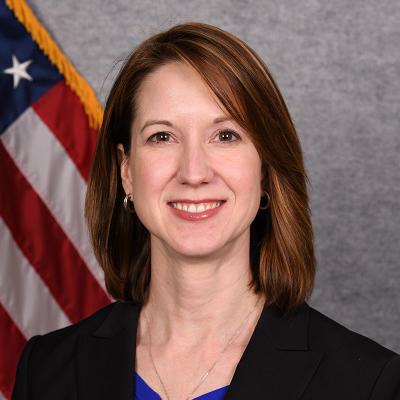
As a child, Kristi Hampton would spend a few weeks every summer with her mother’s family. Little did she know that these visits with her aunt and uncle would be instrumental in her decision to work for the FDA after college.
Kristi’s uncle was an FDA investigator and she enjoyed hearing his stories. “He would talk about his work with such commitment, and it was clear he was making a positive impact as part of the FDA,” she said.
During her childhood, Kristi considered being a firefighter, a teacher, or a doctor. She knew that college, a career involving science, and helping people would be part of her future. After all, each of her four parents was a shining role model for Kristi and helped spark these interests. Three of her parents worked in higher education, and the other in the medical field. They dedicated their lives to helping others and leading efforts to enact positive change in the world.
Her parents’ dedication to helping others, combined with her uncle’s inspiring stories, had a profound impact on young Kristi and so, after graduating from the University of Missouri with a Bachelor of Science degree in biology, she decided to apply for a position as an investigator with the FDA.
|
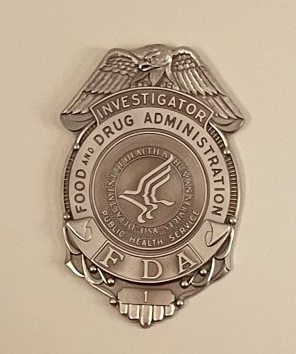
To mark the start of her career, her uncle passed on a special gift to Kristi — his wall badge, handed out to some investigators “back in the day.” It had hung in his office until he retired. He signed the back of it and wrote his years of service. Kristi did the same, adding her start date. The wall badge still hangs in her home office.
“I think that subconsciously I knew I’d have a long career with the FDA as I signed that badge at the start, and I’m still here over 20 years later,” said Kristi, who over the years has held positions as an investigator in ORA and a compliance officer and associate director in the Center for Drug Evaluation and Research’s (CDER) Office of Compliance before coming to OGPS.
From her first day on the job at the FDA, Kristi was treated as an equal rather than a 20-something newbie, an important lesson about how staff thrive best when treated with respect that she still carries with her today. “I’ve had many amazing mentors and bosses throughout my career that have taught me a lot about leadership, integrity, and the importance of investing in people. They cared and it showed,” Kristi said.
She considers Kathy Miracco, former director of compliance risk management and surveillance in CDER’s Office of Compliance, who passed away last year, as a “driving force” in her career. “She had such a strong yet caring leadership style.” Deb Autor, former director of CDER’s Office of Compliance, also had a significant impact on Kristi’s success. In 2008, Kristi took a job as Deb’s senior advisor and later as the associate director for operations. Shortly thereafter, the office was undergoing a reorganization, and Kristi’s portfolio shifted to oversee strategy, planning, and organizational excellence activities. It quickly became apparent that this career shift aligned well with her strengths and interests.
The career change led to Kristi pursuing her Master of Science degree in executive leadership from Champlain University and to her current position as an OGPS senior program advisor, where she leads the Organizational Excellence Program, one of the four pillars of the OGPS Strategic Plan that was created to support the vision of Associate Commissioner Mark Abdoo after OGPS was established in 2019.
Defining what organizational excellence means can be a challenge, Kristi admits, but the leadership team worked together and developed a meaningful definition that now drives Kristi’s work every day — to foster an inclusive, supportive high-performance organization that values employees. This is a goal that Kristi is deeply committed to. “People want to genuinely know that what they are doing is adding value and that they are valued as people, not just employees.”
One way OGPS supports organizational excellence is “by offering coaching to all staff,” said Kristi, who is a certified coach through the International Coaching Federation, with a master’s certificate in comprehensive evidence based coaching from Fielding University.
“A coach serves as a thought partner, someone who can help an employee set goals, identify tangible next steps, and create a positive path forward to achieve their goals, and often find greater balance in their lives. Finding balance is important to all of us,” she said.
|
 Kristi embraces what she calls “whole life balance” rather than “work-life balance” since work is a part of our lives rather than a separate part of us. As a working mother, Kristi understands that sometimes whole life balance can feel like a moving target, but when she’s mindful and purposeful about it, it evolves nicely over time. At home, Kristi and her family have created a “musical home.” Her kids play multiple instruments, and Kristi jokes that the “musical gene” skipped a generation, as she does not play any instruments.
“I love hearing them play their music. They fill the house with such joy,” she said. She finds a lot of joy in life’s simple moments. Her family has a goals board and positive intentions board that they periodically update together to help hold each other accountable and keep them grounded. Being out in nature also helps Kristi stay grounded. She loves trail runs and even takes nature photos along the way.
Kristi said she is “continuously looking for ways to enact positive change and meet the ever-evolving needs of our organization and our people.” As travel restrictions lift, Kristi is looking forward to going to White Oak and each of the foreign offices to connect with employees in person and hear from them about the current state of organizational excellence.
“I have a strong sense of fulfillment working for the FDA and OGPS. The three most important things in a job are who you work for, who you work with, and what you do. I’m very fortunate in all three of these categories – I have a great boss, wonderful colleagues, and engaging and fulfilling work to do. I’m focused on helping to ensure that all employees have the opportunity to feel this same level of satisfaction in their jobs,” said Kristi.
|
|
|
Back to TOP

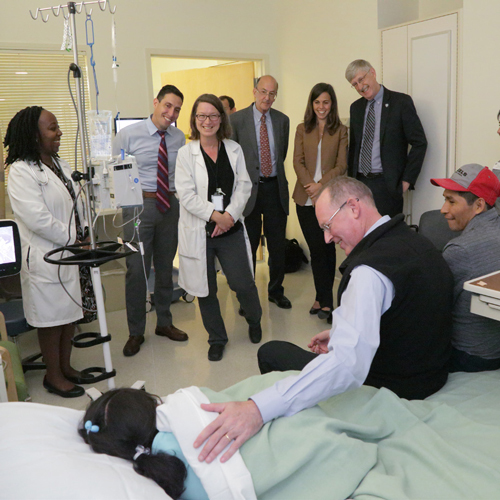
Image courtesy National Institutes of Health.
Remembering Global Heath Activist Paul Farmer
“Tout moun se moun”
(Every person is a person)
— Haitian Creole saying
Paul Farmer, M.D., Ph.D., died on February 21 from an acute cardiac event, on the grounds of a hospital and university he had helped establish in Rwanda. Farmer, a physician, anthropologist, and humanitarian who came to be known internationally for his work delivering effective health care to some of the world’s poorest people, was 62. Co-founder and chief strategist of the Boston-based nonprofit Partners in Health (PIH), he and his colleagues pioneered novel, community-based treatment strategies that continue to deliver high-quality health care in resource-poor settings across the globe.
He died in Butaro, a mountain town on the border of Uganda where he and PIH worked with the Rwandan government to build a health and health education complex. He had been treating patients up until his death.
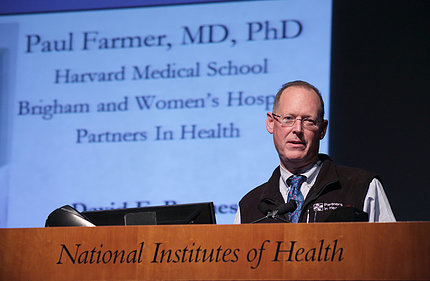
Farmer was both the Kolokotrones University Professor and chair of the Department of Global Health and Social Medicine at Harvard Medical School, and chief of the Division of Global Health Equity at Brigham and Women’s Hospital in Boston. He was also a member of the American Academy of Arts and Sciences and the Institute of Medicine of the National Academy of Sciences, from which he was the recipient of the 2018 Public Welfare Medal.
Farmer's work with PIH significantly influenced public health strategies for responding to tuberculosis, H.I.V., and Ebola. During the AIDS crisis in Haiti, he went door to door to dispense antiviral medications, disproving a common narrative embraced by many medical experts who thought it impossible for poor rural people to survive the disease.
Farmer also spearheaded new public health approaches in Lesotho, Peru, Russia, and Sierra Leone, among other places. He practiced “social medicine,” arguing it was pointless to treat patients for diseases only to send them back to indigent environments that worsened or facilitated sickness. Illness, insisted Farmer, has social roots and must be addressed through social structures.
Paul Edward Farmer Jr. was born on October 26, 1959, in North Adams, Massachusetts. His mother, Ginny (Rice) Farmer, worked as a supermarket cashier, and his father, Paul Sr., was a salesman and high school math teacher. Anthropologist Adia Benton, a colleague of Farmer’s, suggested that his political views had their genesis in his experience of growing up in relative poverty where, as one of six children, Farmer had lived at times in a bus, a boat, and a tent.
|
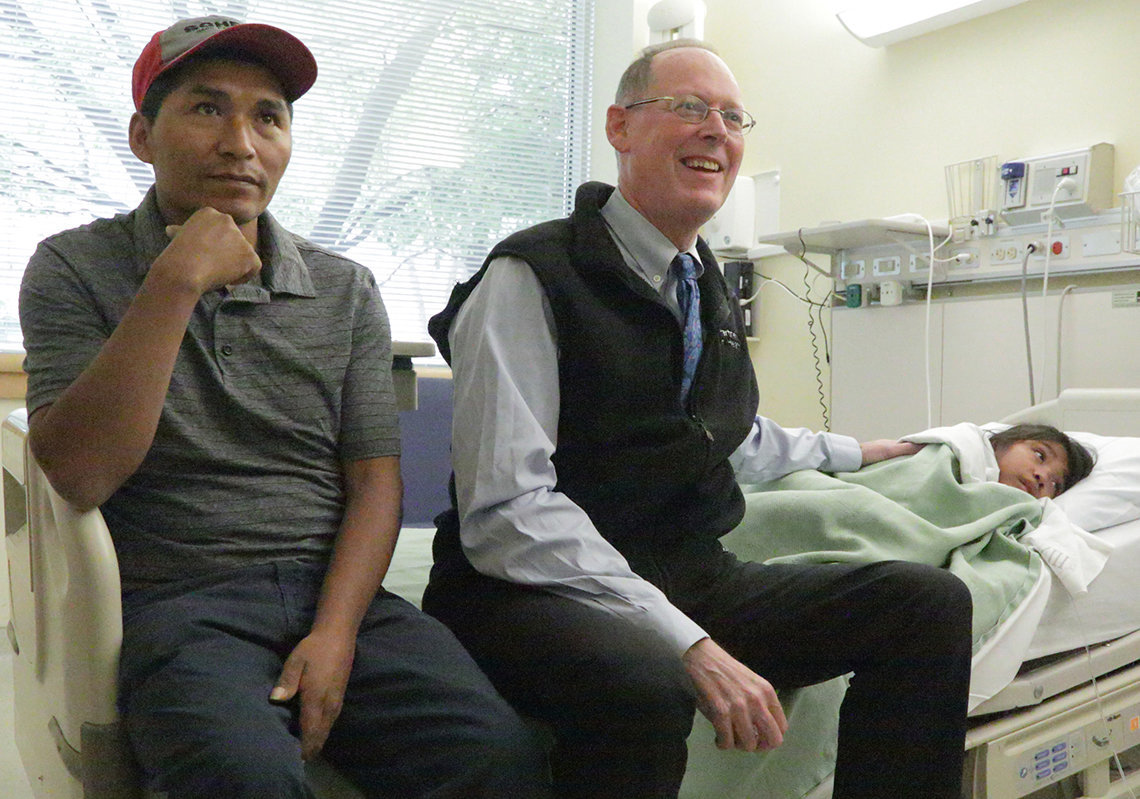 |
Image courtesy National Institutes of Health.
As he and his family worked alongside Haitian migrant workers picking oranges in Florida one summer, young Farmer listened curiously as they chatted in Creole from atop ladders. This first encounter with Haiti, the country that would captivate him in his twenties, later propelled him toward a career in public health. As a medical student, Farmer decided to build a clinic in Haiti that eventually grew into a vast global health network.
His medical care for a broken leg as a graduate student in 1988 cost roughly twice his mother’s annual salary as a cashier, he wrote in the London Review of Books. Farmer was struck by the fact that most of his bill was covered by Harvard’s medical insurance, while similar health costs impoverish some 30 million households each year around the world — if they get care at all. “Three of the Haitian founders of PIH, all in their twenties, had recently died stupid deaths,” he wrote, of sepsis, malaria, and typhoid fever, all preventable and easily treated diseases.
He went on to write several books on health, human rights, and the consequences of social inequality, including In the Company of the Poor: Conversations with Dr. Paul Farmer and Fr. Gustavo Gutiérrez; Reimagining Global Health: An Introduction; Haiti After the Earthquake; Infections and Inequalities: The Modern Plagues; To Repair the World: Paul Farmer Speaks to the Next Generation; and The Uses of Haiti. His most recent book, Fevers, Feuds, and Diamonds: Ebola and the Ravages of History, was released in November 2020.
“What happens to poor people is never divorced from the actions of the powerful,” Farmer wrote in his 2005 book Pathologies of Power: Health, Human Rights, and the New War on the Poor.
Paul Farmer is survived by his wife Didi Bertrand and their three children.
Back to TOP
 Video on “Importing FDA-Regulated Products” Debuts on YouTube
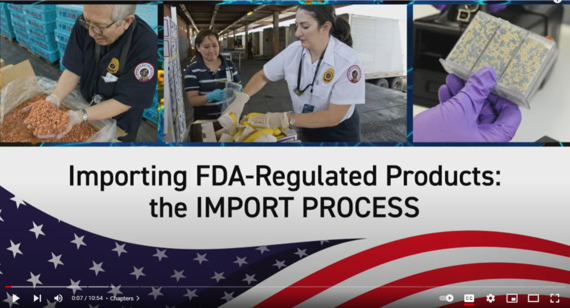
On April 7, the FDA released a video titled "Importing FDA-Regulated Products: The Import Process" that provides basic information for importers, foreign suppliers/exporters, and customs brokers. Available on YouTube, the new video supplements already available guidance about the FDA’s import admissibility process that is obtained via public websites or occasional webinars, industry trainings, or individual communications.
The video provides a high-level overview of what to expect when importing, examining five phases that may be encountered:
- Phase 1: Preparing to Import.
- Phase 2: Entry Submission.
- Phase 3: Entry Review.
- Phase 4: Examination and Sampling.
- Phase 5: Compliance Review.
Spanish and Mandarin versions will be released shortly.
Click the image to go to the YouTube video.
FDA Investigators Help Bring Illegal Supplement Manufacturers to Justice
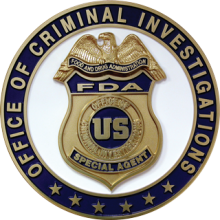
Thanks to the FDA’s Office of Criminal Investigation (OCI), the Department of Justice (DOJ) wrapped up a long-running case in 2021 that resulted in criminal charges against high-ranking executives at USPlabs LLC and fines, seizures, restitutions, and forfeitures totaling approximately $95 million. The Dallas-based manufacturer sold workout and weight loss supplements made from untested synthetic chemicals from China that caused consumers to suffer severe liver damage and other adverse health events. More than half of the sum paid by the companies and individuals involved in the conspiracy, $54 million, went to victims of the fraud and conspiracy.
The case began in July 2013, when the DOJ and the FDA seized and destroyed dietary supplements containing the unsafe food additive 1,3-dimethylamylamine, commonly known as DMAA, an amphetamine-like stimulant that had been linked to at least 86 adverse health events. The supplements had been stored at warehouses in Arizona, Pennsylvania, and South Carolina.
The company claimed that their products were made from natural plant extracts when, in fact, they were made from untested synthetic chemicals from China. Sales of USPlabs products related to the conspiracy brought the company hundreds of millions of dollars in revenue. And although the company was aware of the risks the product posed, they continued to sell it to consumers, compromising the health and safety of thousands of Americans.
|
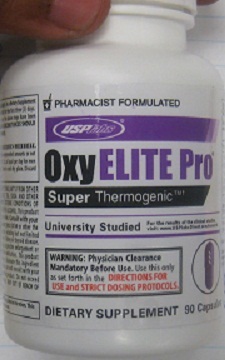
The company, along with at least 10 other manufacturers of DMAA-containing products, agreed to stop manufacturing products containing the stimulant in 2013. Despite this promise, USPlabs engaged in a surreptitious and concerted effort to sell as much OxyElite Pro as it could as quickly as possible at dietary supplement stores across the nation, contacting the retailers by phone to avoid detection by OCI investigators.
In November 2015, USPlabs, S.K. Laboratories Inc., and their operators were charged with a variety of violations related to the manufacture and sale of the companies’ highly popular workout and weight loss supplements. The indictment alleged that USPlabs engaged in a conspiracy to import ingredients from China using false certificates of analysis and false labeling, then lied about the source and nature of those ingredients after it put them in the products. The indictment also alleged that the defendants sold some of their products without determining whether they would be safe to use and that the defendants were aware of studies linking the products to liver toxicity.
|
Latest Blog: FDA Explores Ways to Harmonize Generic Drug Standards
Regulatory requirements and scientific approaches vary from country to country when it comes to generic drugs. Companies have responded by competing in only a selective list of markets, which leads to reduced market access and competition and fewer options for drugs in smaller and less developed countries.
To counter these trends, the FDA has been exploring administrative, scientific, and technical avenues for furthering the harmonization of generic drug standards, as the Associate Director of Global Generic Drug Affairs in the FDA's Center for Drug Evaluation and Research, Sarah Ibrahim, discusses in the latest From a Global Perspective article.

FDA Holds Symposiums with UK and Canadian Regulators
Over 1,800 registrants from more than 40 countries participated in two symposiums in March sponsored by the FDA, the U.K. Medicines and Healthcare products Regulatory Agency (MHRA), and Health Canada. The first symposium, held March 7-9, focused on good clinical practice, including building resilient clinical trials, continuing developments in decentralized trials, use of real-world data and real-world evidence in regulatory decision making, and the importance of sponsor oversight.
The second event, the MHRA Good Pharmacovigilance Practice Symposium (GPvP), held March 10-11, covered compliance trends observed by MHRA and FDA inspectors since the 2020 Symposium. The MHRA/FDA joint symposium is held every two years — this was the first year that Health Canada also participated. For more information: FDA, MHRA, and Health Canada Good Clinical Practice Workshop: Global Clinical Trials - Considerations and Lessons Learned from the Changing Landscape
|
|
Read thought-provoking pieces covering international topics in
From A Global Perspective. |
|
Please follow @FDA_Global. |
|
|
Subscribe to Global Update
Don't miss out on future issues of Global Update or other international news from OGPS. To sign up, click "Manage Subscriptions" in the below footer then follow the prompts and select the "International Programs" box.
|
|
|
|
|