OGPS Year in Review
 With 2020 finally coming to an end, Mark Abdoo, Associate Commissioner for Global Policy and Strategy, looked back at OGPS’ accomplishments in a Dec. 15 message to staff.
 |
|
“I’m so proud of OGPS’ resilience in response to the COVID-19 pandemic and the divisions that have torn at the fabric of American society, he said. “Despite long-term remote work, local lockdowns and shelter-in -place orders and the authorized departures and re-deployments for Mission China and other OGPS deployed staff, OGPS has had a remarkable year of achievements,” he said. |
Our Office of Global Operations team was on the frontlines of the pandemic and resolutely carried out a series of complex and difficult assignments, which included:
- The Europe Office helping to organize the first global regulatory workshop on COVID-19 vaccines, under the auspices of ICMRA, to discuss strategies to facilitate the development of SARS-CoV-2 vaccines and promote regulatory convergence to the extent possible;
- The India Office facilitating development of an MOU, signed in February with the Ministry of Health and Family Welfare, which highlights the importance of effective collaboration to achieve convergence in regulations in keeping with international standards to ensure safe and effective medical products;
- The Europe Office strengthening relations and identifying new areas of collaboration with EU partners in food and medical products during a two-day virtual bilateral between FDA and EU (EC and EMA); and, establishing the FDA-EFSA Cluster on Whole Genome Sequencing for Food Safety;
- The Latin America Office collaborating with a range of partners to deliver both an On-Farm Readiness Review Training and a Farm Tour. These two events resulted in the training of 19 professionals in Chile across various government offices;
- The China Office staff assisting ORA’s Health Fraud Branch (HFB) to identify and research fraudulent COVID-19 claims related to FDA-regulated products, work which included undercover research of social media platforms and web communications; and,
- The India and China Offices combining with CDER’s Office of Pharmaceutical Quality (OPQ) to lead a real-time outreach to Asia on pharmaceutical quality, including manufacturing assessment, quality expectations, and surveillance findings.
Our Office of Trade, Mutual Recognition, and International Arrangements (OTMRIA) had an active year and I am pleased to note that COVID-19 didn’t hinder our team’s determination to engage with our counterparts on behalf of FDA and HHS. Some of the OTMRIA accomplishments include:
- Negotiating and finalizing of five Confidentiality Commitments (with Argentina, Health Canada, Germany, and Australia) and two new cooperative arrangements with India and Mexico;
- Finalizing an equivalence determination that will facilitate the reopening of markets in raw molluscan shellfish that have been closed to trade between the United States and the European Union since 2010;
-
Representing FDA in negotiations of the Phase 1 Trade Agreement between the United States and China and continuing to represent the FDA foods program in bilateral discussions on implementation of the Agreement;
- Leading efforts to ensure the entry into force of the Pharmaceuticals Annex to the United States – United Kingdom Mutual Recognition Agreement once the transition period of Brexit ends on December 31, 2020, by coordinating across FDA centers and offices a review of the GMP processes of the UK’s Medicines and Healthcare products Regulatory Agency.
Our Office of Global Diplomacy and Partnerships had a productive year and its accomplishments include:
- Supporting FDA's COVID-19 pandemic response efforts through engagement with multilateral organizations, responding to numerous inquiries from HHS, the Department of State, and foreign governments, and participating in internal FDA working groups on incident operations, supply chain matters and communications;
- Introducing the new OGPS Five-Year Strategic Plan to guide our work, including laying the groundwork for continued improvement in OGPS systems and data analysis;
- Completing the updated PEPFAR budget model, reflecting changes in PDUFA VI;
- Representing FDA interests during the completion and roll out of two National Academies of Sciences Engineering and Medicine reports – one on Mutual Recognition and the other on Regulatory Systems Strengthening;
Abdoo concluded by thanking the staff for their perseverance and dedication to OGPS’ mission this past year. “You all do amazing work and accomplish so much to advance FDA’s mission to protect and promote the public health,” he said.
FDA Continues Work Toward Eradicating AIDS
On Dec. 1, FDA observed World AIDS Day – to bring attention to the HIV epidemic and increase HIV awareness and knowledge. The FDA Voices blog highlighted some important steps FDA has taken over the years toward eradicating the disease, which includes a commitment made in 2003 to participate in the President’s Emergency Plan for AIDS Relief (PEPFAR) program.
 |
|
FDA plays an integral role in PEPFAR by ensuring safe and effective antiretroviral (ARV) drugs are available for procurement through PEPFAR so these drugs can get to populations in countries with the highest burden of disease in a timely manner. |
Since PEPFAR’s launch, low-cost, quality-assured, life-saving ARV drugs have been provided through the program to nearly 15.7 million people worldwide, including almost 700,000 children.
The Office of Global Policy and Strategy (OGPS) serves as the FDA point of contact with all outside entities in coordinating FDA activities dealing with PEPFAR, including those associated with drug firms seeking to participate in the expedited review process for ARV therapies for use in the PEPFAR focus countries. OGPS recognized World Aids Day by issuing its own blog, Bookmark this Site! FDA’s Comprehensive Database on Antiretroviral Drugs for HIV under PEPFAR. The co-authors, Gabrielle Lamourelle, acting director of the Office of Diplomacy and Partnerships within OGPS and Capt. Mary E. Kremzner, Pharm.D., director of the Division of Drug Information, Office of Communications, in FDA’s Center for Drug Evaluation and Research, discussed the January 2020 revisions to the website that lists PEPFAR drugs.
Previously only basic information about these products was available in a static web table. Now the database is interactive and mobile-friendly, and for the first time, FDA-reviewed product labeling and packaging information is available for each approved or tentatively-approved ARV drug product. That means providers, patients and procurers around the world will have information on dosage and administration, warnings and precautions, contraindications, adverse events, and pediatric use, among other things. Other information is now available as well including updates on manufacturing sites, shelf-life, storage conditions, and current manufacturing status. The labeling information can be downloaded and the database offers dashboards that provide real-time insight into key metrics for those users who want to conduct data analysis.
To date, the database has been utilized by stakeholders 7,381 times. However, surprisingly few of the users are from countries that are most reliant on the PEPFAR program, suggesting the need to further promote the website’s availability.
More Great Content
Since its launch last year, From a Global Perspective, the OGPS blog, has issued 13 articles. The latest piece, The WTO’s Decision on Australia’s Plain Packaging Tobacco Measures Explained, delves into a significant public health ruling by the World Trade Organization, affirming Australia's Plain Packaging Measures that removed packaging designed to attract new customers, especially teens. Catch up on all the blogs and follow OGPS on Twitter @FDA_Global.
The Interesting Birth of the Dear International Colleague Letter
 Communicating with stakeholders
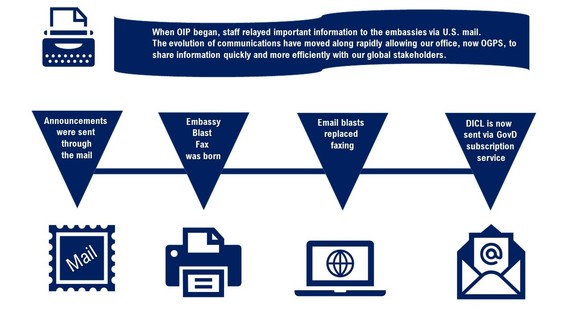
While the technology has evolved from snail mail to email list-serve, FDA has been sending out its Dear International Colleague Letter to keep embassies, foreign regulatory agencies, and global stakeholders apprised of FDA's relevant announcements and communications for more than 20 years.
Mail
It all began as an actual letter sent through the mail. "We used to have to order these large brown envelopes," recalled Sema Hashemi, supervisor of the Global Engagements Team within the Office of Global Policy and Strategy (OGPS). "Sometimes it would take weeks before we would even hear back from anybody."
Hashemi started with the Office of International Programs (OIP), now part of OGPS, in January of 2000. OIP had recently been formed (1999) by merging FDA offices that handled international functions. Over the years, international issues grew with the agency as did the need for greater communication with embassies. During this time, Hashemi was a desk officer, serving as the contact point between the overseas mission and headquarters.
Fax
As time went on, OIP’s role in the international arena grew. OIP moved from sending individual letters to faxing the alerts so they would reach embassies as quickly as possible. Leadership approached Hashemi and asked her to start drafting letters on letterhead when there was an important announcement, embassy seminar, new regulation that would impact the world globally, or FDA recall that could be sent to numerous recipients at once. She asked, “Who do you want me to address it to?” Their reply, “Just say Dear International Colleague.” This correspondence became known as the Embassy Blast Fax.
Gathering and entering numerous fax numbers proved to be no small feat. Hashemi remembers the delay as the numbers would dial, then often have to hang up and redial. “We would have to check the sheet to determine which numbers didn’t go through and then try to dial it again.”
Email
Once some of our stakeholders began to get email addresses, OIP could pivot to sending out alerts via email. It was expensive at first because it required buying a block of time for dial-up service. Moreover, we still had to fax our alerts to those stakeholders who did not have email addresses. “Not all countries, during that time had computers, or there was one computer for the entire office,” said Hashemi.
GovDelivery
The communications mediums of today are a stark contrast to those of yesteryear. How easily we communicate with the embassies now would seem impossible just a few years ago. FDA is committed to transparency and sharing information with various stakeholders. We currently use GovDelivery, a web-based email subscription management system that allows agencies to send news and information to thousands of subscribers with one click. The Embassy Blast Fax has moved through various phases of growth and development yet remains true to its roots. “These letters are very important in getting FDA’s messages out,” said Hashemi.
 The Dear International Colleague Letter (DICL) is a letter sent via email to a list-serve of about 20,000 subscribers – both DC-based embassies and international stakeholders. The DICL is intended to inform these stakeholders of any FDA announcements that are relevant to an audience with international interests. Here are the most recent DICLs:
Drug Registration and Listing Workshop Recordings Available
Diversity in Clinical Trials: Learn about Enrollment Trends and Resources from FDA
Update to CVM eCATS/Export Certificate Announcement
FDA Statement on Vaccines and Related Biological Products Advisory Committee Meeting
FDA Issues Emergency Use Authorization for First COVID-19 Vaccine
Registration Open: CDER Compliance Conference
INO Staff Share Knowledge
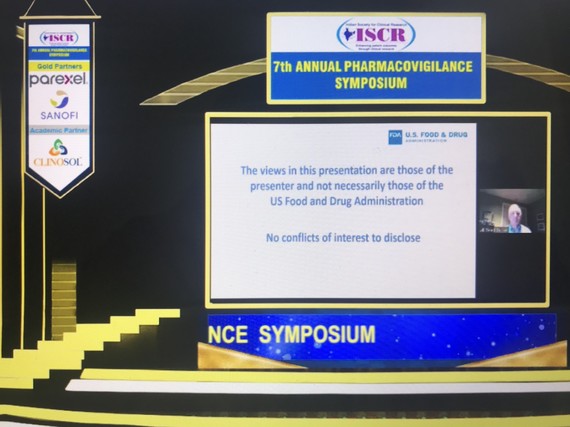
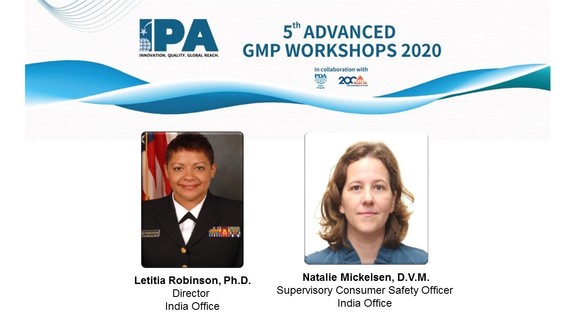
Letitia Robinson, PhD, director of FDA’s India Office (INO), gave the inaugural address during the 5th Advanced GMP Workshop, which took place Nov. 4-6. The event was part of the Indian Pharmaceutical Alliance’s mission to disseminate knowledge, share best practices, and work toward excellence in quality. During the two-day virtual workshop, INO Supervisory Consumer Safety Officer Natalie Mickelsen, DVM, presented, FDA 704 (a)(4) review: Inspection of Records. Section 706 of the Food and Drug Administration Safety and Innovation Act (codified at 704(a)(4) of the Federal Food, Drug, and Cosmetic Act (FDCA)) authorized FDA to conduct “record reviews” to resolve the Official Action Indicated (OAI) status of facilities.
|