Virtual Grower Trainings to Support Produce Safety Culture in Latin America
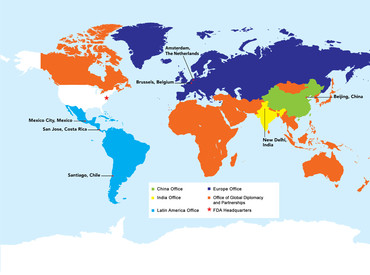
FDA’s Latin America office (LAO), in conjunction with the Inter-American Institute for Cooperation on Agriculture (IICA) and the Joint Institute for Food Safety and Applied Nutrition (JIFSAN), has developed and implemented a virtual Grower Training pilot program that took advantage of a shift in policy by the Produce Safety Alliance (PSA), which in March of 2020 expanded its traditional in-person only training curriculum to online during the COVID-19 pandemic.
 |
|
FDA’s Produce Safety Rule requires that at least one individual from most farms receive certification for produce safety training using a curriculum deemed adequate by the FDA. To date, only one curriculum exists, developed by Cornell University through the Produce Safety Alliance. |
LAO’s virtual Grower Training pilot conducted 16 courses in Mexico, Honduras, Chile and the Dominican Republic from May-Sept. 2020, certifying 222 growers as being in compliance with the Produce Safety Rule training requirement. Additionally, FDA, IICA, and JIFSAN were able to gain valuable knowledge about the effectiveness of online training which will inform the design and execution of similar learning programs in the future.
The pilot’s initial successes led to the development of a “Phase Two,” which will consist of eight additional trainings for growers in hard-to-reach or high-risk produce growing regions of Mexico and Honduras. JIFSAN has contracted with a PSA expert to develop teams of PSA Trainers and Lead Trainers in Mexico and Honduras to recruit growers and co-teach portions of the PSA Grower's curriculum in those locations. Growers are enthusiastic about this training opportunity and the PSA expert has reported full rosters for all courses.
The objective of the training effort is to reach Latin American farmers, increase compliance with FDA’s Produce Safety Rule, and enhance the safety of produce consumed in the United States. Evidence shows training on safe agricultural practices can improve produce safety. Approximately 40% of the fruits and vegetables consumed in the U.S. are of foreign origin and more than 80% of these imports originate in Latin America, which means that training growers in this region is a high-value investment towards ensuring the safety of food imported to the U.S.
LAO believes its work on Grower Training has helped to build and strengthen its relationships with significant partners in produce-rich countries, which in turn will enhance opportunities for collaboration and food safety culture achievement in the future.
For example, in Mexico, LAO has coordinated with major export associations for help in both logistic and training support, including the cilantro industry's UNACOMEX in Puebla, and the Association of Berry Growers (ANEBERRIES).
In addition to providing the standard curriculum, LAO used the virtual trainings as an opportunity to convey additional information on the Food Safety Partnership that FDA signed with Mexico’s National Service of Agro-Alimentary Health, Safety and Quality (SENASICA, for its initials in Spanish) and the Federal Commission for the Protection from Sanitary Risks (COFEPRIS, for its initials in Spanish) on Sept. 29. Personnel from SENASICA were invited to the training to present information about Mexico’s voluntary System for Risk and Contamination Reduction Program (SRRC, for its initials in Spanish), an initiative of the Mexican government to strengthen the safety of their growers’ agricultural practices while personnel from LAO discussed the FDA’s import requirements, ‘what to expect’ during an FDA inspection, and the parallel features of Mexico’s SRRC and the FDA’s Produce Safety Rule.
As a result of the success of these courses, continued demand from growers, and the pandemic’s ongoing limitations for in-person events, LAO, IAS, and JIFSAN are planning additional virtual trainings in 2021.
FDA and Homeland Security Sign MOU to Stop Harmful Products Through International Mail
Announced on Oct. 30, leadership from the U.S. Food and Drug Administration and offices within the Department of Homeland Security — the U.S. Customs and Border Protection (CBP), and the U.S. Immigration and Customs Enforcement, Homeland Security Investigations (ICE-HSI) — signed a Memorandum of Understanding (MOU) to stop products that pose a threat to public health and attempt to enter the U.S. through our International Mail Facilities (IMFs).
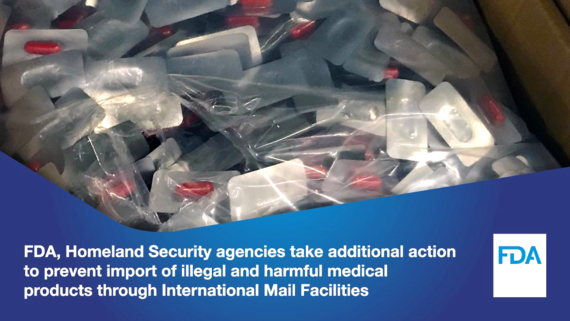 The MOU will maximize inspection and detection capabilities in order to prevent this illegal activity. “The collaborative efforts we’ve announced will enable more resourceful, effective, and efficient oversight to prevent illegal and potentially harmful products from entering the United States,” FDA Commissioner Stephen M. Hahn, M.D., noted.
As a core part of this collaborative effort, CBP and ICE-HSI will continue to partner with the FDA in joint operations at the IMFs to target illicit opioids, including fentanyl and other unapproved or unlawful drugs; medical devices; and dietary supplements regulated under the Federal Food, Drug, and Cosmetic Act. The partnership is also critical in the FDA’s continuing efforts to intercept fraudulent, counterfeit, or illegitimate COVID-19 products that may pose risks to public health.
The FDA and CBP signed a letter of intent in April 2019, to maximize inspection and detection capabilities at the IMFs. As outlined in the letter of intent and in the recently signed MOU, the FDA, CBP, and ICE-HSI will expand the types of information and how that information is shared among the agencies to quickly and effectively identify trends in incoming violative packages.
Both general and specific data points will be shared, which can be used to target impending product entries and to inform future enforcement strategies and coordinated operations. An additional focus of this effort will be coordinating the shared space and increased scientific presence at high-volume IMF locations, helping to facilitate and support real-time entry decisions, and increased data sharing.
As of the end of Oct. 2020, the FDA has screened approximately 27,500 mail parcels, containing almost 43,000 FDA-regulated products — already more than the agency did in all of 2019. Of these products, more than 34,000 were refused admission and more than 24,000 were violative drug products that have been destroyed using FDA’s administrative destruction authority, a process made more efficient by the 2018 Substance Use-Disorder Prevention that Promotes Opioid Recovery and Treatment (SUPPORT) for Patients and Communities Act. Enforcement is managed by the FDA’s Office of Regulatory Affairs, Office of Enforcement and Import Operations, for nine IMFs at the ports of Los Angeles, San Francisco, Honolulu, Chicago, New Jersey, New York, Miami, Puerto Rico, and the Virgin Islands.
FDA Publishes List of Essential Medicines
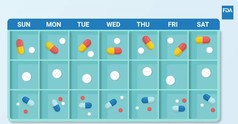
Responding to a recent Executive Order (EO), the FDA has identified a list of essential medicines, medical countermeasures and critical inputs that are medically necessary to have available at all times, in an amount adequate to serve patient needs and in the appropriate dosage forms. |
|
 |
The EO was issued on Aug. 6 to ensure the American public is protected against outbreaks of emerging infectious diseases, such as COVID-19, as well as chemical, biological, radiological, and nuclear threats. To accomplish this goal, the EO seeks to minimize potential shortages of these products and reduce U.S. dependence on foreign manufacturers by ensuring sufficient and reliable, long-term domestic production of these products.
The FDA was given a 90-day deadline to respond to the EO and worked in consultation with other federal partners to identify a list of 227 drug and biological product essential medicines and medical countermeasures. Additionally, 96 device medical countermeasures were identified, including diagnostic testing kits and supplies for rapid test development and processing, personal protective equipment, active vital sign monitoring devices, devices for vaccine delivery, and devices for management of acute illnesses, such as ventilators, among others.
Generally, the essential medicines identified by FDA are those that are most needed for patients in U.S. acute care medical facilities, which specialize in short-term treatment for severe injuries or illnesses, and urgent medical conditions. The medical countermeasures identified are FDA-regulated products (biologics, drugs, devices) that meet the definition of a "medical countermeasure" provided in the executive order and that FDA anticipates will be needed to respond to future pandemics, epidemics, and chemical, biological, and radiological/nuclear threats.
For the greatest public health impact, the list concentrates on those medicines that are medically necessary to have in adequate supply for use by the widest populations. The critical inputs identified included related active pharmaceutical ingredients, as well as ingredients or components that possess unique attributes essential in assessing the safety and effectiveness of such products.
 |
|
The medicines and devices on the list are up for public comment under docket FDA-2020-N-2123-0001 for feedback on any additions or removals, inclusion criteria, and how often the list should be updated. |
The EO also directed the FDA to coordinate with its federal partners on strategies for acquiring the products on the list, accelerating domestic manufacturing, and identifying and addressing supply chain vulnerabilities. The FDA believes that the adoption of innovative technologies, such as advanced manufacturing techniques, could enable U.S.-based pharmaceutical manufacturing to bolster its competitiveness with foreign countries and help ensure a stable supply of drugs critical to the health of U.S. patients.
https://www.whitehouse.gov/presidential-actions/executive-order-ensuring-essential-medicines-medical-countermeasures-critical-inputs-made-united-states/
https://www.fda.gov/news-events/congressional-testimony/safeguarding-pharmaceutical-supply-chains-global-economy-10302019
https://www.fda.gov/news-events/press-announcements/fda-publishes-list-essential-medicines-medical-countermeasures-critical-inputs-required-executive
|