|
EPA Region 8 Wyoming Drinking Water
Monthly Newsletter
June, 2026
|
|
|
|
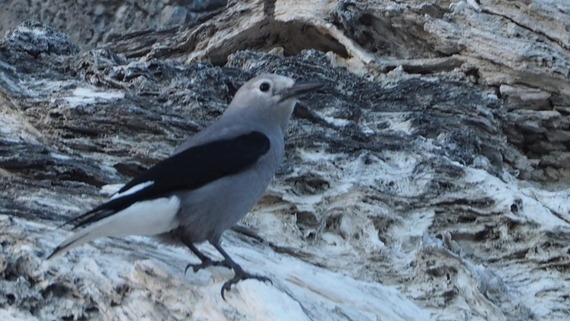
Photo Credit: Lucien Gassie, Wyoming Sanitary Survey Rule Manager. Photo taken near Yellowstone National Park, Wyoming.
|
|
|
EPA Announces Two Proposed Rules for Per- and Polyfluoroalkyl Substances (PFAS)
Two proposed rules for PFAS were announced by the EPA on May 18, 2026 in this press release:
-
Proposed PFAS and PFOS Compliance Extension Rule
- Establishes a Federal Exemption Framework which would allow systems to submit a request for 2 additional years (until 2031) to comply with the PFOA and PFOS MCL compliance deadline.
- Systems with PFOA or PFOS ≥ 12 ppt must implement at least two short term control measures to avoid “unreasonable risk to health.”
- Does not allow systems to violate the National Primary Drinking Water Regulation but does allow them more time for treatment evaluation, funding, design, construction, implementation, and advancement of treatment technologies.
-
Proposed Rule to Rescind Regulatory Determinations and Regulations for PFHxS, PFNA, HFPO-DA, and Hazard Index Mixtures
- Proposes a regulatory reform and re-evaluation of the MCLs for PFHxS, PFNA, HFPO-DA (Gen X), and the Hazard Index mixtures of those three PFAS plus PFBS.
- Would remove all regulatory provisions for the rescinded PFAS.
There is a 60-day public comment period on the proposed rules, and the EPA will hold a virtual hearing on July 7, 2026, to receive verbal comments from the public. Registration for the hearing is required by July 1, 2026.
Until these rules are finalized, the April 2024 PFAS National Primary Drinking Water Regulation is effective and enforceable.

|
|
Consumer Confidence Report Rule Upcoming Deadlines
It is about that time of the year that we start working on Consumer Confidence Reports (CCR). Here is the reminder that all Wyoming community water systems (CWS) are required to prepare a CCR each year. This report must be distributed to all customers of the system, ensuring that consumers receive essential information about the quality of their drinking water. The system must also provide a signed certification regarding the contents of the report and its distribution to the EPA. Due dates for these requirements are listed below.
July 1st - Final date for all community public water supply systems to distribute a CCR to their consumers and to submit a copy to the EPA.
October 1st - Final date to submit a certification of report content and distribution to the EPA.
An email was sent on May 21, 2026, to the systems that still need to submit the CCR. The email provided information if your system had an open significant deficiency as of December 31, 2025, conducted a Revised Total Coliform Rule (RTCR) Level 1 assessment, a RTCR Level 2 assessment was conducted at your facility, or you were required to monitor for unregulated contaminants in 2024. Please remember to include all relevant information in your 2025 CCR.
Contact Pragati Sharma, CCR Rule Manager at sharma.pragati@epa.gov if you have any questions.
|
|
Lead and Copper Rule Upcoming Reporting Deadline
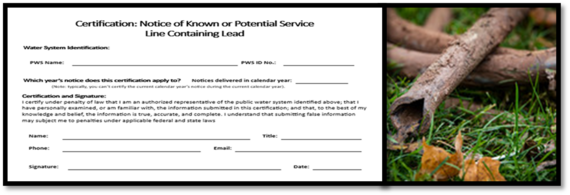
Time to certify your 2025 lead service line notices!
What’s due
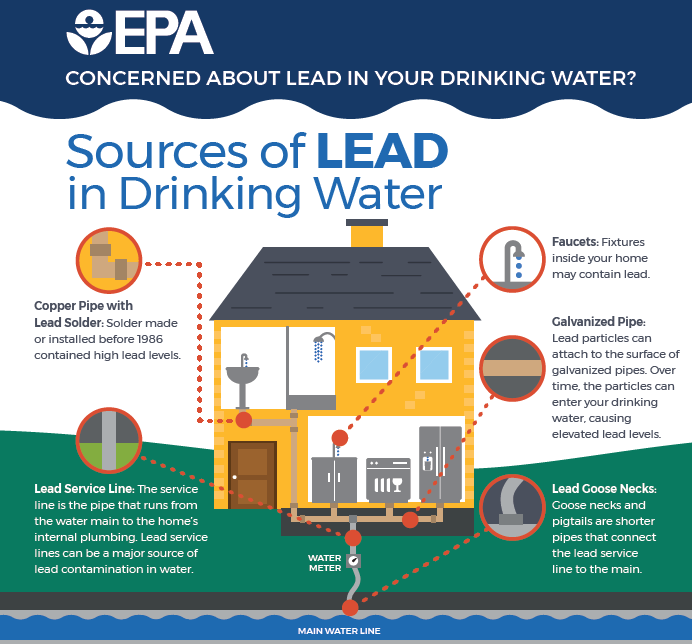
- Certification: Tell us that in calendar year 2025 you sent required notices to every service connection with a lead service line, a galvanized line that must be replaced (GRR), or a line with unknown material that may be lead.
- Copies of notices: Send example copies of the notices you used for lead, GRR, and unknown lines.
Who must submit
- Any system with lead, GRR, or unknown lines in its 2024 initial inventory must submit the certification and notice copies.
- Systems with only non‑lead lines in the 2024 initial inventory do not need to submit.
Due date
What your certification should show
- You sent the first notice or the annual repeat notice to each affected address, and you gave the notice to new customers when service started.
- Each notice clearly stated the specific material for that address: lead, galvanized requiring replacement, or unknown (may be lead).
- Each notice told people simple steps to lower lead in drinking water (for example, use cold water, flush taps, and use a certified filter if needed).
- You delivered notices by mail or by hand. If you used another method, you had written approval from EPA Region 8.
What to submit
- A signed certification for 2025 from an authorized representative.
- Copies of each type of notice (lead, GRR, unknown), in every language you used.
Where to submit
- Email: R8DWU@epa.gov. Subject line: “<PWSID> LSL Notice Cert”.
- Mail: U.S. Environmental Protection Agency, Region 8, Mail Code 8WD‑SDP, 1595 Wynkoop Street, Denver, CO 80202, Attn: LSLI Team.
- Fax: 303‑312‑7517, Attn: LSLI Team.
If you have questions, reach out to Erica Wenzel, wenzel.erica@epa.gov, or (303) 312-6411
|
|
Lead and Copper Rule Lead Action Level Exceedance Tier 1 Public Notice
It’s that time of year again! Systems on reduced annual and triennial monitoring with samples due in 2026 are required to collect their samples between now and the end of September. If you are unsure where to collect your samples, please reach out to Bolor Bertelmann at Bertelmann.Bolor@epa.gov.
If you collect your samples and receive lead results indicating that your system’s 90th percentile is above the action level of 0.015 mg/L, your system may have an Action Level Exceedance (ALE). If your system has a lead ALE, you are required to do a Tier 1 Public Notice (PN) within 24 hours of receiving your results. You should notify the ALE rule manager, Chelsea Ransom, at ransom.chelsea@epa.gov or 303-312-6876 immediately and proceed forward with issuing your Tier 1 PN. Note you are required to do the Tier 1 PN even if you are unable to get in touch with EPA.
To issue a Tier 1 PN, follow the instructions for filling out and distributing it. The instructions, a template, and certification form can be found on our website in word and pdf formats in English and Spanish.
Due to the tight time constraint, EPA does not need to pre-approve the Tier 1 PN template before it is distributed. Please send your completed Public Notice and certification to EPA as soon as possible after distribution. Note that if a system fails to do the Tier 1 PN within 24 hours of learning of the ALE, EPA is required to issue the public notification on behalf of the water system. EPA Region 8 would do this as a public service announcement in the media.
|
|
EPA Announces $9.4 Million for Wyoming to Address PFAS in Drinking Water
EPA has announced $9.4 million in new Emerging Contaminants in Small or Disadvantaged Communities (EC-SDC) grant funding to address PFAS and emerging contaminants in Wyoming communities that need it most. This new funding is part of a comprehensive, lifecycle-based strategy to address per- and polyfluoroalkyl substances (PFAS) that underscores EPA’s commitment to Making America Healthy Again by ensuring clean water for all.
“EPA is committed to advancing safe, reliable drinking water for Wyomingites with real, on‑the‑ground solutions,” said EPA Region 8 Administrator Cyrus Western. “Through strong state partnerships this funding will help Wyoming communities test for PFAS, plan solutions and install treatment so families can trust the water at the tap.”
|
|
EPA Announces $27,456,000 Million to Reduce Lead in Drinking Water in Wyoming
EPA is announcing $27.5 million in funding to protect Wyoming from exposure to lead in drinking water. This investment will go directly to states through the Drinking Water State Revolving Fund (DWSRF) and is part of EPA’s unwavering commitment to Making America Healthy Again.
This funding will go toward finding and replacing lead pipes (also known as lead service lines) that deliver water to homes. Communities can use these funds for identifying lead pipes, planning removal projects, and funding replacement of these lead service lines. Lead is a powerful neurotoxin that is especially harmful to children. Each lead pipe removed and replaced delivers real, tangible human health benefits in communities across our great nation.
“An investment in removing lead pipes is an investment in America’s children and families,” said EPA Assistant Administrator for Water Jess Kramer. “The Trump EPA is committed to tackling lead exposure and this $2.9 billion will help protect current and future generations by accelerating local efforts to find and replace toxic lead pipes.”
“EPA is committed to ensuring every American has access to clean drinking water,” said EPA Region 8 Administrator Cyrus Western. “This funding will help small and rural systems know exactly where lead lines are and replace pipes safely – delivering clean water that communities need and the accountability taxpayers deserve.”
|
|
EPA Tools & Resources Webinar Practical Tools to Advance Water Reuse
There are no overarching federal regulations specific to water reuse. Instead, states, Tribes, and territories can establish their own regulations or standards. This approach has led to a fragmented landscape for aspiring water reuse practitioners, including industrial water users who operate in many states.
Join us for an informational webinar with EPA’s Water Reuse Program, which is working to remove barriers to water reuse. Our presenters will address the latest developments of EPA’s Water Reuse Action Plan 2.0 initiative and will highlight the EPA’s priorities for advancing water reuse in key industrial sectors, such as manufacturing and AI. Presenters will also provide a live walkthrough of the REUSExplorer, a searchable tool for navigating summaries of state reuse regulations. Additionally, the webinar will provide insight into EPA’s 2025 publication Risk-Based Framework for Developing Microbial Treatment Targets. Attendees will leave with new resources and tools they can incorporate and utilize in existing or future water reuse activities.
 |
|
Webinar Details
- Date: Thursday, June 17, 2026
- Time: 1:00 p.m. – 2:00 p.m. Mountain Standard Time
|
|
|
Keep Water Flowing: Free Cybersecurity Training + CEUs
Cybersecurity Refresher Training
This refresher training to water and wastewater utilities will reinforce their foundational understanding of cybersecurity and how it applies to the water sector. This training will cover topics from Cybersecurity 101, Cybersecurity 102, and Cybersecurity 103 trainings.
Webinar Details
- Date: Thursday, June 17, 2026
- Time: 11:00 a.m. – 12:00 p.m. Mountain Standard Time
Water Cybersecurity Assessment Tool Training
EPA will demonstrate how to use EPA’s Water Cybersecurity Assessment Tool (WCAT) to conduct cybersecurity assessments at water and wastewater systems.
Webinar Details
- Date: Wednesday, June 24, 2026
- Time: 11:00 a.m. – 12:00 p.m. Mountain Standard Time
Cybersecurity Procurement Checklist Tool Training
EPA will demonstrate how to use EPA’s Cybersecurity Procurement Evaluation Checklist for Drinking Water and Wastewater Systems to assess and compare cybersecurity-related vendors.
Webinar Details
- Date: Thursday, June 25, 2026
- Time: 11:00 a.m. – 12:30 p.m. Mountain Standard Time

|
|
EPA 2026 National Cyber Drill: “A Day Without SCADA”
The drill is designed to test the ability of drinking water and wastewater utilities to maintain critical functions during a temporary loss of telecommunications and internet services.
What you'll do:
- Operate in a “disconnected” environment (limited/no SCADA remote access, cloud, email, Voice over IP, or other digital communications tools).
- Test preparedness by practicing manual operations at your system or joining a tabletop exercise.
Objectives:
- Assess your ability to sustain essential water/wastewater operations without telecom/internet.
- Exercise cyber incident response plans and manual workarounds.
- Identify gaps, resource needs, and resilience improvements.
 Webinar Details
- Date: Wednesday, July 8, 2026
- Time: 11:00 a.m. – 1:00 p.m. Mountain Standard Time
|
|
Building Water Sector Natural Hazard Resilience in Montana and Neighboring States
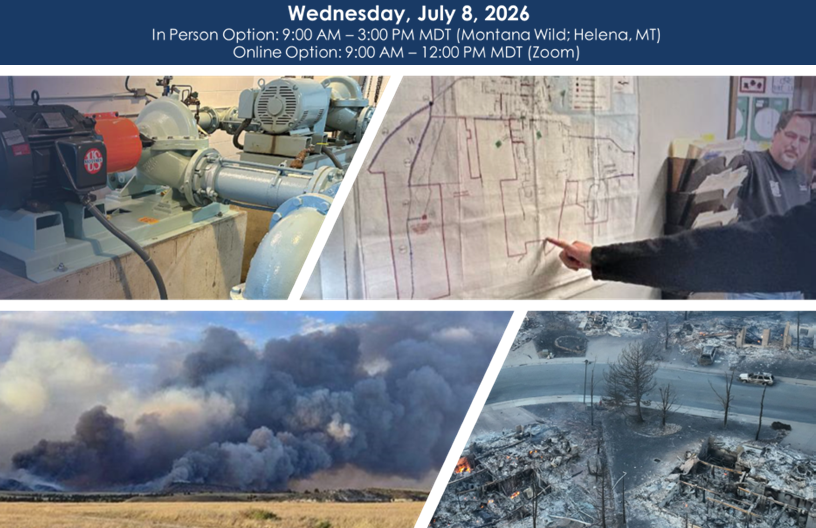
US EPA’s Strengthening Water Infrastructure for Tomorrow (SWIFT) initiative is hosting a free workshop highlighting the availability of no-cost technical assistance support through EPA SWIFT, natural hazard resilience, watershed health, and funding opportunities for drinking water, wastewater, and stormwater (water sector) utilities in Montana and neighboring states.
- Learn about the FREE natural hazard risk assessment technical assistance available for water sector utilities through EPA SWIFT.
- Review drought, wildfire, flooding, and other natural hazard data and explore tools to support risk-informed infrastructure planning and investment.
- Learn about local watershed health and management.
- Gain insights into federal, state, and local funding and assistance programs for water sector utilities and build meaningful connections with experts.
Attendees can register to attend either the full-day, in-person workshop or abbreviated online option. Continuing education units (CEUs) will be available for Montana, Idaho, and Wyoming drinking water and wastewater utility operators that attend in-person only. However, upon request, certificates of attendance and other supporting documentation can be provided for virtual attendees who wish to individually pursue CEUs from their certifying organization.
Webinar Details
- Date: Wednesday, July 8, 2026
- Time: 9:00 a.m. – 3:00 p.m. Mountain Standard Time
|
|
Mitigating Insider Threats at Water Utilities
Insiders—current or former employees, contractors, or other trusted partners with authorized access—can intentionally or accidentally disrupt utility operations. This webinar, hosted by the U.S. Environmental Protection Agency (EPA) and the Cybersecurity and Infrastructure Security Agency (CISA), will:
- Explain potential consequences of insider actions for drinking water and wastewater systems
- Share practical, cost‑effective strategies to reduce insider risk
- Highlight free tools and resources from EPA and CISA to strengthen security and operational resilience
Who Should Attend
- Drinking water and wastewater utility owners and operators
- State, local, Tribal, and territorial drinking water/wastewater program staff
- Water sector associations and organizations
For questions or additional information, email OWERC-Outreach@epa.gov
Webinar Details
- Date: Thursday, July 9, 2026
- Time: 1:00 p.m. – 2:00 p.m. Mountain Standard Time

|
|
Public Water System Facility and Contact Changes
Please contact EPA Region 8 Drinking Water Program if your system has a change in the treatment process; you add or remove a water source; there is a change in the number of people served or the number of water connections; or different contact information becomes available for your water system. This allows us to keep you up to date on monitoring requirements and keeps our inventory current. Failure to notify EPA about water source or treatment changes may result in a violation.
|
|
|
EPA Region 8 Drinking Water Program Contacts
- Kyle St Clair, Wyoming Liaison – 303-312-6791 – stclair.kyle@epa.gov
- Rob Parker, Field Services and Tribal Section Supervisor – 303-312-6664 – parker.robert@epa.gov
- Seth Tourney, Rule Implementation Section Supervisor – 303-312-6579 – tourney.seth@epa.gov
- Ándie Trujillo Guajardo, Partnerships and Data Section Supervisor – 303-312-6454 – guajardo.andrea@epa.gov
- If there is an after-hours or holiday emergency, please call 303-312-6327.
Questions related to a specific newsletter article, please contact:
|
|
|
|
|
|