|
EPA Region 8 Wyoming Drinking Water
Monthly Newsletter
December, 2025
|
|
|

|
Photo Credit: Lucien Gassie, Wyoming Sanitary Survey Rule Manager. Photo taken near Grand Teton National Park, Wyoming.
|
|
|
2026 Calendar Year Monitoring and Reporting Requirements Kickoff
The 2026 Calendar Year Monitoring and Reporting Requirements Kickoff season has officially started! You should have received an email the afternoon of Tuesday, November 25, 2025, requesting you review your current information and update as necessary. Starting in 2026, your monitoring and reporting requirements will look different. Please see the presentation here for additional information.
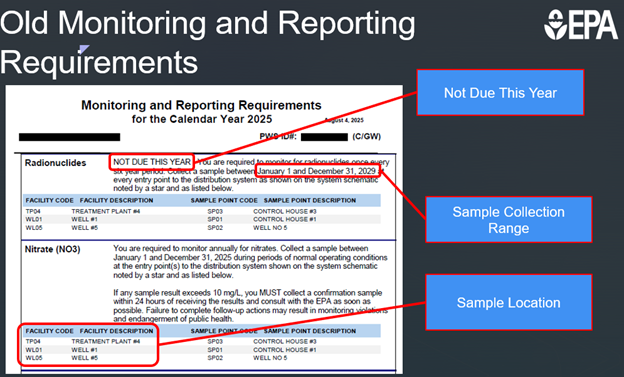
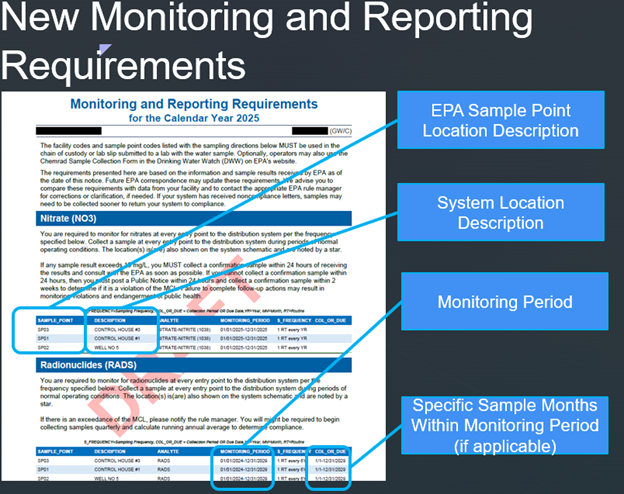 If you have any questions regarding changes to your system or the new monitoring and reporting requirements, please contact Angela Mendrala at mendrala.angela@epa.gov.
|
|
Cybersecurity Alert - Security Vulnerability Affecting FortiWeb Products
This alert is to inform water and wastewater system owners and operators about the active exploitation of a newly disclosed vulnerability in Fortinet FortiWeb - a web application firewall. Currently, there is no indication this vulnerability directly implicates OT systems and would not compromise a water utility's ability to provide clean and safe water, hence the medium level designation.
|
|
Free Natural Hazard Risk Assessment Technical Assistance from EPA's Strengthening Water Infrastructure for Tomorrow Initiative
As a drinking water, wastewater, or storm water (water sector) utility or stakeholder, to inform you of an upcoming opportunity to receive free natural hazard risk assessment technical assistance from EPA’s Strengthening Water Infrastructure for Tomorrow (SWIFT) Initiative.
SWIFT provides location-specific natural hazard data and practical risk assessment tools to identify and evaluate resilient strategies. Technical assistance under SWIFT promotes a better understanding of natural hazard threats and their impacts on vulnerable assets, providing the guidance needed to make risk-informed infrastructure and investment decisions. SWIFT also makes connections to infrastructure financing that help utilities fund the implementation of their hazard resilience projects.
If you are interested in receiving SWIFT technical assistance, please contact Aliza Furneaux (furneaux.aliza@epa.gov).

|
|
EPA Announces $7 Billion in Newly Available WIFIA Funding and Five New WIFIA Loan Approvals
On November 20th, U.S. Environmental Protection Agency (EPA) announced $6.5 billion in Water Infrastructure Finance and Innovation Act (WIFIA) funding available for water systems, with an additional $550 million available to states. Interested entities can apply for this funding through a rolling application process. The agency is also announcing approval of five new WIFIA loans that will invest in critical water infrastructure projects in Texas, Illinois, Oregon, and Florida. EPA’s WIFIA program provides a powerful financial tool that can significantly accelerate investments in water infrastructure to protect human health and the environment while saving communities millions of dollars.
|
|
EPA Announces $3 Billion in New Funding for States to Reduce Lead in Drinking Water
On November 25th, U.S. Environmental Protection Agency (EPA) announced $3 billion in new funding for states through the State Revolving Fund (SRF) programs to reduce exposure to lead in drinking water. EPA conducted a thorough review of previously awarded funding and assessed updated lead service line data to increase accountability and ensure funds are properly distributed to achieve maximum impact in removing lead pipes and reducing lead contamination in drinking water systems. This funding will accelerate progress in finding and removing lead pipes (also known as lead service lines that deliver water to homes, schools, and businesses) as the agency also announces a new lead service line inventories dashboard with the latest information provided by states. Lead pipes are the key source of lead—a potent neurotoxin particularly harmful to children—in drinking water.
|
|
EPA Proposes Changes to Make PFAS Reporting Requirements More Practical and Implementable, Reducing Regulatory Burden
On November 10th, U.S. Environmental Protection Agency (EPA) released a proposal to improve the scope of its perfluoroalkyl and polyfluoroalkyl substances (PFAS) reporting regulations under the Toxic Substances Control Act (TSCA) to make them more practical and implementable and reduce unnecessary, or potentially duplicative, reporting requirements for businesses while maintaining the ability to obtain important use and safety information on PFAS.
|
|
Public Water System Facility and Contact Changes
Please contact EPA Region 8 Drinking Water Program if your system has a change in the treatment process; you add or remove a water source; there is a change in the number of people served or the number of water connections; or different contact information becomes available for your water system. This allows us to keep you up to date on monitoring requirements and keeps our inventory current. Failure to notify EPA about water source or treatment changes may result in a violation.
|
|
|
EPA Region 8 Drinking Water Program Contacts
- Kyle St Clair, Wyoming Liaison – 303-312-6791 – stclair.kyle@epa.gov
- Rob Parker, Field Services and Tribal Section Supervisor – 303-312-6664 – parker.robert@epa.gov
- Seth Tourney, Rule Implementation Section Supervisor – 303-312-6579 – tourney.seth@epa.gov
- Ándie Trujillo Guajardo, Partnerships and Data Section Supervisor – 303-312-6454 – guajardo.andrea@epa.gov
- If there is an after-hours or holiday emergency, please call 303-312-6327.
Questions related to a specific newsletter article, please contact:
|
|
|
|
|