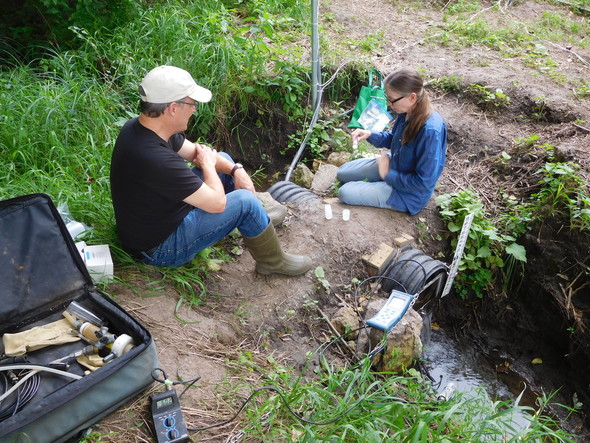
 The League of Women Voters was a recent winner of the Nutrient Sensor Action Challenge. They demonstrated how an edge-of-field sensor system could support farmers in reducing nitrogen loss from their fields. Learn more about all the winners below.
EPA Research Updates
Harmful algal blooms can have significant impacts on human health, aquatic ecosystems, and the economy. EPA researchers are using satellite data to better track algal blooms to help local and state water quality managers make faster and better-informed management decisions. Read about their work in a recent article from Wisconsin Public Radio.
Millions of Americans will be exposed to smoky conditions from wildfires this year. Experts, including EPA researchers Dr. Wayne Casio and Dr. Ana Rappold, recently discussed the health effects of exposure to wildfire smoke, as well as what you can do to protect yourself.
Excess nutrients are one of our country’s most widespread and challenging water quality problems. EPA and partners are focused on improving nutrient management by incentivizing the development of low cost technology solutions such as nutrient sensors. Read about the winners of the recent Nutrient Sensor Action Challenge.
It’s important to always follow the instructions on labels when applying pesticides. Misusing pesticides can result in indoor contamination which may harm the health of users and require special clean-up. EPA researchers evaluated procedures to more effectively manage clean-up when pesticides are used incorrectly.
We’re looking for teams of college students working to design solutions for a sustainable future. Submit an application for our P3 program to research, develop, design, and demonstrate solutions to real-world challenges.
Meet Our Researchers

Meet EPA Scientist Sherri Hunt, Ph.D.
Dr. Sherri Hunt is a senior scientist in the Office of Research and Development’s new Office of Science Advisor, Policy, and Engagement and the new coordinator for the Science and Technology Policy Council. Learn more about her work.
|
Events
Science Matters is produced by the U.S. Environmental Protection Agency, Office of Research and Development. All content is copyright free and can be reprinted without permission.
Questions or comments? Send us an email.
EPA Research | EPA Science Matters
|