New Outreach Material from EPA
It’s Lung Cancer Awareness Month!
Radon and Lung Cancer
Radon is the second leading cause of lung cancer in the United States and is responsible for about 21,000 lung cancer deaths each year. It is a naturally occurring gas that can build up in your home. It is both colorless and odorless, so the only way to know if you have high levels in your home is to test.
Testing for radon is easy, inexpensive and you can do it yourself or hire a qualified radon testing professional. Test kits can be purchased online. Contact your state or tribal radon program for advice.
Learn more about radon.
New Radon Outreach Materials
EPA’s Indoor Environments Division is pleased to announce new radon outreach materials available online. New materials include ready to use social media posts, and graphics that highlight how radon can impact your health and how to test for and mitigate radon.
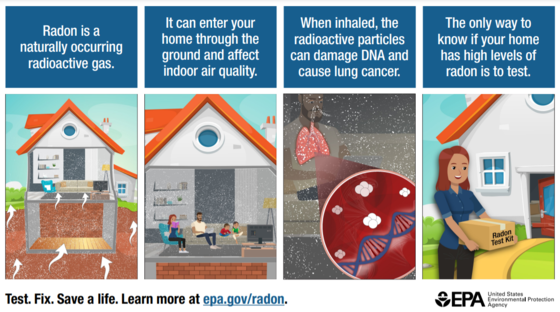 Learn more about radon and radon health risks.
Indoor airPLUS
The Indoor airPLUS Program improves the quality of air in homes by requiring construction practices and product specifications that minimize exposure to airborne pollutants and contaminants like radon. Indoor airPLUS specifications include radon-resistant construction techniques in areas with high radon potential.
Learn more about the benefits of an Indoor airPLUS home.
|
Secondhand Smoke and Lung Cancer
Secondhand smoke is a mixture of the smoke given off by the burning of tobacco products, such as cigarettes, cigars or pipes and the smoke exhaled by smokers.
Secondhand smoke can cause lung cancer among nonsmokers. The 2006 Surgeon General’s Report, The Health Consequences of Involuntary Exposure to Tobacco Smoke, indicates nonsmokers who are exposed to secondhand smoke may increase their risk of developing lung cancer by 20-30%. There is no safe level of exposure to secondhand smoke.
Learn more about secondhand smoke.
What You Can Do
Establish and enforce smoke-free rules in your home and car.
Many multifamily housing buildings are adopting smoke-free policies. Your state or local health department may be able to provide you with information on smoking prohibition policies and other restrictions in your area.
|