A Clean Start: Controlling Viruses and Bacteria in Schools with Healthy Cleaning Practices
Part 1: Practical Recommendations for Implementing Effective Cleaning and Maintenance
You asked, we answered! The US Environmental Protection Agency (EPA) Indoor Environments Division received many questions from the recent webinar Cleaning Schools to Control for Viruses and Bacteria: Maintaining Healthy Indoor Learning Environments that were not able to be answered during the presentation. Over the summer, questions will be answered in the Schools IAQ Connector series: A Clean Start: Controlling Viruses and Bacteria in Schools with Healthy Cleaning Practices.
Q&A: Proper Cleaning Procedures
 |
Question: How can I implement all the information I learned from the webinar? How can my school institutionalize the proper cleaning procedures? And most importantly, how can we engage custodians, facilities, teachers, staff, and school administration to ensure healthy indoor environments in our schools?
|
|
Answer: Our expert speakers emphasized that an effective cleaning plan is more important now than ever. An effective cleaning and maintenance plan, however, is only one component of an indoor air quality (IAQ) management program. Good IAQ is an important component of a healthy indoor environment and can directly impact student health and academic performance.
|
Building Your IAQ Program
Learn how to build your IAQ program today using the resources below to guarantee a healthy indoor environment in your school tomorrow.
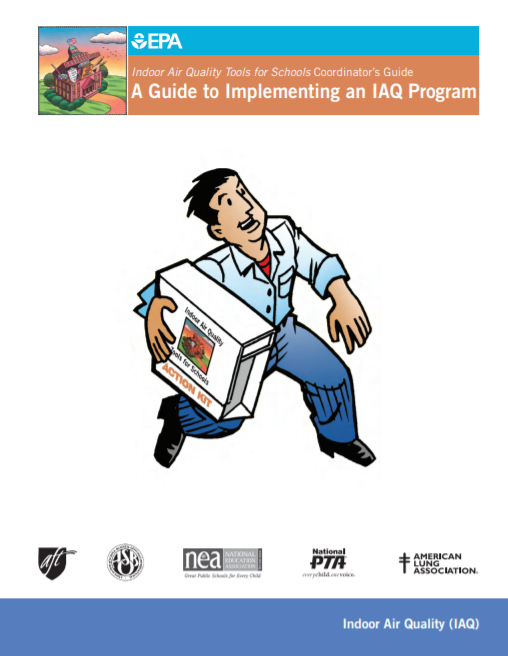
| Develop Your Plan: The IAQ Tools for School Coordinator’s Guide outlines the steps to develop not only your cleaning plan, but also your entire IAQ program. |
|
Familiarize yourself with IAQ issues: A great starting place is EPA’s IAQ website and IAQ in schools website!
Commit to and gain support for an IAQ program: Write your “elevator pitch” to focus your goals and describe the benefits of healthy indoor environments for student health and performance using the Value Proposition Worksheet. Learn more how to effectively make your case by clearly communicating return on investment (ROI) of comprehensive IAQ management.
Select an IAQ coordinator and form an IAQ team: Gather your champions! Developing an effective cleaning and disinfecting plan requires cross-disciplinary coordination across multiple departments and functions. From teachers and principals, to administrative staff, facility operators, custodians, and school nurses, to parents and the school board, everyone has a role to play in creating healthy learning environments.
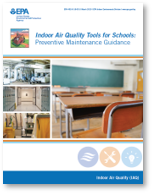
Gather information on IAQ: Become an IAQ super-sleuth! Conduct walkthroughs of the school and engage your senses to see, hear, and smell IAQ problems. Use the checklists from the Action Kit and the Preventive Maintenance Guidance to guide your detective work.
Establish your IAQ management plan: Use the model plans in the IAQ Tools for Schools Coordinator’s Guide and the Preventive Maintenance Guidance as starting points.
|
|
Implement Your Plan: Find resources to help make your plan a reality!
|
 |
IAQ Problem Solving Tool: How are health complaints connected with IAQ? Use the IAQ Problem Solving tool to see possible IAQ causes of common health symptoms and complaints.
IAQ Technical Solutions: Technical solutions related to common IAQ problems can be found on the IAQ in Schools website.
IAQ Preventive Maintenance Model Plan: IAQ Preventive Maintenance Model Plan will guide you through the 4 Steps critical to successfully implementing your plan.
Measurements and Statistics: Keep track of your progress through measurements and statistics by creating an equipment inventory, preventive maintenance timeline, measurements tracking sheet, and health statistics log.
|
|
Maintain and Revise Your Plan: Build on your plan and strive for continuous improvement! Keep the following in mind as your program grows:
|
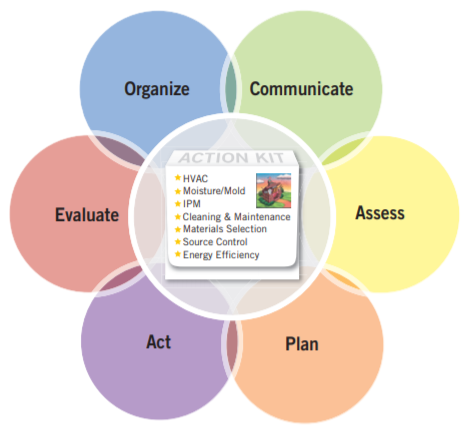 |
The Framework is your guide to success: Six Key Drivers constitute the Framework for the IAQ Tools for Schools approach and will help to launch, reinvigorate, and sustain an effective IAQ management program in any school, regardless of location, size, budget, or condition.
Put the Framework into action: The IAQ Tools for Schools Reference Guide details the full cycle of IAQ management, from understanding the problem to diagnosing and solving the issue.
Be proactive and predictive with preventive maintenance: Prevent IAQ problems before they start by following the Preventive Maintenance Guidance. Learn about taking a comprehensive approach to IAQ management through preventive maintenance to promote healthy, reliable, and efficient school buildings in the on-demand webinars From Roof to Curb and A Proactive Approach to IAQ.
|
|
Find Additional Resources: Use additional resources to help develop, implement, and maintain your cleaning and maintenance plan as part of your IAQ management program.
|
 |
ROI of green cleaning: Learn how to utilize data tracking and evaluation strategies to develop a business case, value proposition, and communication strategy that generates broader acceptance of, compliance with and funding for green cleaning in the on-demand webinar, Green Cleaning for Improved Health.
Technical solutions: Get an overview of best practices in effective cleaning and maintenance on the IAQ in Schools website. Learn how to control pollutants using materials selection and source control in the IAQ Design Tools for School guide.
Create an “owner’s manual”: Create an owner’s manual that contains all the information needed to maintain the school and its equipment. Include training materials for staff, a maintenance schedule, and instructions on the proper handling and use of all cleaning products within the school.
Join the IAQ Master Class: Learn about how effective cleaning and maintenance can improve health outcomes in your school by viewing the on-demand webinar, Clean Bill of Health. Complete all ten IAQ Master Class Professional Training webinars developed by the EPA in collaboration with the School Health and Indoor Environments Leadership Development (SHIELD) Network and receive a certificate that recognizes your efforts toward IAQ mastery!
Expand knowledge, take action: View the IAQ Knowledge-to-Action Professional Training webinars to learn how the knowledge gained in the IAQ Master Class Training Webinars can be translated into actionable steps. The Green, Clean and Healthy and Insights from the Experts webinars focus on healthy green cleaning.
|
Spread the word! Forward this email to a colleague. 
Questions?
EPA offers free IAQ Tools for Schools resources—including the School IAQ Assessment Mobile App—to help schools maintain a healthy indoor environment by identifying, correcting and preventing IAQ problems. Learn more about the IAQ Tools for Schools guidance and access other valuable school environmental health resources at www.epa.gov/iaq-schools.
If you have any questions about the IAQ Tools for Schools guidance, please contact the IAQ Tools for Schools Connector Coordinator at iaqschools@epa.gov.
|