|
Prevent Asthma Triggers and Other IAQ-Related Issues
With Preventive Maintenance!
|
The Indoor Air Quality (IAQ) Tools for Schools: Preventive Maintenance Guidance can help you plan ahead and prevent IAQ issues—such as the generation of asthma triggers—before they occur. Learn the value of IAQ preventive maintenance from the experiences of champion school districts like North East Independent School District in Texas, whose program works to lower the number of missed school days for students with asthma by reducing asthma triggers.
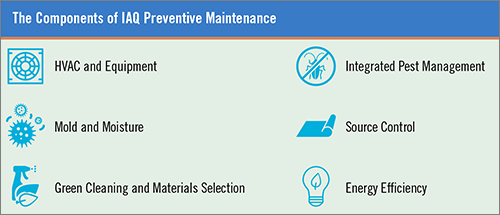
Browse the guidance and use the components of IAQ preventive maintenance to help address your school’s unique IAQ challenges.
|
 |
 |
HVAC and Equipment
Monitoring your school’s HVAC system using preventive maintenance is like an early warning system—doing so will help you find problems before they find you. When your HVAC system is working correctly, your facilities have better air circulation and odor control, as well as a reduced level of pollutants.
|
 |
Mold and Moisture
The best way to control indoor mold growth is to control moisture. Mold can cause a variety of health problems, increase allergic reactions and cause asthma attacks. Facility neglect often leads to moisture problems, especially when roofs, plumbing or ventilation systems are not routinely inspected.
|
 |
Green Cleaning and Materials Selection
Green cleaning products and maintenance practices can increase a school building’s life span and cut unexpected costs. They also can be less harmful to student and staff health and IAQ than traditional products and practices.
|
 |
Integrated Pest Management
Pests can be a major, hard-to-manage problem in schools. Not only can they damage school facilities, they also can cause IAQ and health problems for students and staff. Deferring maintenance of your building can cause it to start deteriorating, which gives pests easy entry points, such as wall cracks, and ideal living situations, such as leaky areas or poorly cleaned spaces.
|
 |
Source Control
Eliminating or reducing individual pollution sources, such as chemicals, radon, pesticides, emissions, etc., can improve IAQ and student and staff health. Source control is critical for reducing pollutant exposures and expensive accidents.
|
 |
Energy Efficiency
There is a close connection between IAQ, energy efficiency and preventive maintenance and how they affect the school environment. Poor energy management can create IAQ problems and lead to poor ventilation in occupied spaces. Preventive maintenance plans can include proactive actions to improve energy efficiency while ensuring that IAQ is protected.
|
Including preventive maintenance as a part of your IAQ management in schools will present new opportunities to elevate your current practices to become more proactive and predictive, achieving better facility performance, extending equipment longevity and avoiding costly repairs. By acting quickly to address IAQ issues as they arise, school districts can save money while protecting the health of students and staff members. Download the guidance and learn more today!

Spread the word! Forward this email to a colleague. 
Questions?
EPA offers free IAQ Tools for Schools resources—including the School IAQ Assessment Mobile App—to help schools maintain a healthy indoor environment by identifying, correcting and preventing IAQ problems. Learn more about the IAQ Tools for Schools guidance and access other valuable school environmental health resources at www.epa.gov/iaq-schools.
If you have any questions about the IAQ Tools for Schools guidance, please contact the IAQ Tools for Schools Connector Coordinator at iaqschools@epa.gov.
|