|
Use EPA guidance to implement
IAQ preventive maintenance in these four steps!
The Indoor Air Quality (IAQ) Tools for Schools: Preventive Maintenance Guidance can help you address specific IAQ issues and successfully implement each stage of an IAQ preventive maintenance plan. The sections of this guidance translate into four distinct and actionable steps that coordinate with the IAQ Tools for Schools Framework for Effective IAQ Management in Schools. Although these steps appear linear, they are interconnected and can be followed in any order that fits your situation. Depending on the actions that your school district already has taken to implement IAQ preventive maintenance best practices, you could start with any of these steps.

Step 1 will help you make the case to various funders, decision makers and stakeholders. Start by defining clear goals and objectives for your IAQ preventive maintenance program. Utilize the financing tools mentioned in the guidance to make a solid business case for cost savings. Use EPA’s Value Proposition Worksheet to develop your elevator pitch and demonstrate to your target audience that your proposed activities are critical to the district’s mission and worth funding/supporting.

Step 2 outlines the specifics of developing your IAQ preventive maintenance plan. The guidance describes methods to track equipment inventory, conduct walkthroughs and assessments, maintain and service equipment, and manage your processes and procedures effectively. Use EPA’s IAQ Preventive Maintenance Model Plan and IAQ Preventive Maintenance Checklist as a basis for tailoring products that meet the specific needs of your school district.

Step 3 addresses how to build a committed team positioned for success. The guidance outlines strategies for designating an IAQ Preventive Maintenance Coordinator, training staff, creating reports and recognizing success. A committed interdisciplinary team of valued professionals is necessary every step of the way—from the creation of the plan through its execution, review and refinement.

Step 4 explains the importance of continuously evaluating your program. The guidance provides strategies for assessing your program’s success, as well as sample equipment inventory lists and tracking sheet templates. These tools can help you track and measure the results of your activities, analyze those results, and document and communicate your success to others. Use the data you collect to refine your goals and redirect your investments to acquire the resources your program needs.

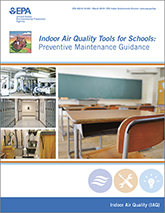 |
The Indoor Air Quality (IAQ) Tools for Schools: Preventive Maintenance Guidance and associated materials can help your school district take a holistic approach to preventive maintenance and IAQ management. Including preventive maintenance as a part of your IAQ management in schools will present new opportunities to elevate your current practices to become more proactive and predictive, achieving better facility performance, extending equipment longevity and avoiding costly repairs. By acting quickly to address IAQ issues as they arise, school districts can save money while protecting the health of students and staff members.
|
Spread the word! Forward this email to a colleague. 
Questions?
EPA offers free IAQ Tools for Schools resources—including the School IAQ Assessment Mobile App—to help schools maintain a healthy indoor environment by identifying, correcting and preventing IAQ problems. Learn more about the IAQ Tools for Schools guidance and access other valuable school environmental health resources at www.epa.gov/iaq-schools.
If you have any questions about the IAQ Tools for Schools guidance, please contact the IAQ Tools for Schools Connector Coordinator at iaqschools@epa.gov.
|