|
Schools for Health: Impacts of Indoor Air Quality on Students
John Spengler, Piers MacNaughton, Erika Eitland
Healthy Buildings Program at Harvard T.H. Chan School of Public Health
For more information, visit forhealth.org.
 With the warmer days behind us, the migration indoors begins. By winter, kids ages 11–17 will spend 60 minutes a day outdoors, compared to 175 minutes in the summer. For kids younger than age 11, the difference is even greater. At the same time, our facility managers prepare for the colder temperatures by sealing up schools and reducing ventilation rates to conserve energy. Current ventilation guidelines recommend lower per‑person ventilation rates in schools than in offices, despite increased occupant density and child physiological differences. This is further exacerbated by the lack of an indoor air quality management plan in more than 50 percent of schools, which were built on average 50 years ago. With the warmer days behind us, the migration indoors begins. By winter, kids ages 11–17 will spend 60 minutes a day outdoors, compared to 175 minutes in the summer. For kids younger than age 11, the difference is even greater. At the same time, our facility managers prepare for the colder temperatures by sealing up schools and reducing ventilation rates to conserve energy. Current ventilation guidelines recommend lower per‑person ventilation rates in schools than in offices, despite increased occupant density and child physiological differences. This is further exacerbated by the lack of an indoor air quality management plan in more than 50 percent of schools, which were built on average 50 years ago.
Given these trends, the Schools for Health team dove deeply into the more than 30 years of research to investigate the causes of poor air quality; the impacts on student health, thinking and performance; and the solutions to optimize ventilation and air quality in schools.
The recent report, Foundations for Student Success: How School Buildings Influence Student Health, Thinking and Performance, details the findings of the Team from the Healthy Buildings Program at Harvard T.H. Chan School of Public Health.
Below are some of the pollutant sources that may lead to poor indoor air quality if the building is not properly ventilated:
Indoor Sources
-
Cleaning products may contain phthalates, which are associated with allergies and asthma in schools.
-
Mold can form due to a lack of temperature and humidity controls, leading to asthma exacerbation, dizziness and headaches.
-
Accumulated dirt and dust may contain pest allergens, flame retardants, stain-repellent chemicals, radon, asbestos, polychlorinated biphenyls (PCBs) and heavy metals (e.g., lead, mercury), all of which are detrimental to young learners, who have been shown to ingest more dust and spend more time on the floor than adults.
-
School supplies can release volatile organic compounds (VOCs) and nose- and throat-irritating odors.
-
Kids release body odors, bring pet allergens from home on their clothes, spread infectious agents and contribute to high carbon dioxide (CO2) levels.
Outdoor Sources
-
Idling buses and vehicles result in buildups of diesel exhaust that affect local air quality and bus driver health. Diesel exhaust is associated with respiratory illnesses, allergies and asthma.
-
Wildfires cause smoke and other gaseous air pollutants to migrate indoors, resulting in school closures. For example, many schools closed in response to the wildfires in California and Canada this summer.
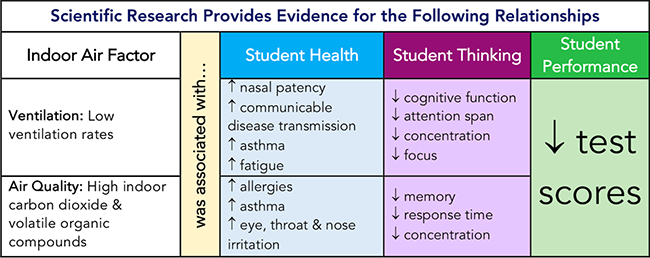
How indoor air quality and ventilation impact student health, thinking and performance:
What can you do to optimize indoor air quality?
To improve air quality in schools, either remove sources of air pollutants or deploy strategies to reduce pollutant concentrations through ventilation or filtration.
Remove Sources
- Many classroom supplies and cleaners emit VOCs, which can cause respiratory symptoms. Make sure these products are district approved, stored properly and used only when necessary.
- When purchasing supplies and cleaners, give preference to those that are third-party certified by programs like Green Seal or EPA’s Safer Choice.
- When conducting renovations and repairs, make sure work zones are properly contained and that low- or no-VOC sealants and paints are used.
- Institute bus idling policies.
Improve Ventilation
- If your school is mechanically ventilated, increase the MERV rating of the filters in your HVAC system. For example, MERV 13 filters will remove about 90 percent of fine particulate matter.
- If your school is naturally ventilated, open the windows to mitigate exposures to indoor sources. However, in cool climates or areas with poor outdoor air quality, portable filtration units may be a better solution to reduce the concentration of pollutants of both indoor and outdoor origin.
- Increasing ventilation rates will reduce concentrations of indoor gaseous pollutants, such as VOCs and CO2, which are not affected by filtration.

Spread the word! Forward this email to a colleague. 
Questions?
EPA offers free IAQ Tools for Schools resources—including the School IAQ Assessment Mobile App—to help schools maintain a healthy indoor environment by identifying, correcting and preventing IAQ problems. Learn more about the IAQ Tools for Schools guidance and access other valuable school environmental health resources at www.epa.gov/iaq-schools.
If you have any questions about the IAQ Tools for Schools guidance, please contact the IAQ Tools for Schools Connector Coordinator at iaqschools@epa.gov.
|