|
Did You Know?
DOE is exploring how advanced power electronics can make the electric grid more flexible and reliable. These technologies can regulate voltage and frequency, integrate new energy resources, and reduce losses across transmission lines. DOE estimates that reducing transmission and distribution losses by just 1% could save the United States more than $100 million annually. Learn more about how DOE is advancing power electronics for the grid.
|
|
|
You are receiving this email because you previously subscribed to communications from the U.S. Department of Energy’s former Solar Energy Technologies Office or Wind Energy Technologies Office. As part of the Office of Critical Minerals and Energy Innovation's (CMEI's) reorganization, these offices have merged to form the new Integrated Energy Systems Office. To update your subscription preferences or unsubscribe from future communications, please use the subscription management link.
This message was sent in accordance with federal email communication requirements.
|
|
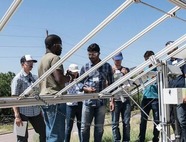
The National Laboratory of the Rockies is now accepting applications for its Hands-On Photovoltaic Experience (HOPE) Workshop on July 11–16, 2027. The workshop gives graduate students the opportunity to gain hands-on experience with photovoltaic research, work alongside leading solar researchers, and build connections with other students and professionals in the field. Participants will explore current photovoltaic technologies, research methods, and challenges while learning about career opportunities in the energy sector. Applications are open through Jan. 31, 2027.
|
|
|
The Tribal Energy Capacity Expansion Prize, designed to support the role of Tribal Nations in energy decision-making processes, recently opened for Phase 1 submissions. Intended for federally recognized Tribal entities and multi-Tribe collaborative teams, this $6 million, three-phase competition aims to increase resources and capabilities in sectors such as energy permitting, workforce development, and environmental compliance. Alaska Native villages and regional and village corporations are encouraged to apply.
To learn more about the prize and how to apply, follow the HeroX prize page. For a detailed overview and opportunity to ask questions about the prize, register for the informational webinar on Nov. 4, 2026, at 3 p.m. ET. Submissions are due by Dec. 4, 2026.
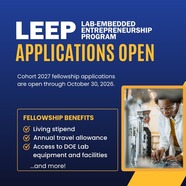
DOE has announced that applications are now open for the next cohort of the DOE Lab-Embedded Entrepreneurship Program (LEEP). The two-year fellowship gives early-stage entrepreneurs the opportunity to work alongside National Laboratory scientists and access world-class facilities, technical expertise, mentorship, and entrepreneurial resources to help advance their technologies toward commercialization. LEEP has created thousands of jobs and supported more than 200 startups that have attracted more than $6 billion in follow-on funding. Applications to the 2027 LEEP cohort are open through Oct. 30, 2026.
|
IESO and the National Laboratory of the Rockies (NLR) have launched the Energy District Cup, which invites multidisciplinary student teams to develop practical energy plans for college campuses or mixed-use districts. Teams will explore energy management, building systems, on-site generation, storage, electricity procurement, and energy management while gaining hands-on experience with the technical, financial, and planning decisions energy professionals face every day.
|
The U.S. Environmental Protection Agency (EPA) is seeking input on methods used to sample and test hazardous waste. The request for information asks for feedback on challenges with current methods and ways EPA could improve them. Solar panels are one example of a waste stream that can be difficult to sample because materials such as lead may not be evenly distributed throughout a panel. Feedback could help EPA improve how it evaluates these and other types of waste. The comment period is open through Nov. 14, 2026.
|
NLR has opened its 2026 Competitiveness Improvement Project request for proposals. Small- and medium-sized U.S. manufacturers can apply for funding and technical assistance to advance distributed wind energy technologies from early-stage design through certification and commercialization. This year’s opportunities also include new topic areas focused on power electronics and field validation.
released the 2026 U.S. Energy and Employment Report (USEER), which provides new data on the nation’s energy workforce. The report tracks energy employment at the national, state, and county levels, with the 2026 edition including additional information on wages, methodology, and anticipated hiring. The 2026 USEER’s new Future Outlook chapter highlights rising demand for skilled energy workers and growing competition for talent across energy and other expanding industries. These trends are opening new pathways to high-paying, skilled careers for American workers.
|
|
Research & Development Spotlight |
|
Researchers at Sandia National Laboratories, in collaboration with NLR and Lawrence Livermore National Laboratory, have developed a pioneering method for conducting virtual aircraft flight tests in realistic weather conditions using the same software used to model airflow and wind-tunnel simulations. The method can reduce the need for time-consuming and costly wind tunnel or physical tests. It allows engineers and designers to better define the range of conditions in which an aircraft can safely operate and refine vehicle designs more quickly. The technology could ultimately contribute to safer flights, even in severe weather conditions.
Creating these virtual flight tests requires combining two state-of-the-art modeling techniques. Researchers simulated large-scale weather phenomena then coupled the simulation results with high-resolution models of fluid flow around the vehicles. This approach more accurately calculates the vehicles’ structural and thermal dynamics than existing models.
|
|
|
DOE announced that applications are open until November 18 for the Energy Technology Innovation Partnership Project (ETIPP), which helps coastal, remote, and island communities develop more affordable, reliable, and secure energy systems through strategic energy planning and in-depth technical assistance.
|
|
IESO released the 2026 Space Photovoltaics (PV) Workshop Report, highlighting R&D priorities to advance space PV performance and reliability, strengthen domestic manufacturing and supply chains, and modernize testing and qualification. The workshop convened 78 participants from industry, federal agencies, national laboratories, and academia, who developed a phased roadmap for advancing U.S. space PV capabilities through 2035.
|
|
|
DOE recently announced the Space Photovoltaics (PV) Research and Development funding opportunity to support the advancement of mission-critical space PV capabilities within the United States. Up to $12 million will be awarded to selected research and development projects that address key challenges in durability, performance, cost, and manufacturing throughput for space PV technologies.
DOE's REMADE Institute awarded $4.8 million to 10 projects that will advance promising materials recovery, remanufacturing, and recycling technologies. The selected projects will move these technologies from successful laboratory demonstrations to commercial deployment.
|
|
DOE’s Office of Critical Minerals and Energy Innovation (CMEI) announced a Notice of Intent for up to $100 million to strengthen America’s critical minerals workforce, support U.S. affordable energy dominance, rebuild domestic supply chains, and reduce reliance on foreign adversaries for the materials that power modern energy, manufacturing, and defense technologies.
Three projects supported by IESO were named finalists for the 64th annual R&D 100 Awards, which highlights advances across laboratories, universities, and industry.
|
|
|
|
|






