|
|
Welcome to The Water Wire, a snapshot of all water power funding opportunities, upcoming events, and recent news. This month’s newsletter takes approximately 5 minutes to read.
Reach out to the U.S. Department of Energy’s (DOE’s) Hydropower and Hydrokinetic Office (H2O) at H2O@doe.gov with any inquiries or suggestions. Follow the Office of Critical Minerals and Energy Innovation’s (CMEI) X, Facebook, and LinkedIn channels for news, announcements, and water power content. Connect with CMEI's Energy Technology Pillar through it's new LinkedIn account.
|
|
Did You Know?
The O.H. Hinsdale Wave Research Lab was featured in a recent episode of Changing Seas TV on PBS. The research lab has hosted critical tests for many H2O-funded projects while providing research, testing, and education opportunities for ocean-based industry stakeholders to improve the resilience and sustainability of coastal areas.
|
|
H2O Announcements and Features |
|
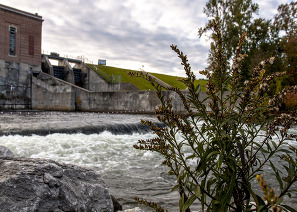
DOE’s HyTN is accepting applications from hydropower technology developers looking to test and validate innovative technologies. HyTN aims to raise the technology readiness of hydropower innovations by connecting technology developers to testing facilities to accelerate research, development, and deployment. Explore the testing facilities in the network and apply to be matched with a provider by July 23, 2026.
|
The NAVFAC EXWC has opened an award that aims to deliver specialized facility, ocean system, and expeditionary solutions to the U.S. Navy through research, development, testing, and evaluation. Topic area 12, titled “Marine Energy Development,” requests that applications submitted under this section advance energy generation, storage, management, and distribution in the marine environment. Applications for this award will be reviewed every three months until June 14, 2027.
DOE’s Office of Indian Energy’s (IE’s) $50 million NOFO is aimed at fostering affordable, reliable, and secure energy solutions for Tribes across the United States. This investment will support Tribal-led community-scale energy project planning and development as well as large-scale energy project planning. IE is currently soliciting applications from Indian Tribes with full applications due by July 24, 2026. |
|
 |
To help modernize American canals and waterways that support almost 60 million acres of agriculture, the Idaho National Laboratory (INL) and PNNL developed IrrigationViz, an online software tool to help water users explore modernization options. First introduced to water power stakeholders in 2021, the tool’s success and popularity have allowed developers to add new abilities that will further support American power generation and water preservation efforts.
H2O has conducted studies, engaged with industry stakeholders to understand testing needs, and launched a new testing program to better understand and further the state of hydropower testing in the United States. Through these efforts, H2O has uncovered common roadblocks and begun to develop solutions that will help improve American hydropower stability and reliability.
|
|
Hydropower Office and National Lab Events
TODAY July 15, 2026 at 2 p.m. ET
H2O staff will join an EnergyWerx webinar focused on the HyTN Round 2 voucher opportunity for HyTN recipients. The webinar will provide potential applicants with an overview of the opportunity and a chance to ask questions.
July 30, 2026 at 2:00 p.m. ET
H2O staff have spent the last six months undertaking stakeholder engagement with the hydropower industry and academia to better understand the testing needs of the sector. Join this final webinar to hear the results of the stakeholder engagement and help validate the findings that will guide H2O’s approach to hydropower testing in the coming years.
August 11, 2026 at 3 p.m. ET
Since March 2026, the Small Underwater Research Flap Wave Energy Converter (SURF-WEC)—a 1m x 1m oscillating surge device—has been successfully deployed off the coast of Oahu, Hawaii. Developed by the National Laboratory of the Rockies (NLR) in partnership with the Hawai'i Marine Energy Center, this project represents a significant step forward in small-scale wave energy technology. Join the upcoming webinar for an in-depth overview of the SURF-WEC project. The SURF-WEC team will walk through the entire lifecycle—from design and build to testing, marinization, and deployment—and share critical lessons learned to help advance the wider marine energy community.
|
|
|
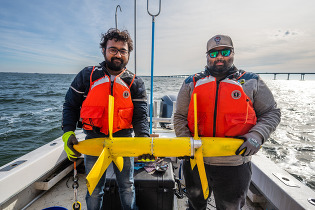
In a recent publication, PNNL outlined a project that developed a new protective cover, called a flow shield, for underwater microphones (hydrophones). In the field, hydrophones often pick up rushing noises made by fast-moving water in river and tidal areas, making it difficult for scientists to determine the sound made by marine energy devices and how it may impact wildlife. The flow shields were confirmed to be highly effective in laboratory and field testing, reducing background noise by over 20 decibels.
The Eastern Band of Cherokee Indians (EBCI) worked with Oak Ridge National Laboratory to study environmentally conscious micro-hydropower options. The EBCI deeply values protecting tribal lands and water, so developing small, modular water power systems designed to generate power with minimal impact on the surrounding ecosystem is a priority for EBCI. The project used laser imaging and remote sensing to map regional streams in high detail, evaluating over 500 potential sites to see if they could be leveraged to generate affordable energy.
A recent study published by NLR evaluated whether highly miniaturized mooring system models, at a 1/100th-scale, can be used to accurately predict how full-sized, real-world systems will behave in the ocean. The study found that while these models were extremely useful in determining general trends, they cannot accurately measure the actual physical forces or rapid tension changes that real-world mooring systems would experience when deployed
|
|
|
|
|