Upcoming Deadlines
-
Oct. 18, 2024, is the deadline to submit proposals for the Ocean Energy Safety Institute’s Request for Proposals II, which seeks projects from the marine energy sector.
-
Oct. 23, 2024, is the deadline to submit full applications for the Water Power Innovation Network funding opportunity.
-
Oct. 25, 2024, is the deadline to submit concept papers for the Oceans of Opportunity funding opportunity.
-
Nov. 8, 2024, is the deadline to submit nominations for the University Marine Energy Research Community’s (UMERC’s) board of directors.
-
Dec. 6, 2024, is the deadline to submit applications for the Marine Energy Fellowship program for those interested in beginning their fellowships in summer 2025.
-
Dec. 13, 2024, is the deadline for nonprofit science, technology, engineering, and math organizations to apply to the Clean Energy Careers for All program.
Looking for more detailed information on the latest funding opportunities and events related to water power? Make sure you subscribe to The Water Wire! Find the next issue in your inbox on Nov. 13, 2024.
Announcements
This five-year investment will significantly accelerate the design, fabrication, and testing of multiple wave energy converters. It will help identify and mature high-potential technologies, reduce financial risks for developers, incentivize investors, progress technologies at smaller scales while developing toward utility scale, and increase learning for installation, operations, and maintenance. Concept papers are due by 5 p.m. ET on Oct. 25, 2024.
UMERC is now accepting nominations to fill vacant seats on its board of directors. UMERC aims to increase collaboration among U.S. marine energy researchers. Open positions include two university research seats, one national laboratory seat, and one blue energy cluster seat. Terms last for two years and will begin on Dec. 1, 2024. Self-nominations will be accepted. The call for nominations closes on Nov. 8, 2024.
The Marine Energy Fellowship program connects participants with leading scientists and researchers and allows them to gain insight into marine energy career and research opportunities. The program now features a two-track structure: one for graduate students working on marine energy-focused research theses or dissertations and a new post-graduate track for recent graduates focused on advancing their careers in marine energy. Applicants who would like to begin their fellowship in summer 2025 must submit their applications by 5 p.m. ET on Dec. 6, 2024, and applicants who prefer to start in fall 2025 must submit their applications by 5 p.m. ET on March 7, 2025.
The Clean Energy Careers for All program will award nearly $3 million to non-profit science, technology, engineering, and math organizations in support of their workforce development initiatives targeting K–12 and university students, alumni and academic professionals, veterans, and formerly incarcerated individuals. Register for the informational webinar TODAY, Oct. 16, 2024, and apply for the program by 5 p.m. ET on Dec. 13, 2024.
WPTO announced funding for 25 small business-led hydropower and marine energy projects through Phase I and Phase II of the Small Business Innovation Research and Small Business Technology Transfer program. These projects can help to accelerate the growth of water power innovation and technology.
This funding includes nearly $25 million for 25 hydropower and marine energy R&D projects across six DOE national laboratories. This includes six marine energy projects focused on modeling for wave and current energy converters and a testing facility for mooring lines and umbilical cables, among other topics. It also includes six "Sapling" projects supported through WPTO's Seedlings and Saplings program, which encourages and supports new and innovative research ideas at DOE’s national laboratories.
Project Updates and Stories
The National Renewable Energy Laboratory (NREL) updated its Marine Energy Risk Management Framework, first launched in 2015. This 2024 revision aims to help reduce risks in marine energy projects and boost the development of innovative technologies. The framework addresses key uncertainties in areas like technology, regulation, and commercialization, improving the chances of success for projects at all stages of development.
Recent updates to the Marine and Hydrokinetic Toolkit (MHKiT)—developed by NREL, Pacific Northwest National Laboratory, and Sandia National Laboratories—enhance its applicability for tidal turbine developers. These updates enable modeling of extreme sea states, visualizing river flow and turbulence, and standardizing measurement data. Designed to save time and reduce costs for engineers and researchers, MHKiT helps improve marine energy technologies, making them more reliable and better suited to withstand extreme weather conditions.
|
DOE welcomed 25 communities into the Energy Transitions Initiative Partnership Project (ETIPP), marking its largest and most geographically diverse cohort yet. ETIPP provides direct funding and technical assistance to help communities overcome unique energy challenges and advance clean energy solutions. Partnering with national labs and regional organizations, ETIPP aims to enhance energy resilience, affordability, and sustainability across the United States and its territories.
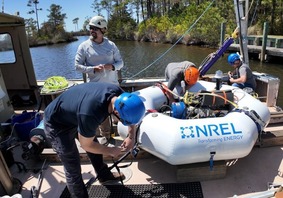
For the University of Washington, support from the Testing Expertise and Access for Marine Energy Research program enabled testing of several environmental monitoring technologies. Researchers were able to deploy and further develop their technologies and equipment, advancing the field of marine energy and enabling other researchers and technology developers to better understand how marine life interacts with deployed devices.
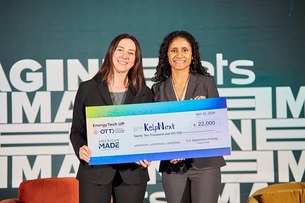
In April 2024, two young women walked onto a stage in Austin, Texas, to accept an oversized check. Embodying an entrepreneurial ambiance, Jessica Beck and Samantha Jayasundera earned this $22,000 prize thanks to inspiration from a slimy, mud-colored algae called kelp. For about three months, the budding engineers had been refining a business plan for a technology that could mimic these squiggly ocean plants to generate clean energy, help restore ocean ecosystems, and protect coastal communities from natural disasters.
|
WPTO Events
Feb. 10–14, 2025
Registration will open in the fall for WPTO's 2025 Peer Review. The purpose of peer review is to evaluate WPTO-funded projects based on their contributions to the office’s mission and goals, track progress made against stated objectives, and assess the office’s overall management and performance.
EnergyTech University Prize Informational Webinars
-
Oct. 24, 2024, 1–2 p.m. ET: This prize introduction webinar will familiarize students and faculty with the 2025 EnergyTech University Prize. Registrants will learn more about key prize details, important dates, submission materials, and more. The webinar will conclude with a live Q&A.
-
Dec. 10, 2024, 1–2 p.m. ET: This track details webinar will cover important information for the 2025 round of the EnergyTech University Prize. Students and faculty alike will learn more about key prize details, important dates, submission materials, and more. The webinar will conclude with a live Q&A.
In Case You Missed It
In August, WPTO hosted a stakeholder webinar focused on artificial intelligence and machine learning and their potential use across the water power sector. Two guest speakers from DOE's new Office of Critical and Emerging Technologies also joined the webinar to talk about their office's role working with DOE and its national laboratories, which involves identifying potential uses for artificial intelligence in the energy sector and ensuring those uses are developed safely. Learn more about these topics and check out the webinar recording.
In a new video, Sandia National Laboratories highlights its work through a WPTO-funded project to develop a wave energy converter that can support the Coastal Pioneer Array, one of five arrays that make up the U.S. National Science Foundation's (NSF's) Ocean Observatories Initiative. This NSF-funded major research facility collects open-source data from more than 900 instruments to address questions about the ocean. Sandia is working with engineers from Woods Hole Oceanographic Institution, Evergreen Innovations, Johns Hopkins University, East Carolina University, Monterey Bay Aquarium Research Institute, and NREL.
Follow along on the Office of Energy Efficiency and Renewable Energy's Twitter, LinkedIn, and Facebook channels for more water power content each week.
Making a Splash in the News
Climate Solutions: 2 Kinds of Ocean Energy Inch Forward off the Oregon Coast
—Associated Press, Claire Rush and Jennifer McDermott, Sept. 24, 2024
Marine Energy Technology Development Risk Management Framework
—NREL, David Snowberg, Ritu Treisa Philip, and Jochem Weber, Sept. 23, 2024
Pacific Northwest National Laboratory Vessel Dedicated at Ceremony
—Peninsula Daily News, Matthew Nash, Sept. 20, 2024
U.S. Rolls Out Largest Wave Power Fund in Its History To Step Up the Ocean Energy Game
—Offshore Energy, Zerina Maksumic, Sept. 20, 2024
'State of the Science' Report Updates on Marine Energy Environmental Effects
—Hydro Review, Elizabeth Ingram, Sept. 19, 2024
SLB OneSubsea Signs MoU With C-Power To Develop Wave Energy System
—Offshore Magazine, Staff Writer, Sept. 16, 2024
Wave and Tidal Energy: Key to Net-Zero Future
—International Water Power and Dam Construction, Sept. 16, 2024
'It's Been a Huge, Huge Effort': Wave Energy Testing Site Nearing Completion off the Oregon Coast
—KGW8, Kale Williams, Aug. 28, 2024
|