|
|
Estimated reading time: 8 minutes
|
|
|
No matter when you last set foot in a classroom, September always feels like back-to-school season. It’s around this time of year that I think back to the origins of my love for geothermal energy. For me, it began in the ground—an early fascination with the Earth led to the academic interests that would become a lifelong journey to learn what exactly was going on beneath my feet. Every September I take time to remember and appreciate the schools and teachers that helped me along my path, something I hope the Geothermal Technologies Office (GTO) can do for the next generation of students.
Geothermal energy is its own kind of educator—it teaches us about flexibility, in both a literal sense and in the ways we study and use it. The resourcefulness of researchers, engineers, and data scientists allows us to imagine ways to leverage existing knowledge and infrastructure, as is being explored in our GEODE initiative which launched last week in Houston, TX. Fostering diversity in the growing geothermal workforce—through initiatives like the Geothermal Collegiate Competition and the Geothermal INTERN opportunity—ensures a range of creative perspectives, leading to innovative energy solutions that positively impact energy practices for entire communities. And, as a testament to the hard work and adaptability of the geothermal community, our top energy officials are lauding the importance of geothermal technologies as the industry expands.
Intellectual curiosity doesn’t start in September, but it does bring back the nostalgia of the learning process, the value of asking questions, and the beauty of discovering what you’re truly passionate about. We hope you’ll register to attend our upcoming Quarterly Webinar on September 25, where my team will offer up plenty of opportunities to add to your body of geothermal knowledge and engage with GTO in new ways. Happy learning and have a lovely fall!
 |
|
Lauren Boyd
GTO Director
|
Programming Note: I would be remiss if I did not acknowledge our new Acting Data, Modeling, and Analysis Program Manager, Alexandra Prisjatschew, who will be temporarily filling in for Sean Porse. Alex has been a familiar face on the Hydrothermal Resources Team for many years, taking on high profile topics like lithium extraction in recent years, and I am excited to see her flourish in this role.
Trivia Question: Where is the first geothermal district heating system built in the United States located?
|
|
GTO's Latest
Planned Funding for Geothermal Data Partnerships
GTO expects to release funding in early 2025 to facilitate discovery and development of new U.S. geothermal resources through field data collection, including geophysics and exploratory drilling. This planned funding will convene regional data collection partnerships to support resource assessment, exploration, and development data for multiple geothermal projects across a given project area. The initiative also aims to enhance engagement with Tribal authorities and develop a pipeline of energy projects that are well positioned to compete for support from programs focused on Tribal energy development. Learn more, including how to stay apprised of this potential opportunity.
GEODE Kick Off in Houston
Over 100 attendees took part in GTO’s Geothermal Energy from Oil and Gas Demonstrated Engineering (GEODE) initiative, which kicked off at a two-day event beginning September 10, in Houston, Texas. Led by Project InnerSpace, GEODE aims to leverage best practices from oil and gas to expand geothermal energy deployment. On day one, GTO, Project InnerSpace, and the Society of Petroleum Engineers provided remarks to set the stage for GEODE’s plans and priorities. On day two, participants got right to work, breaking into working groups designed to address the first task of the initiative: developing the GEODE roadmap.
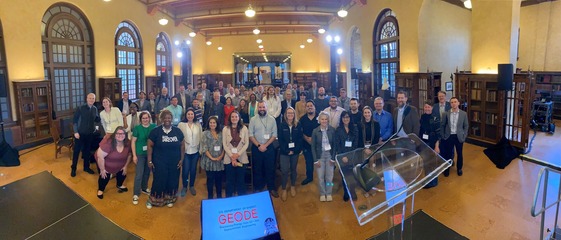 Team GEODE at the Houston, TX kickoff event. Photo by Alexis McKittrick.
GTO Selects Projects to Receive $31M for Wellbore Construction and Energy Storage
The U.S. Department of Energy (DOE) announced the selection of six projects that will receive up to $31 million in funding to advance geothermal energy implementation across the country. The selected projects will focus on two topics: methods to improve wellbore construction and integrity, and reservoir thermal energy storage (RTES).
Geothermal Collegiate Competition Helps Communities Explore Clean Energy
The Geothermal Collegiate Competition (GCC) is a prime example of meaningful community partnerships shaping tomorrow. GCC student teams gain practical knowledge and experience in geothermal while working directly with communities to explore geothermal solutions to real-world challenges—a winning combination for the nation’s clean energy future. Learn how the winning teams in the 2023 competition worked with communities in Elim, AK, and Pawhuska, OK.
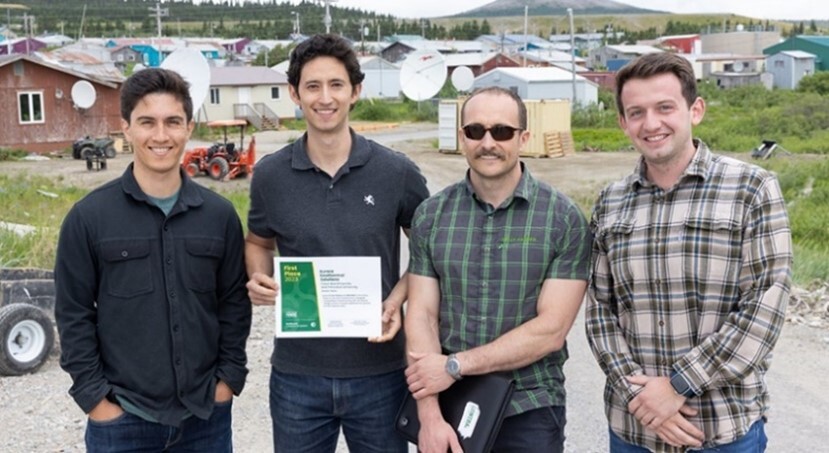 GCC Fall 2023 Policy Track Team Winners (left to right): Jonathan Lesh, Moises Escobar, Nicholas Fry (team mentor), and Jackson Blackwell on site in Elim, AK. Photo by Joe DelNero, NREL.
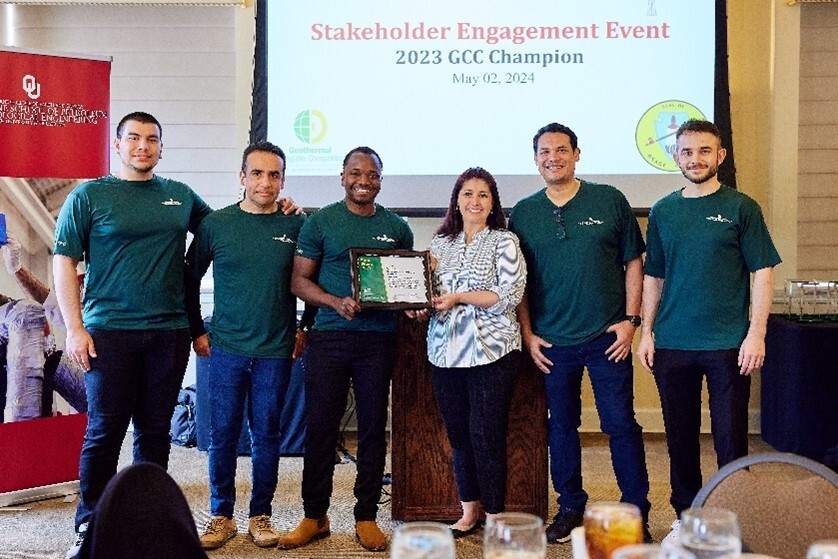 GCC Fall 2023 Technical Track Winners (Left to right): Vagif Mammadzada, Cesar Vivas, Nabe Konate, Jose Aramendiz, and Gurban Hasanov receive their award from NREL researcher Diana Acero-Allard (center-right) at their stakeholder event in Pawhuska, OK.
Small Business Selected for Geothermal Research
GTO selected an Arkansas-based small business to receive $1.1 million to advance its high-temperature flow rate instrument for geothermal monitoring. Ozark Integrated Circuits, Inc., was selected as part of Phase II research and development under DOE’s Small Business Innovation Research (SBIR) and Small Business Technology Transfer (STTR) program. See GTO’s website for more about small business research on geothermal energy.
|
|
Headlines Around DOE
Office of Indian Energy Issues NOIs to Support Tribal Clean Energy Efforts
DOE’s Office of Indian Energy Policy and Programs (Office of Indian Energy) issued two Notices of Intent (NOIs) for a combined $30 million in funding for two main goals: Tribal clean energy planning and development and supporting Tribal Colleges and Universities’ transition to clean energy. The funding opportunities are expected soon, so stay tuned!
Clean Energy Jobs Prove Fruitful for U.S. Employment Rate
A new DOE report shows that 56% of jobs added in the energy sector were clean energy jobs, with clean energy industry growth at more than twice the job growth rate of the economy overall. Per the 2024 U.S. Energy and Employment Report, 142,000 jobs were added in the clean energy field out of 250,000 across the sector. The increase is largely due to the Biden-Harris Administration’s commitment to investing in climate, clean energy, and manufacturing via the Investing in America agenda.
OCED NOI Offers up to $400M in Rural and Remote Clean Energy Solutions
The DOE Office of Clean Energy Demonstrations (OCED) issued a NOI for up to $400 million for community-focused clean energy solutions in rural and remote areas of the United States. The funding, which includes opportunities for projects on geothermal heating and cooling, geothermal power, and community geothermal heating and cooling systems, was made possible through the Biden-Harris Administration’s Bipartisan Infrastructure Law and builds on the Energy Improvements in Rural or Remote Areas Program. DOE anticipates a Notice of Funding Opportunity to be released this fall.
2024 CEIF Class to Help Advance DOE Clean Energy Projects
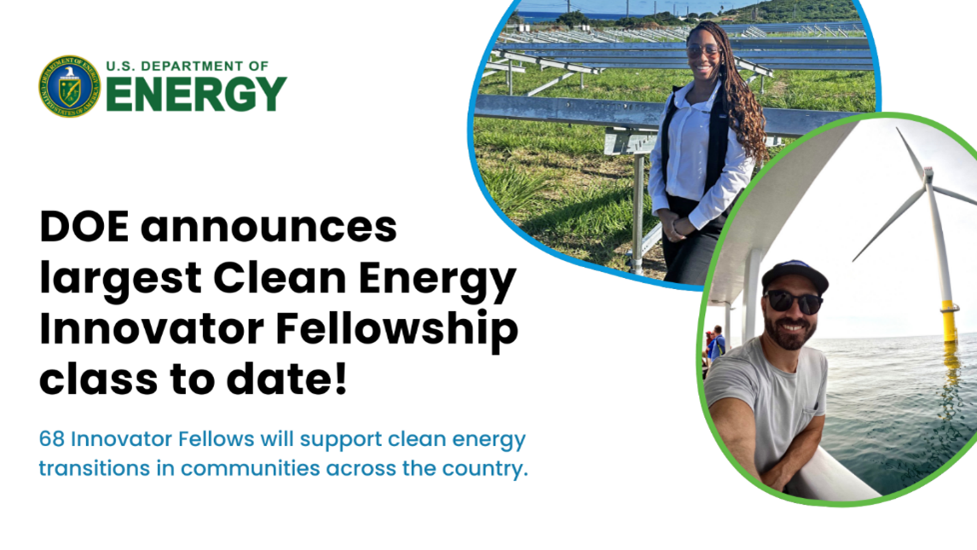
Under the Clean Energy Innovator Fellowship (CEIF), DOE has recruited 68 fellows to spend up to two years at critical energy organizations across 38 states, D.C., and Puerto Rico, where they will help advance decarbonization, resilience, and energy equity projects. The largest class announced to date, the fellows will be on the frontlines where federal investment in clean energy is transforming communities and supporting organizations.
 Energy Efficiency Grant Program Receives Another $12M from Biden-Harris Administration
The Energy Efficiency and Conservation Block Grant (EECBG) Program received an additional $12.6 million in funding for 35 state, local, and Tribal governments as part of the Bipartisan Infrastructure Law. The EECBG program provides flexible spending options, with recipients able to apply the funds towards 14 eligible categories of clean energy projects. Applications for the next round of EECBG funding are due October 31, 2024, for eligible local governments and May 31, 2025, for Tribes.
OTT Announces CLIMR NOI for FY25
The DOE Office of Technical Transitions (OTT) has announced a NOI to issue a call for proposals from DOE national laboratories, plants, and sites for the FY25 Core Laboratory Infrastructure for Market Readiness (CLIMR) Lab Call. The goal of OTT's annual Technology Commercialization Fund solicitation is to improve America’s energy competitiveness and security by accelerating commercialization of critical clean energy technologies to market. OTT expects to award up to up to $36.8 million across six topics, subject to appropriations. DOE anticipates releasing the FY25 CLIMR Lab Call in October 2024.
OCED Provides up to $100M toward Pilot Projects on Non-Lithium LDES Systems
Applications are now open for pilot projects focusing on non-lithium long-duration energy storage (LDES) systems. The Notice of Funding Opportunity released by OCED aims to move energy storage technologies close to commercial viability and utility-scale deployment. OCED plans to fund 5–15 projects for electrochemical, thermal, and mechanical storage technologies. Concept papers are due October 16, 2024, with full applications due February 13, 2025.
|
|
GTO Quarterly Webinar
September 25, 2024, 1:00 p.m.–2:00 p.m. ET
Join GTO leadership as they discuss several exciting developments, including the second Geothermal INTERN cohort, updates on the 2024 Geothermal Collegiate Competition, and the most recent critical minerals project selections. Registration is required to attend.
|
|
In Case You Missed It
Deadline to Register for GCC Approaching
Don’t forget to sign up for the Geothermal Collegiate Competition (GCC)—or to encourage a student you know to do so! Student teams will have the opportunity to compete for cash prizes while gaining real-world experience in geothermal heating and cooling. Registration closes on October 7, 2024.
NARUC Digs into Geothermal for Innovation Webinar
Geothermal energy was front and center at the August Innovation Webinar, part of a monthly series hosted by the National Association of Regulatory Utility Commissioners (NARUC) on emerging issues in electricity. GTO’s Alexis McKittrick spoke on the value of geothermal heating and cooling, potential grid impacts from mass deployment of geothermal heat pumps, and GTO’s Community Geothermal projects. View the recording and presentation on the NARUC website.
Critical Materials Community: New Newsletter Launch!
Get ready! DOE’s Critical Materials Collaborative (CMC) is launching its first-ever quarterly newsletter this October. The CMC is a network of DOE offices (including GTO), federal agencies, and research community members designed to enhance communication and coordination across the critical materials innovation ecosystem. Created for the critical materials community, this quarterly newsletter will keep you informed of the latest CMC activities, funding opportunities, key events, and more within DOE and our partner agencies. Subscribe today!
|
|
|
Trivia Answer: The United States’ first geothermal district heating system, known as the Warm Springs Water District, was created in Boise, Idaho in 1892 and is still running today!
Correction: Well spotted to those of you who noticed the error in last month’s trivia question! The highest-altitude hot springs, the Yangbaijan Hot Springs in Tibet, are not 4,200 feet above sea level—they are in fact 4,200 meters above sea level. Thank you to our eagle-eyed readers!
Want to receive GTO news as soon as it’s released? Subscribe to receive all GTO emails.
|
|
|
|
|