|
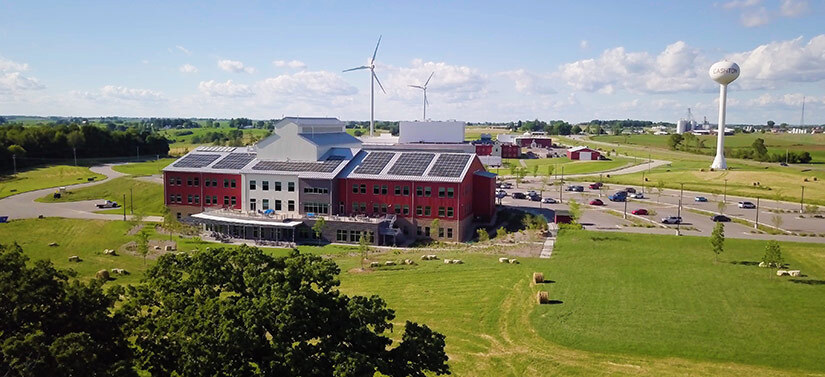
The U.S. Department of Energy’s (DOE) National Renewable Energy Laboratory (NREL) announced plans to award $3.15 million to 12 American component suppliers and manufacturers of small- and medium-sized wind turbines as a part of the 2024 Competitiveness Improvement Project. These selections will advance distributed wind turbine technology through testing and commercialization, providing more certified technology options for clean energy deployment.
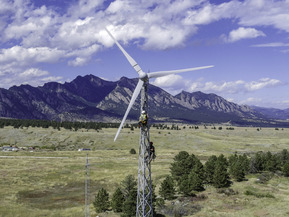
Achieving a clean energy future is going to take energy of all kinds, and every little bit helps. Enter distributed energy resources (DERs), which generate, store, and manage energy locally for energy users. Wind energy technology applied as a DER—known as distributed wind—is ideal for a wide range of customers, including residential and agricultural. Researchers from NREL plan on using three recently installed small wind turbines at their Flatirons Campus.
|
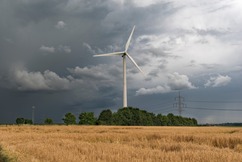
Risks from extreme weather events are increasing as temperatures rise due to global climate change. Deploying renewable energy resources like wind turbines is a way to mitigate the impacts of global climate change and lessen the impacts of extreme weather in the future. But understandably, you may be wondering how wind turbines behave in extreme weather like tornadoes, hurricanes, and other storms with high winds. We have answers.
|
DOE's Lawrence Berkeley National Laboratory, in partnership with researchers from Colorado School of Mines, released a paper that investigates the effects of wind energy development on employment and wage rates in communities near wind development, and the distribution of those effects within communities. The study finds a significant increase in employment rates and income within 20 miles of operating wind projects. Employment benefits are most pronounced for black workers, men, and both low-skilled and high-skilled workers.
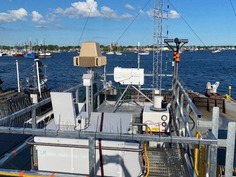
In support of the Wind Forecast Improvement Project, DOE is collaborating with DeTect Inc, the National Oceanic and Atmospheric Administration, the Pacific Northwest National Laboratory, and Woods Hole Oceanographic Institution on an 18-month initiative to gather extensive weather, ocean, and wildlife data near the sites of active offshore wind farms and lease areas off the coast of the Northeast United States.
This effort will use a specially designed radar system to gather met-ocean-environmental observations onboard an autonomous moored barge to improve the design and operation of offshore wind turbines and wind farms.
|
With support DOE's Wind Energy Technologies Office (WETO), NREL is helping grid operators and equipment manufacturers successfully adapt to the energy transition. The Grid Impedance Scan Tool makes it possible to identify and avert potentially disruptive electrical oscillations. This capability is essential in the effort to integrate more clean energy resources while maintaining grid reliability.

This edition's Clean Energy Champion worked as a construction engineer on projects to retrofit fossil-fueled boilers at power plants.
"We all depend on electricity, and it was fascinating to learn about power generation. I heard that offshore wind energy might be a promising as a type of clean energy generation, and that really piqued my interest. I wanted to get into offshore wind and went back to school to help pivot my career."
Armed with bachelor's degrees in architectural engineering and civil engineering, and a master's degree in ocean engineering, Maher now supports WETO as an Offshore Wind Senior Technical Advisor. When asked what her favorite thing about wind energy, it's simple: "It's clean!" 🛁
|
Webinar: July 23, 2024, at 9–10 a.m. PDT, Virtual
The U.S. Offshore Wind Synthesis of Environmental Effects Research (SEER) effort, led by NREL and the Pacific Northwest National Laboratory with support from the WETO, is continuing its free, public webinar series to share the latest research on the potential environmental effects of offshore wind energy development. This webinar will provide a background on oceanographic systems to describe potential interactions between atmospheric and oceanographic processes and offshore wind energy infrastructure.
Conference: Sept. 16–20, 2024, Albuquerque, NM
The 2024 Sandia Blade Workshop will bring together wind industry experts, wind farm stakeholders and operators, manufacturers, and researchers to address the major topics for wind turbine blades, facilitate interaction and networking among the attendees, and identify future technology pathways.
Conference: Sept. 24–25, 2024, Portland, ME
American Offshore Floating Offshore Wind Technical Summit (AFloat) 2024 brings together leading experts to address drivers and challenges to chart a course for floating offshore wind in the United States.
|