Upcoming Deadlines
June 28, 2024, is the deadline to apply to the Testing Expertise and Access for Marine Energy Research (TEAMER) program's Request for Technical Support (RFTS) 13.
June 28, 2024, is the deadline to provide feedback on the draft Ocean Energy Systems (OES)-Environmental 2024 State of the Science Report: Environmental Effects of Marine Renewable Energy Development Around the World.
June 30, 2024, is the deadline to express interest in serving as a mentor for the 2025 Marine Energy Collegiate Competition (MECC).
July 10, 2024, is the deadline for communities to apply to receive technical assistance through the Energy Transitions Initiative Partnership Project (ETIPP).
July 26, 2024, is the deadline for submissions for the first phase of the Powering the Blue Economy™: Power at Sea Prize.
Looking for more detailed information on the latest funding opportunities and events related to water power? Make sure you subscribe to The Water Wire! Find the next issue in your inbox on July 10, 2024.
Announcements
OES-Environmental released a draft of its 2024 State of the Science Report: Environmental Effects of Marine Renewable Energy Development Around the World for public comment. The draft report serves as an update to the 2020 State of the Science Report and features several new sections on topics that include resources to advance marine renewable energy and moving beyond stressor-receptor interactions. Feedback on the draft report will be accepted via a Public Review Form through June 28, 2024.
In May, the TEAMER program announced the selection of 11 projects through RFTS 12, reflecting a total funding amount of more than $1.1 million. These projects will receive support for testing expertise and access to numerical modeling, laboratory or bench testing, tank/flume testing, and expertise within the growing TEAMER Facility Network. Applications for RFTS 13 are being accepted through June 28, 2024.
Applications are open for ETIPP, which provides technical assistance for remote and island communities to bolster energy resilience with tailored solutions. New this year, communities selected for technical assistance will also receive direct funding to support their time and engagement on the ETIPP project. Applications for the 2024 program are due July 10, 2024.
The Powering the Blue Economy: Power at Sea Prize will award up to $1.7 million to competitors to advance technologies that use marine energy to power ocean-based activities. The first phase, CONCEPT, will center on developing teams and sound concepts, awarding up to 20 winners from a cash prize pool of up to $200,000. The CONCEPT phase will close on July 26, 2024.
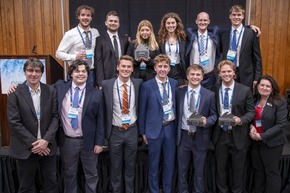
WPTO announced the winners of the 2024 MECC. The University of New Hampshire claimed first place, repeating its victory from the 2023 competition. Purdue University secured second place, while Oakland University and Oregon State University tied for third. Now in its fifth year, the MECC challenges multidisciplinary collegiate teams to develop solutions that can help power sectors in the blue economy, like aquaculture and ocean observation. Students gain hands-on experience by identifying markets for marine energy technologies and designing their own devices.
|
WPTO recently announced the 23 teams selected to compete in the next MECC. New for the 2025 competition, each team will be assigned a marine energy mentor. This will allow students to build working relationships with industry experts who can provide real-world experience, technical expertise, career advice, and other insights into how to navigate the industry. Mentors can expect to contribute approximately 15 hours of their time over the course of the competition. Competition activities will begin in August 2024 and conclude by the end of May 2025. Interested in serving as a mentor? Please complete this mentor registration form by June 30, 2024.
DOE and NOAA signed a memorandum of agreement on future collaborations regarding marine carbon dioxide removal (CDR) research and development. This agreement will formalize collaboration between DOE and NOAA to share expertise on research and technology development, as well as avoid duplicative work. The agreement makes clear that combining the ocean science expertise of NOAA with the CDR and energy science and technology expertise of DOE will be a powerful way to advance the state of marine CDR science and strengthen the existing relationship between the agencies.
Project Updates and Stories
In recognition of World Oceans Day on June 8 and National Ocean Month throughout June, WPTO revisited several of its Ripple Effect profiles focused on protecting and harnessing the power of the ocean. This profile series highlights the keen minds behind some of the most critical advances in water power technologies, including budding marine energy devices, which can generate renewable energy from waves, tides, and ocean and river currents.
In its 2022–2023 Accomplishments Report, WPTO highlighted projects the office supported at DOE national laboratories, companies, and academic institutions across the country. For example, researchers deployed devices in a stream in Maine and off the coast of Massachusetts, advanced critical testing infrastructure at several national laboratories, and used cutting-edge systems to help developers collect data on their marine energy device prototypes.
Meet Two Experts Working in Clean Energy at National Laboratories
In two recent Ripple Effect profiles, WPTO featured Sandia National Laboratories' Megan Lee Anderson and the National Renewable Energy Laboratory's (NREL's) Andrew Simms. Anderson, an R&D mechanical engineer, shared her childhood interest in helping the environment and how a lifetime of interaction with the coastline, along with a series of serendipitous events, led her to a career in marine energy. Meanwhile, Simms, an NREL researcher, discussed how a childhood experience, his father’s influence, and his quest to find a sense of purpose led him to a career path where he is searching for the "big answer" in wave energy.
WPTO announced more than $1.7 million for 16 hydropower projects and 12 marine energy projects to further water power research and development at DOE's national laboratories. These projects will advance hydropower and marine energy technologies and their roles in achieving both national and local clean energy goals.
Oak Ridge National Laboratory researchers developed environmentally friendly lubricant additives for water turbine equipment. These additives, based on ionic liquids, enhance performance while minimizing environmental impact. Testing showed 50% less friction and a tenfold decrease in wear compared to commercial gear oil. The project aims to create sustainable lubricants for aquatic environments, crucial for marine energy turbines.
Dive into the latest advancements in offshore energy testing with NREL's large amplitude motion platform (LAMP), which brings ocean conditions to the Rockies. Watch how NREL uses LAMP to replicate powerful ocean waves in a low-risk laboratory setting, helping to accelerate a marine energy device's journey from concept to commercialization.
Ryan Coe, of Sandia National Laboratories, highlighted wave energy converters’ potential to provide autonomous power for marine applications such as ocean sensing and aquaculture, at the North Carolina Renewable Ocean Energy Program's 13th annual research symposium. Coe discussed his work on wave energy co-design, focusing on efforts to optimize their components for increased energy production. The event, hosted by the Coastal Studies Institute, showcased advancements in marine energy and fostered interdisciplinary collaboration.
Graduate students at the University of New Hampshire, with help from researchers at NREL, Sandia National Laboratories, and PNNL, are preparing to deploy a tidal turbine that will provide key data for future marine energy research. The turbine, which was designed by NREL researchers and is outfitted with NREL's Modular Ocean Data Acquisition system, will gather information on strain, power output, environmental conditions, and more. The data will be shared on DOE's Marine and Hydrokinetic Data Repository.
The Waterborne Plastics Assessment and Collection Technologies project is on a mission to develop renewable-energy-powered technologies to detect, quantify, and collect plastic debris from U.S. waterways. This collaboration among NREL, PNNL, the Bio-Optimized Technologies to keep Thermoplastics out of Landfills and the Environment consortium, and the Environmental Molecular Sciences Laboratory aims to reduce the volume of plastic currently entering the ocean annually via U.S. waterways by more than half by 2040.
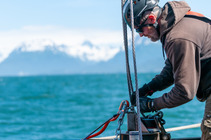
An NREL study highlighted tidal energy’s potential to decarbonize the power grid and boost Alaska’s economy. It found that, with planned upgrades, Alaska’s largest power grid, known as the Railbelt, could support up to 300 megawatts of tidal energy, which could power a substantial portion of Anchorage’s homes. Moreover, excess tidal energy could be used to produce green fuels for export, positioning Alaska as a leader in renewable energy exports.
|
See WPTO at These Events
Aug. 7–9, 2024, Duluth, Minnesota
The University Marine Energy Research Community (UMERC) will once again team up with the Marine Energy Technology Symposium (METS) to host its annual conference this summer in Duluth, Minnesota, at the Duluth Entertainment Convention Center.
In Case You Missed It
As acting director, Grosso leads strategy, management, and execution of WPTO's $200 million annual budget as the office works to advance research, development, and demonstration of hydropower and marine energy technologies. He brings more than three decades of public sector experience, including eight years leading WPTO's operations, and aims to foster relationships with clean energy leaders within and outside of government to better coordinate and collaborate on shared efforts and goals.
At its latest semiannual stakeholder webinar on May 9, WPTO highlighted funding, technical collaboration opportunities, and prizes, along with recent accomplishments. Read highlights of remarks from WPTO leadership and Jeff Marootian, principal deputy assistant secretary in the Office of Energy Efficiency and Renewable Energy and watch a recording of the webinar using the link above.
The latest edition of the "On the Road with WPTO" series explores team members' visits to the Pacific Northwest, a coastal city in the Netherlands, and more locales to meet with researchers, industry representatives, and others working in water power!
DOE announced Sunvapor as the second finalist in the American-Made Challenges: Solar Desalination Prize, a $1 million competition designed to accelerate the development of low-cost desalination systems that use solar-thermal power to produce clean water from salt water. Sunvapor’s technology will help recover clean water from water produced as an incidental byproduct of oil and gas production in the Permian Basin.
Follow along on the Office of Energy Efficiency and Renewable Energy's Twitter, LinkedIn, and Facebook channels for more water power content each week.
Making a Splash in the News
C-Power Upgrades SeaRAY and Sends It Back to Hawaii
—Offshore Energy, Zerina Maksumic, May 23, 2024
A Juneau Inventor Wants To Bring Ocean Energy to Your Outlets
—KTOO, Anna Canny, May 23, 2024
Co-Designing the Future of Wave Energy: Sandia Researcher Presents at NCROEP
—Sandia National Laboratories, Spring Booth, May 22, 2024
Utility Serving San Juan Islands Proposes To Harness Tidal Power
—News From The States, Toby Cooper, May 21, 2024
Stantec Consulting on Ocean Grazer Ocean Battery Storage Project
— Hydro Review, Elizabeth Ingram, May 21, 2024
US Selects 11 Marine Energy Projects for R&D Funding
—Power Engineering International, Elizabeth Ingram, May 20, 2024
Tidal Energy Company Gets New Name and New CEO
—Offshore Energy, Zerina Maksumic, May 20, 2024
Water Research Hub Earns 5 More Years of Funding
—NREL, Caitlin McDermott-Murphy, May 10, 2024
NREL Advances Sustainable Marine Energy Technology With 3D Printing
—3D Natives, Isaac B., May 6, 2024
|