|
Estimated reading time: 6.5 minutes |
|
As I immerse myself in my new role, this past month has proven to be exceptionally productive at the U.S. Department of Energy’s (DOE) Geothermal Technologies Office (GTO). I am grateful so many of you joined us during our first 2024 quarterly webinar and got a peek at some of our exciting happenings—you can view the slides and transcript on our Presentations page.
Last week, I attended the Geothermal Rising Thermal Energy Network Symposium in Minnesota, where I heard many speakers reference GTO’s report on the impact of mass deployment of geothermal heat pumps (GHPs). The event focused on education and collaboration on Thermal Energy Networks (TENs) and the opportunities they provide for communities to source clean energy locally. Attendees left the symposium with a strong foundation to help their communities or cities consider installation of their own TEN.
As you read this, I’m at CERAWeek 2024, where I have the honor to serve on two panels to discuss how geothermal can be a gamechanger for our energy future. During the event, Energy Secretary Jennifer Granholm announced the Next-Generation Geothermal Power Liftoff Report, which highlights pathways to reach the commercial potential of next-generation geothermal.
Before closing and in honor of Women’s History Month, I want to shine a spotlight on the career of Marie Tharp, whose work in the field of geology has deeply inspired me. Tharp’s groundbreaking bathymetric maps debunked the myth of a flat ocean floor, unveiling the world of mid-ocean ridges for the first time and laying the groundwork for the theory of plate tectonics. Tharp has been a foundational role model and “rock” for me over the years—discover more about Marie Tharp here.
Enjoy the rest of the month and the beginning of spring!
 |
|
Lauren Boyd
GTO Director
|
Trivia Question: How many total miles of piping are in Boise, Idaho’s geothermal district heating system?
|
|
GTO's Latest
GTO Drilling Demonstrations Initiative Celebrating Early Success
One of GTO’s two Drilling Demonstrations projects—both of which aim to reduce drilling times by at least 25%—is already celebrating success! Geysers Power Company is using innovative drilling technology and methodologies to increase drilling rates in California’s Geysers Geothermal Field. Their analysis already shows an increase in rate of penetration in all three sections of their first demonstration well. See the results the project team presented at the 2024 Stanford Geothermal Workshop.
DOE Signs Agreement to Support Feasibility Study for Romania
In a meeting that included Energy Secretary Jennifer Granholm and Romanian Minister of Energy Sebastian Burduja, DOE signed an agreement with utility company Electrocentrale Bucuresti SA (ELCEN) to conduct a feasibility study on the potential use of geothermal energy for heating in the city of Bucharest. The agreement includes GTO-funded work by the National Renewable Energy Laboratory to help the city assess their geothermal potential and the best-fit geothermal system for Bucharest.
 |
Success Story: How the Utah FORGE Team Has Become a Celebrated Part of the Local Community
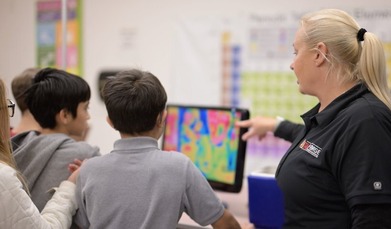
GTO’s Frontier Observatory for Research in Geothermal Energy (FORGE) has made significant strides since its launch in 2015, transforming into a full-scale underground research laboratory with eight wells spanning over 10 miles. Alongside technical advancements, FORGE staff actively engage with the local community to raise awareness about geothermal energy, fostering meaningful relationships and understanding while expanding the site's capabilities.
Read more about their success in forging connections, and watch the video FORGE created thanking the community of Beaver County for its support!
Energy Transitions Initiative Partnership Project (ETIPP) Releases Annual Report
The U.S. Department of Energy’s (DOE) ETIPP continues to expand its footprint and advise community representatives on how to achieve their desired energy resilience goals. GTO is one of the offices contributing funding to ETIPP, which just released its 2023 annual report.
 |
GTO Awards Prize to Student Finalist Team in EnergyTech University Prize
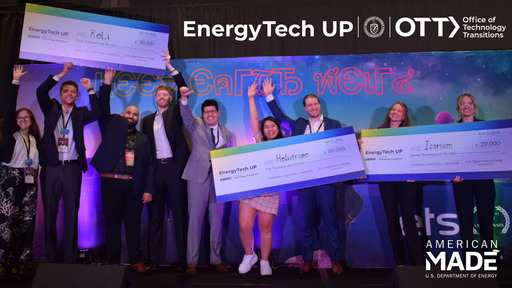
A student team from the Massachusetts Institute of Technology (MIT) focused on geothermal district heating and cooling and thermal energy storage at colleges was selected as the GTO Technology Bonus Prize Finalize in the EnergyTech University Prize (EnergyTech UP)! The EnergyTech UP prize challenges collegiate teams to develop and present a business plan leveraging national-laboratory-developed or other emerging energy technologies. The MIT team received $3,000 and an invitation to compete in the National Pitch Event next month. Congratulations to all the EnergyTech UP student finalists!
|
|
Headlines Around DOE
Secretary Granholm Visits Geothermal Power Plant in Iceland
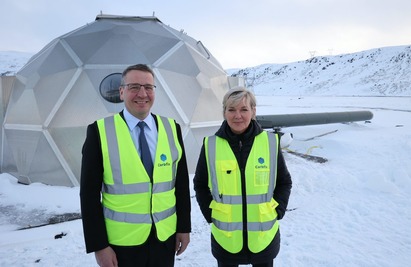
Secretary Jennifer Granholm recently traveled to Iceland to launch the new U.S.-Iceland Energy and Climate Dialogue, which will include work streams on geothermal energy, carbon management, and hydrogen. While there, the Secretary visited the Hellisheiði Geothermal Power Plant and was impressed by its scale. The plant generates 303 MW of electricity and includes a major carbon capture and storage project, Orca. “With $60 million to expand U.S. geothermal energy,” Secretary Granholm said, “I'm excited for the prospects of this renewable in America.”
New Prize Available to Support Innovative Local Clean Energy Solutions
DOE recently announced the SOlutions for Lasting, Viable Energy Infrastructure Technologies (SOLVE IT) Prize, which aims to support communities—even those with little to no energy expertise—to set their own direction in clean energy by providing direct financial support for identifying and planning innovative clean energy solutions. The first-round deadline is April 12—up to $5 million is available, with teams eligible to win up to $730,000 each.
Funding for Tribal Clean Energy Projects Announced
DOE announced $25 million in funding last month to support clean energy technology deployment on Tribal lands. This investment will strengthen Tribal energy sovereignty through local clean energy generation, while increasing energy access, reliability, and security.
DOE Issues Request for Qualifications for Clean Energy Projects
DOE has announced a request for qualifications (RFQ) to identify and evaluate qualified clean energy developers interested in leasing DOE-owned land for commercial clean energy projects. Part of DOE’s Cleanup to Clean Energy Initiative, the selected projects could include geothermal as well as other clean energy technologies. Proposals are due via email to bluthtm@id.doe.gov no later than 3:00pm MT on April 1, 2024.
|
|
Selling Renewable Energy to the Federal Government | March 21, 2:00 p.m. ET
This training will help explain the challenges, considerations, and best practices surrounding federal procurement of energy attribute certificates (EACs). It will provide an overview of the common procurement approaches used to acquire EACs in the federal sector, with a particular focus on the Indian Energy Purchase Preference provision in the Energy Policy Act of 2005. Learn more and register.
New York Geothermal Energy Organization (NY GEO) 2024 Conference | April 8-9
Gather with leaders in the geothermal heat pump industry, including keynote speaker and GTO program lead Alexis McKittrick, at this in-person event in Albany, NY! The year’s tracks include design, policy and programs, and building electrification. Learn more and register.
DOE's Pathways to Commercial Liftoff: Next-Generation Geothermal Power Webinar | April 12, 2:00 p.m. ET
Join DOE leaders for a deep dive into the new liftoff report, which covers the state of the geothermal market as it stands today, as well as the key challenges and potential solutions that can enable next-generation geothermal to reach full commercial liftoff. Learn more and register.
|
|
In Case You Missed It
Geothermal Collegiate Competition Winners Announced
READ: International Energy Agency’s U.S. Geothermal Report
Check out the International Energy Agency’s 2022 U.S. Geothermal Report to learn more about U.S. geothermal energy and where it is heading.
What’s So Critical about Critical Materials?
|
|
|
|
|