|
Biden-Harris Administration Releases First-Ever National Strategy to Accelerate Deployment of Zero-Emission Infrastructure for Freight Trucks |
|
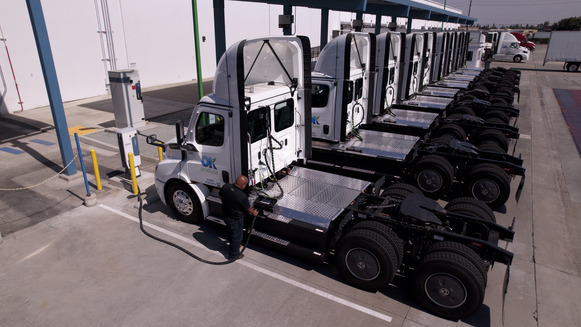 Photo credit: NACFE's Run on Less – Electric DEPOT
|
|
|
The Biden-Harris Administration today released the National Zero-Emission Freight Corridor Strategy. Developed by the Joint Office of Energy and Transportation and U.S. Department of Energy, in collaboration with the Department of Transportation and the Environmental Protection Agency, the Strategy will guide the deployment of zero-emission medium- and heavy-duty vehicle (ZE-MHDV) charging and hydrogen fueling infrastructure from 2024 to 2040. The Strategy is designed to meet growing market demands by targeting public investment to amplify private sector momentum, focusing utility and regulatory energy planning, aligning industry activity, and improving air quality in local communities heavily impacted by diesel emissions.
“For over a century, petroleum-fueled freight has transported vital food and resources to American families but at the same time, these vehicles have also contributed to lower public health, especially in densely populated communities,” said U.S. Secretary of Energy Jennifer M. Granholm. “The Biden-Harris Administration is addressing this issue head-on with innovative strategies to transform freight so it not only supports American families and businesses, but also protects the environment for future generations.”
Providing ubiquitous and convenient access to electric vehicle charging and hydrogen refueling along our nation’s freight corridors and at intermodal freight facilities and high-usage ports is key to achieving U.S. goals to promote at least 30% ZE-MHDV sales by 2030 and 100% sales by 2040. The goal of the Strategy is to align public policy and investments by prioritizing, sequencing, and accelerating infrastructure along the National Highway Freight Network in four phases. A core objective of the Strategy is to meet freight truck and technology markets where they are today, determine where they are likely to develop next, and set an ambitious pathway that mobilizes actions to achieve decarbonization.
|
|
|
|