|
|
Upcoming Deadlines |
 |
|
Recent News & Funding Opportunities |
 |
|
Highlights |
On Feb. 27, 2024, DOE announced the appointment of 18 science, business, academic, and industry leaders to the Industrial Technology Innovation Advisory Committee (ITIAC) to help decarbonize America’s industrial sector. ITIAC is a federal advisory committee reporting directly to the Secretary of Energy with a comprehensive strategy to accelerate the development of technologies and processes that will reduce emissions across the U.S. industrial sector and move the nation closer to a net-zero emissions economy by 2050. In developing recommendations, the committee will provide a wide range of community perspectives to ensure industrial decarbonization strategies will directly and equitably benefit the industrial workforce and surrounding communities, including those that have been historically marginalized and underserved.
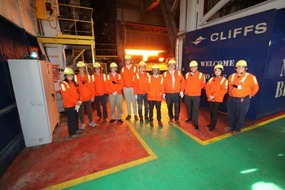
A recipient of multiple rounds of federal funding through DOE’s Industrial Efficiency and Decarbonization Office, CIVS has been refining simulation techniques that could drastically reduce emissions from steel production.
After touring CIVS, Richmond and Mrvan also traveled to the Cleveland-Cliffs Indiana Harbor complex (left), one of the largest steelmaking facilities in North America.
|
The Mike Monroney Aeronautical Center (MMAC) in Oklahoma City is a Federal Aviation Administration facility that hosts over 6,300 employees with an annual operating budget of over $1 billion—and the first U.S. Department of Transportation facility to establish an energy management system and achieve DOE's 50001 Ready recognition. The 50001 Ready program is a self-paced, no-cost way for organizations to build a culture of energy improvement that leads to energy and greenhouse gas savings. Read how MMAC incorporated the 50001 Ready program into its energy system and furthered the facility’s sustainability goals.
From the 2022 Industrial Efficiency and Decarbonization FOA, IEDO has been funding the University of Cincinnati project, Selective, Durable, and Energy-Efficient Electrolyzer for Carbon Dioxide to Ethylene Conversion. At the university, researchers and engineers are developing an electrified process to produce ethylene through the electrochemical reduction of CO2 by creating an innovative, single-site doped copper catalyst to incorporate into a gas diffusion electrode reactor. If successful, this technology will enable onsite conversion of captured CO2 into ethylene at low operating cost with reductions in carbon intensity from 50% to 70% compared to conventional ethylene production.
After evaluating hundreds of startups, C&EN added Trillium Renewable Chemicals, an IEDO-funded chemicals portfolio company, to its “10 Startups to Watch” list. In December 2022, DOE issued funding for Trillium Renewable Chemicals to support its Sustainable Manufacturing of Acrylonitrile project. Trillium Renewable Energy leads a team in designing, building, and operating a pilot plant that converts a biobased glycerol feedstock into acrylonitrile. The project’s impacts include lower production cost and reduced water and carbon intensity compared to the state of the art.
 |
|
In Case You Missed It |
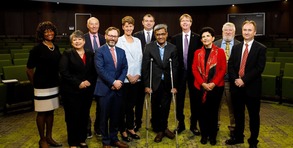
Last week, Deputy Secretary of Energy David Turk joined state, Tribal, academic, and industry leaders, and Arizona State University students in Tempe, Arizona to formally launch DOE's seventh Clean Energy Manufacturing Innovation Institute. EPIXC, short for Electrified Processes for Industry without Carbon, will mobilize a coalition of private companies, national labs, universities, labor unions, and community partners to electrify process heating and decarbonize the industrial sector.
|

With up to $70 million in federal funding over the next five years, EPIXC is critical to achieving President Biden’s climate goals, including cutting 85% of emissions from industrial heat by 2035. “That’s a big number,” Deputy Secretary Turk said at the event, “but that’s what we have to do if we’re going to be successful on climate change.”
|
In 2023, IEDO made many strides in driving innovation and advancing the next-generation technologies to foster a clean energy future and empower the U.S. industrial sector to move toward cleaner and more efficient energy use. The office’s new and growing team accomplished IEDO’s 2023 industrial efficiency and decarbonization goals through:
- Announcing over 100 new projects and investment opportunities worth over $300 million.
- Launching new initiatives worth over $100 million.
- Providing specialized expertise and technical assistance for 175 requests at 154 U.S. sites.
- Leading departmentwide coordination on several decarbonization programs.
- Providing expert information and analysis to hundreds of stakeholders.
 |
|
Events |
Check out these open opportunities:
|
ITIAC will hold its first meeting on March 21–22, 2024. Please register to participate virtually.

The Better Buildings, Better Plants Summit will be hosted at the Capital Hilton in Washington, D.C., on April 2–4, 2024. This annual event for Better Buildings, Better Plants partners and other key stakeholders provides the opportunity for professionals to explore emerging technologies and share innovative strategies in energy efficiency, decarbonization, water, and waste reduction. Attendees take part in interactive sessions with industry experts and market leaders as well as multiple opportunities to network with peers.
|

The U.S. Department of Energy (DOE) Clean Fuels & Products Shot™ Summit, will be held on April 8–9, 2024. The summit goal is to create an environment that engages government, industry, academia, and non-profit organization partners to learn about the Clean Fuels and Products Shot objectives, progress, priorities, and future plans. In addition, the Clean Fuels and Products Shot aims to decarbonize the transportation and chemical industries by accelerating technologies necessary to reduce emissions from the manufacturing of fuels and chemicals.
|
|