|
|
Acting Director’s Note: Happy New Year!
I hope your end-of-year holidays were joyful and restorative, and that your new year has kicked off well. This month, the U.S. Department of Energy’s (DOE) Geothermal Technologies Office (GTO) is highlighting six “hot” accomplishments from 2023. Before diving into some of the incredible things our team worked on last year, I have a few 2024 updates.
First, you won’t want to miss our featured section right below this note, titled ‘Ya Disponibles: ¡Materiales en Español sobre Bombas de Calor Geotérmicas!’ (‘Now Available: Materials in Spanish on Geothermal Heat Pumps!’). We are always looking to ensure our materials are useful and accessible, and these new resources are part of that goal. For a quick peek, check out the new geothermal heat pumps (GHPs) webpage in Spanish (English version).
Also, we are excited to share that earlier this month, DOE’s Office of Science announced awards totaling $24 million for small businesses under the Small Business Innovation Research (SBIR) and Small Business Technology Transfer (STTR) programs. The 111 projects selected under Fiscal Year 2024 Phase I Release 1 topics include five focused on improving multiphase flow data from geothermal production wells.
If you missed the National Renewable Energy Laboratory’s (NREL) December webinar about their GTO-funded report on tackling geothermal regulations at the state level, check out the recording. And if you’re a student (or know one!) doing clean energy research, click here for an opportunity to access NREL’s high-performance Kestrel Computing System for your work.
Here's to 2024!
Cullen Henderson
GTO Acting Director
|
|
|
Lithium in the Salton Sea Region
In November, GTO released results of the most comprehensive analysis to date quantifying the domestic lithium resources in California’s Salton Sea geothermal area, confirming the region's significant potential as a domestic source of this critical mineral. Prepared by Lawrence Berkeley National Laboratory, this new analysis found that with expected technology advances, the Salton Sea region’s total geothermal resources could produce more than 3,400 kilotons of lithium, enough to support over 375 million batteries for electric vehicles—more than the total number of vehicles currently on U.S. roads.
Read the fact sheet for a synopsis of the full report.
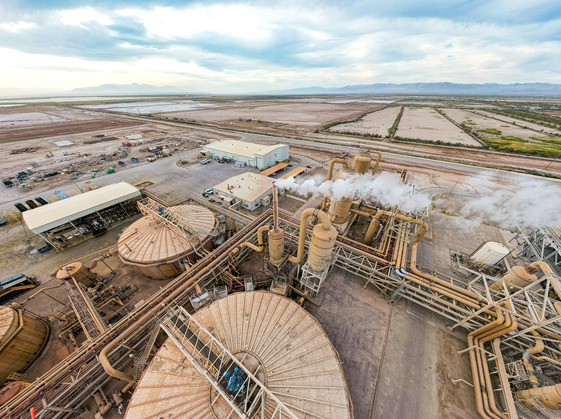 Photo Credit: Jeremy Snyder (Lawrence Berkeley National Laboratory)
|
|
|
America’s Future (Clean Energy) Leaders
GTO took new steps to help build the clean energy workforce in 2023.
 |
|
For the first time, the GTO-funded Geothermal Collegiate Competition (GCC) offered two tracks—technical and policy—inviting teams from collegiate institutions to develop real-world geothermal solutions. A total of 33 teams from 25 U.S. collegiate institutions registered to compete for a chance at $32,000 in prize funding. |
This year also saw the first cohort of graduate students in the National Science Foundation’s (NSF) and DOE’s Geothermal INTERN opportunity pursuing their bespoke internships in the geothermal industry, along with the announcement of this opportunity’s continuation. GTO’s blog series explored how the first cohort came to pursue geothermal, what they experienced in their internships, and their five tips for pursuing a career in renewable energy—read part 1, part 2, and part 3 of the blog series. |
|
 |
|
|
|
GHPs: Saving Money, Saving Power
In November, GTO released an assessment on the potential impacts of national-scale mass deployment of GHPs. Conducted by Oak Ridge National Laboratory and NREL, the analysis found that, coupled with building envelope improvements, retrofitting about 70% of U.S. buildings with GHPs could reduce U.S. electricity generation demands as much as 13% by 2050—in turn, reducing grid costs and the need for new grid transmission as well as substantially reducing CO2 emissions, even in the absence of any other decarbonization policy.
Check out GTO’s webpage about GHPs and the fact sheet summarizing key information about the systems!

|
|
|
First-of-its-Kind Geothermal Heating & Cooling Initiative
In April, GTO selected 11 projects in the Community Geothermal Heating and Cooling Design and Deployment initiative to design and deploy geothermal district heating and cooling systems, create related workforce training, and identify and address environmental justice concerns within their communities. In a first for GTO, all selected projects—located across the United States in remote, rural, suburban, and urban areas—are required to form community coalitions to execute on their projects, including representatives for four key roles: community voice, analysis and design, workforce, and deployment.
Given this initiative’s emphasis on addressing community environmental justice concerns and alignment with DOE’s Justice40 initiative, GTO was tapped to present on this initiative during DOE’s Justice Week in October (check out Alexis McKittrick’s overview of the initiative for the event).
|
|
|
MIT Technology Review Features Geothermal Energy
MIT Technology Review released its annual Top 10 Breakthrough Technologies, which includes EGS and heat pumps. The EGS page features three entities that have been funded by GTO: Utah FORGE, Fervo Energy, and AltaRock Energy.
|
|
Looking Ahead 👀
IGSHPA January Dig Deeper Webinar with U.S. Dept. of Energy | January 26, 2024, 11:30 a.m. ET
Join GTO’s Sean Porse and Jeff Winick on the International Ground Source Heat Pump Association’s (IGSHPA’s) Dig Deeper Webinar to discuss the GHP Mass Deployment Impacts Report and its findings. They will discuss the how the report analyzed mass GHP deployment, the resulting changes in end use load profiles for the U.S. building stock, and the impacts on the bulk power system. Register now.
Energy Transition Summit | February 5-8, 2024
Panelists from industry and DOE will convene in Arlington, VA, to present strategies for modernizing the grid while advancing national goals in energy resilience, security, and affordability. The event includes strategy talks, training exercises, and cross-sector conversation with research institutions, government officials, communities, and thought leaders in tech and energy. Register now.
Stanford Geothermal Workshop | February 12-14, 2024
GTO is looking forward to gathering with the engineers, scientists, and many others involved in geothermal reservoir studies and developments at this year’s Stanford Geothermal Workshop. Register here to join this forum for discussion of new ideas and exploration surrounding geothermal energy.
|
|
|
|
|