GTO's Latest
DOE Analysis Confirms California’s Salton Sea Region to Be a Rich Domestic Lithium Resource
DOE has released the results of the most comprehensive analysis to date quantifying the domestic lithium resources in California’s Salton Sea region. Conducted by DOE’s Lawrence Berkeley National Laboratory, this new analysis found that with expected technology advances, the Salton Sea region’s total geothermal resources could produce more than 3,400 kilotons of lithium, enough to support over 375 million batteries for electric vehicles (EV)—more than the total number of vehicles currently on U.S. roads. The analysis confirms the region has significant potential as a domestic source of this critical mineral used in batteries for stationary storage and EVs, both of which are crucial to the Biden-Harris Administration’s goal of a net-zero emissions economy by 2050.
Read the report and its fact sheet for more and check out a few of the many news stories in the Los Angeles Times, POLITICOPro (paywall), International Business Times, Huffpost Spain, The Driller, and El Periodico del a Energia.
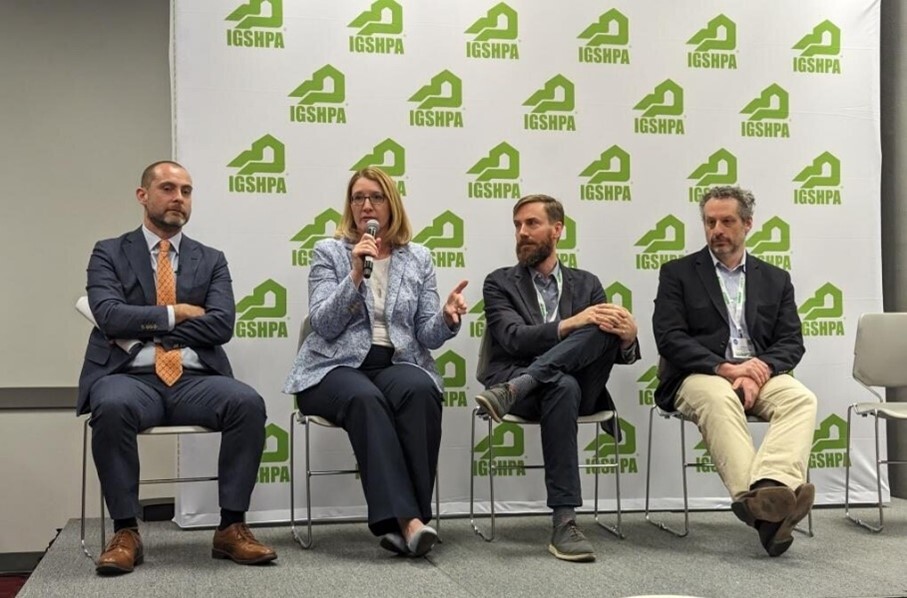 Alejandro Moreno, Alexis McKittrick, Sean Porse, and Jeff Winick announce the release of the new GHP impacts report at the International Ground Source Heat Pump Association (IGSHPA) Annual Conference. Photo Credit: Bryce Carter
New Analysis Highlights Geothermal Heat Pumps as a Pathway to a Decarbonized Energy Future
GTO released a groundbreaking report—conducted by Oak Ridge National Laboratory and the National Renewable Energy Laboratory (NREL)—confirming that if geothermal heat pumps (GHPs) are adopted across the country, they can defer or avoid investing in significant new infrastructure in the electricity system and reduce the cost of electricity. The analysis found that, coupled with building envelope improvements, retrofitting about 70% of U.S. buildings with GHPs could reduce electricity generation demands as much as 13% by 2050—in turn, reducing grid costs and the need for new grid transmission as well as substantially reducing CO2 emissions, even in the absence of any other decarbonization policy.
Read more about the report in PV Magazine, Renewable Energy Magazine, GeoDrilling International, and CNET.
Tips from Geothermal Interns: How to Build a Career in Renewable Energy
The first cohort of the National Science Foundation’s and DOE’s Geothermal INTERN opportunity have big hopes for a clean energy future and their roles in achieving it. Check out their five tips for pursuing a career in renewable energy in our new blog, then read back in our blog series to find out how these students came to pursue geothermal and what they experienced in their internships.
And don’t forget – NSF is actively accepting applications from graduate students for the Geothermal INTERN opportunity’s second round. Apply or share about this opportunity to create a bespoke internship in the geothermal industry today!
GTO-Funded Project Uncovers New Sustainable Energy Sources
Last week, Lawrence Berkeley National Laboratory, Rice University, and the Zayo Group announced the successful completion of the GTO-funded Imperial Valley Dark Fiber Project. The project kicked off in 2019 with the goal of using seismic sensing via existing telecommunications dark fiber to develop better strategies for finding renewable resources. Throughout this four-year project, researchers have been able to use Zayo's telecommunications dark fiber network to efficiently map and uncover renewable energy sources in California.
Learn more about the Imperial Valley Dark Fiber Project in ThinkGeoEnergy, BizWest, and Lightwave Online.
|