|
|
The U.S. Department of Energy (DOE) announced two initiatives to expand its research and development in heliostats. In concentrating solar-thermal power (CSP), heliostats are devices that tilt mirrors to track the sun and reflect sunlight toward a receiver, where it can be stored as heat for long-duration energy storage and converted into electricity.
Lowering the cost of heliostats supports President Biden’s goals of achieving a decarbonized energy sector by 2035 and a net-zero economy by 2050 which will require the deployment of flexible and dispatchable generation and energy storage technologies, like CSP with thermal energy storage and high temperature process heat.
American-Made Heliostat Prize
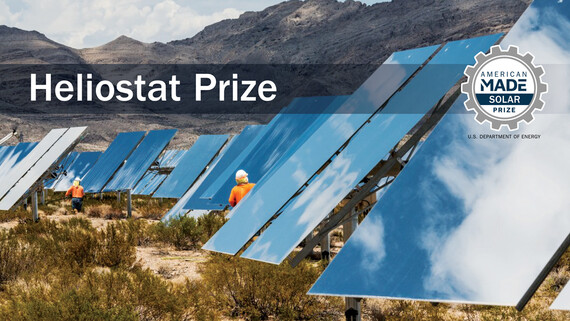
DOE today opened applications for the American-Made Heliostat Prize, a competition designed to reduce the cost and improve the performance and reliability of heliostats by developing novel components, including heliostat support structures, mirror facets, and wireless control systems. Competitors will drive innovations from concept to prototype on an accelerated schedule—just short of 18 months—as they participate in escalating challenges.
This prize contest offers a total of $3 million in cash prizes for innovations and credible concepts for technology supporting the advancement of heliostat technologies, with up to three winners. Competitors can win up to $580,000 in cash across the three phases of the prize contest.
-
Phase 1 “Concept” – 7-9 teams can win $100,000 for credible concepts for technology supporting the advancement of heliostat technologies.
-
Phase 2 “Design” – 4-6 teams advance and win $180,000 based on design and modeling of the components from Phase 1.
-
Phase 3 “Assess” – Build prototypes, perform initial testing of the components from Phase 2, and finalize design. DOE expects to award $300,000 in prizes to 2-3 winners.
Heliostat Consortium Selections
Today NREL and Sandia National Laboratories also announced seven awardees from a request for proposals (RFP) aimed at achieving DOE’s goals for heliostat cost reduction, sustained multifaceted innovation, and improved solar field performance. The Heliostat Consortium, also known as HelioCon, was established in 2021 to integrate all types of stakeholder input to address the challenges in heliostat technology advancement and market adoption.
|
Projects from this RFP, which will be implemented over the next 1-3 years, will focus on lowering the cost of heliostats and heliostat technologies and creating new market opportunities for the heliostat industry. The selections are:
-
Northeastern University (Boston, MA): This project by Northeastern University will develop an educational program focused on CSP and heliostats for power generation and industrial processes. It will be developed during the two-year project and then become part of the Northeastern curriculum for undergraduate and graduate engineering students. (Award Amount: $250,000)
-
Sarcos (Salt Lake City, UT): Sarcos Technology and Robotics Corp., in collaboration with Heliogen, will investigate the feasibility of a novel mobile robotic system capable of supporting the installation of mirror facets onto a heliostat. (Award Amount: $360,000)
-
Solar Dynamics (Broomfield, CO): Solar Dynamics LLC, with partners Remcom and Vanteon Corporation, will create a components-and-controls project aimed at demonstrating the reliable operation of a heliostat solar field wireless control system using commercial off-the-shelf hardware and prove that the selected wireless technology is fully capable of replacing traditional wired networks with minimal compromises. (Award Amount: $330,000)
-
Solar Dynamics (Broomfield, CO): This project by Solar Dynamics LLC and partners will develop processes to maximize cost-competitiveness, performance, and reliability of Solar Dynamics’ existing SunRing heliostat design. (Award Amount: $660,000)
-
Tietronix (Houston, TX): This project will use a model-based systems engineering approach to improve the design, analysis, and verification of heliostats and overall solar fields. The project will also use digital twin technology during the heliostat manufacturing process, conducting thorough testing before achieving full functionality. (Award Amount: $500,000)
-
University of Arizona (Tucson, AZ): This project will design, manufacture, and test a new type of heliostat and study its application for high-concentration CSP. The University of Arizona will integrate a reflector (developed from a DOE Small Innovative Projects in Solar award) with a high-accuracy mount and tracking camera to demonstrate an accurately focused and centered image of the solar disc. (Award Amount: $400,000)
-
University of New Mexico (Albuquerque, NM): This components-and-controls project by the University of New Mexico will introduce a resilient wireless communication system based on the principles of integrated access and backhaul (IAB) technology, entropy-based routing, dynamic spectrum management, and interference mitigation. (Award Amount: $450,000)
|
|
|
|
|
|
|