|
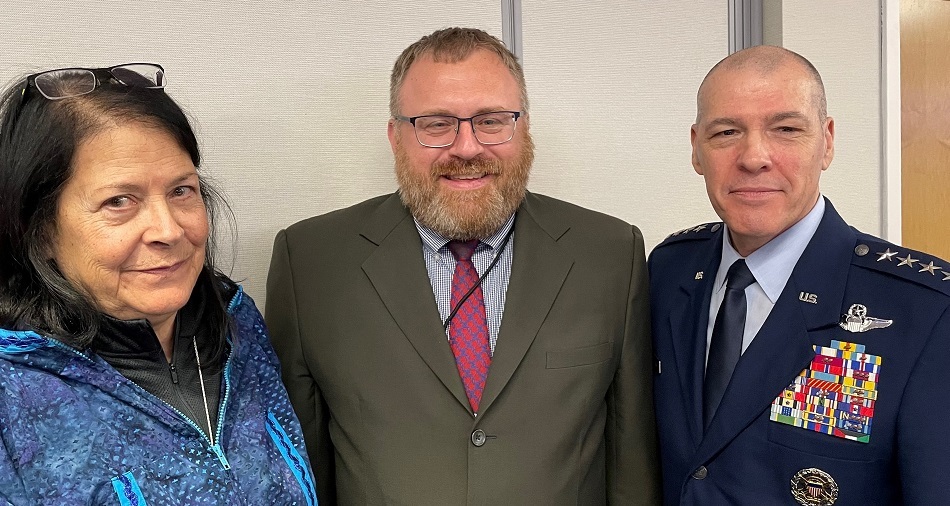
Julie Kitka, AFN president, AEO Senior Advisor Givey Kochanowski, and Lt. Gen Thomas Bussiere at Alaska Day.
With its strategic location, Alaska is considered a focal point of U.S. security, energy resources and traditional subsistence lifestyles. Keeping those priorities in the spotlight was the aim of the Alaska Federation of Natives (AFN)’s Alaska Day, March 1-2 in Washington, D.C.
With a slate of speakers including Alaska’s two senators, U.S. House representative and governor, plus cabinet secretaries, DOE’s Deputy Energy Secretary, White House advisors, three- and four-star generals, Alaska Native Regional Corporation leaders, state legislators, cable, oil and gas and Space X executives and other VIPs, the event’s prominence was evident to all participants, including AEO’s entire team.
The conference theme, “Challenges at the Northernmost Border: A Focus on Getting the Right Priorities Resourced,” highlighted the need for a deep and lasting engagement on specific issues, from critical infrastructure needs, technology, security, climate change, communications and energy. Ensuring investment in those issues was emphasized throughout the event. AFN leadership will prepare a final report of the event and send it to participants.
“When we work together, we are unstoppable,” said Richard Petersen president of the Tlingit and Haida Central Council.
During the session on critical Alaska Native concerns on economic, energy and food security, Deputy Secretary David Turk announced $315 million for the new Energizing Rural and Remote Communities program for rural communities of 10,000 or fewer residents to build the capacity for clean energy development and deployment.
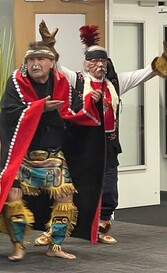
Beginning with a prayer and a dedication to Inupiat leader and long-time AFN Board member, Dr. Oliver Aveogan Leavitt, the conference kept the focus on Alaska Natives’ contributions, traditions and priorities. It ended with a special dance performance from Yees Ku.oo (meaning “new people/new beginning”) comprised of many indigenous nations including Tlingit, Haida and Tsimshian. With the permission of tribal elders, AFN members presented Alaska Senator Dan Sullivan and three Air Force generals with warrior names memorializing their ancestors.
Learn more about AFN about its history as the largest statewide Native organization in Alaska or watch a video about AFN's Land Claims Foundation.
|
Arctic Encounters Highlights Federal Funding Coordination, Innovation in the North
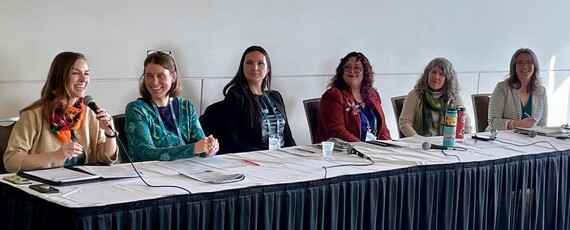 Julia Hnilicka, director of USDA Rural Development Alaska, speaks at the Federal Coordination and Support Panel at Arctic Encounter on March 31. Dr. Erin Whitney is sitting next to her. Photo courtesy of Arctic Encounter.

AEO’s new director, Dr. Erin Whitney, joined Alaska federal colleagues in shedding insight into the federal funding process during a panel presentation on March 31 at the Arctic Encounter Symposium, the largest annual Arctic policy event in the United States. For the last 10 years, the event has confronted the United States and global partners’ shared Arctic interests and concerns.
Led by the Denali Commission’s Director of Programs, Jocelyn Fenton, the panel also included the National Oceanic Atmospheric Administration’s Amy Holman, EPA's Tami Fordham, the Department of the Interior’s Raina Thiele, and USDA-Rural Development-Alaska Director Julia Hnilicka. Together, they discussed ideas for on Federal agency coordination and support for Sustainable Arctic communities. (See details on the March 31 panel on page 36 in this agenda link).
Another Arctic Encounter highlight was DOE Under Secretary for Science and Innovation, Dr. Geraldine Richmond (on the left in the above photo), serving on an “Innovating Now for the Future” panel on March 29 moderated by Launch Alaska CEO Isaac Vanderburg. (See page 7 in the Arctic Encounter agenda.) Dr. Richmond joined a distinct international group including Dr. Jennifer Spence, Senior Fellow of the Arctic Initiative; Matt Perkins, CEO of Alaska Renewables; Kiera O’Brien, Public Policy Representative from TOTAL Energies; and Gwen Holdmann, Associate Vice Chancellor of Research at the University of Alaska Fairbanks.
Together, they discussed innovations in energy, industry, policy, and decarbonization for the Arctic region. This included insights into how to balance environmental protection with diverse resource development in the region.
See highlights of the 2023 event on the Arctic Encounter YouTube channel.
|
Carbon Capture, Critical Minerals Workshops Highlight Opportunities in Alaska
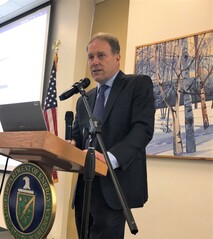
What is Alaska’s potential for critical minerals mining and carbon management? This is the question explored by industry stakeholders and government leaders at two DOE workshops on Feb. 21 and 22 at Alaska Pacific University in Anchorage.
AEO Director Dr. Erin Whitney joined Brad Crabtree, DOE’s Assistant Secretary for Fossil Energy and Carbon Management (FECM), in leading both workshops. Their goals were to underscore DOE’s commitment to helping Alaska and the Arctic region capitalize on energy and mineral resources and address climate challenges, while advancing the nation’s energy security and climate goals.
|
The events provided the opportunities to:
- Review Alaska’s potential for carbon management and critical minerals mining and processing projects;
- Improve understanding of federal funding and tools to support critical minerals production; and
- Identify opportunities to advance projects and infrastructure that reduce emissions, expand energy access, and foster economic development in the state.
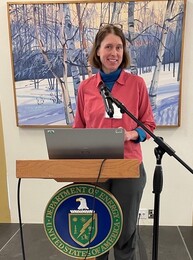
During the workshops, industry, tribal, academic and government stakeholders learned about current DOE commitments that include the Carbon Ore Rare Earth and Critical Minerals (CORE-CM) Initiative. This initiative, jointly funded with the University of Alaska Fairbanks and the Alaska Department of Natural Resources, includes 13 projects and $19 million to assess critical mineral and rare earth element capacity across Alaska and various other basins.
Additionally, DOE has partnered with Alaska’s only operating coal mine—Usibelli Coal Mine--to develop a business plan to co-produce rare earth elements and critical minerals.
Read more about DOE’s FECM programs here. See the agenda and Carbon Management workshop materials. See the agenda and Critical Mineral workshop materials.
|
Upcoming Conferences
|