Paper and Plastic instead of Coal
Researchers Team with Commercial Partner to Pelletize Materials That Would Otherwise End Up in Landfills
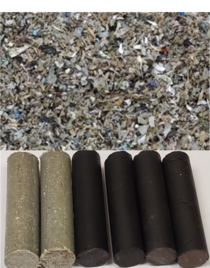
The idea of using biomass or non-recyclable materials to produce power has been around for a long time, but techniques for developing a consistent feedstock to produce a fuel that is economical compared to coal, resistant to moisture, and has no spontaneous combustion in storage has been a daunting challenge.
With funding from the U.S. Department of Energy (DOE) Bioenergy Technologies Office (BETO), researchers at Idaho National Laboratories (INL), in partnership with Michigan Technological University and Convergen Energy, pioneered a technique for combining non-recyclable plastics and paper fiber that would otherwise end up in landfills to form pellets with an energy content like bituminous coal (see image courtesy of INL).
The key to the technique is torrefaction, a thermal process that INL has used before to convert biomass into a coal-like material. Torrefaction uses the mild application of heat, typically between 200°C and 320°C, to make biomass materials more homogenized and consistent while also removing chlorine and other compounds that can turn into harmful gases during combustion.
Learn more about how combining paper and plastic to form stable feedstocks can substitute for coal and reduce landfill mass on the Bioprose: Bioenergy R&D blog.
|
The Bioenergy Technologies Office (BETO) supports research, development, and demonstration to enable the sustainable use of domestic biomass and waste resources for the production of biofuels and bioproducts. BETO is part of DOE's Office of Energy Efficiency and Renewable Energy.
Stay up-to-date with the latest BETO news!
Sign up to receive regular communications about BETO vacancy announcements, webinars, workshops, Bioprose: Bioenergy R&D Blogs, funding opportunities, and technical reports.
|