Upcoming Deadlines
Announcements & Opportunities
WPTO Releases $10 Million Funding Opportunity to Advance Marine Energy Innovation: The U.S. Department of Energy’s (DOE) Water Power Technologies Office (WPTO) released a $10 million funding opportunity to accelerate the development and testing of marine energy technologies with a focus on wave and ocean current resources. This opportunity will invest in projects that advance wave-powered technology innovation and research and development for seawater desalination, as well as a feasibility assessment for an ocean-current test facility. The deadline to submit concept papers is Dec. 2, 2022, at 5 p.m. ET, and full applications are due Feb. 24, 2023, at 5 p.m. ET. More information can be found on DOE’s Office of Energy Efficiency and Renewable Energy (EERE) Exchange.
WPTO Announces $35 Million in Funding to Advance Tidal and River Current Energy Systems: WPTO announced a notice of intent that proposes $35 million in funding from the Bipartisan Infrastructure Law to advance tidal and river current energy systems. The funding opportunity is the largest ever from DOE in marine energy. The funding opportunity is expected to be released in early 2023 and aims to develop a tidal- or river-current research, development, and demonstration site and support in-water demonstration of at least one tidal energy system. More information can be found on EERE Exchange.
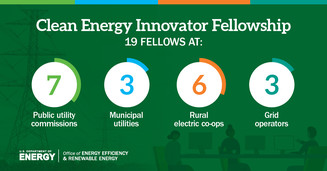
DOE Announces Clean Energy Innovator Fellowship Selections: DOE announced 19 institutions that will host fellows as part of the new Clean Energy Innovator Fellowship program. The program, which is funded by several DOE offices, including WPTO, matches recent graduates and energy professionals with public utility commissions, municipal and rural cooperative utilities, and grid operators, with whom they will spend one to two years advancing innovative clean energy solutions. The $6 million program seeks to increase access to clean energy career opportunities and accelerate the national transition to a resilient and affordable clean energy economy.
Applications Open for Next Round of TEAMER Technical Support: The TEAMER program is accepting applications for its next RFTS through Nov. 4, 2022. The access period for teams to utilize facilities for RFTS 8 is March–December 2023. Sponsored by WPTO and directed by the Pacific Ocean Energy Trust, TEAMER offers marine energy stakeholders and developers access to the nation’s best facilities and expertise to support technology development and testing. Apply for the next round today, and learn about the latest technical support recipients.
Apply to the Marine Energy Graduate Student Research Program: WPTO and the Oak Ridge Institute for Science and Education are accepting applications for the Marine Energy Graduate Student Research Program. Previously only open to doctoral students, the program is now accepting applications from all graduate-level (master’s and doctoral) students. The program is designed to advance the students’ marine-energy-focused theses by providing access to the expertise, resources, and capabilities available at DOE offices, national laboratories, industry partners, and other approved facilities. Applications are due Dec. 2, 2022.
DOE Seeks Input on New Program to Improve Energy Systems in Rural or Remote Communities: DOE’s Office of Clean Energy Demonstrations released a request for information to gather input on the new Energy Improvements in Rural or Remote Areas program. The Bipartisan Infrastructure Law provided $1 billion for this new program, which aims to strengthen the resilience, reliability, and availability of energy systems in rural or remote communities across the United States. DOE welcomes public input from a wide range of stakeholders, including energy project developers, utilities, community organizations, environmental justice organizations, as well as state, local, and tribal governments, to shape this program. The deadline for comments is Nov. 28, 2022, at noon ET.
|
Upcoming Events
EnergyTech University Prize Informational Webinar
TODAY, October 26, 2022, 3–4 p.m. ET, Online
Sponsored by DOE’s Office of Technology Transitions, the EnergyTech University Prize (EnergyTech UP) is a collegiate competition challenging multidisciplinary student teams to develop and present a business plan that leverages DOE national laboratory-developed and other high-potential energy technologies. As part of the American-Made Challenges program, EnergyTech UP awards cash prizes to teams that successfully identify an energy technology, assess its market potential, and propose a strategy for commercialization. Join this webinar to learn about competing, get ideas about energy technologies, and ask questions about getting started.
Register for the webinar.
Inclusive Energy Innovation Prize Summit
Day 1: Nov. 2, 2022, 10 a.m.–7:30 p.m. ET, Virtual & Google DC, 25 Massachusetts Ave NW, Washington, D.C., 20001
Day 2: Nov. 3, 2022, 9 a.m.–2:30 p.m. ET, Virtual & National Renewable Energy Laboratory’s Washington, D.C., Office at 901 D Street SW, Suite 930, Washington, D.C., 20024
This EERE summit will bring together the 18 teams competing in Phase 2 of the Inclusive Energy Innovation Prize competition, with a focus on supporting the teams before their final pitch competition in May 2023. The first day will focus on best practices for working within federal spheres and how community-based organizations can best use the tools available as they continue to build an equitable renewable energy infrastructure. The second day will focus on business and communications workshops led by experts in the field.
Attendance at this event is by invitation only.
Hybrid and Hydrogen Research Vessel Webinar
Nov. 3, 2022, 3–4 p.m. ET, Virtual
The Pacific Northwest National Laboratory (PNNL) and Scripps Institution of Oceanography (Scripps) recently agreed to advance collaborations in marine and offshore wind energy and ocean and climate technology research and development. With this new partnership, there will be a series of lunch-and-learn seminars. The first will feature Bruce Applegate (Scripps) and John Vavrinec (PNNL) presenting on two novel research vessels that use sustainable propulsion systems. Scripps has commissioned a hydrogen-hybrid vessel, and PNNL will soon add the first plug-in electric-diesel hybrid vessel to its research fleet.
Register for the webinar.
WPTO Semiannual Stakeholder Webinar
Nov. 9, 2022, 1:30–3 p.m. ET, Virtual
Join WPTO staff and leadership for their Semiannual Stakeholder Webinar on Wednesday, Nov. 9, 2022, at 1:30–3 p.m. ET. Hear a report out from the results of the 2022 Peer Review process that took place this summer and receive updates on major accomplishments, current funding opportunities, and all that has taken place since we last came together in March 2022. Have questions for the team? The event will conclude with a Q&A session built of questions submitted by stakeholders like you! Submit any questions that you might have to waterpowertechnologiesoffice@ee.doe.gov.
Register for the webinar.
Products & Publications
With Marine Power, It's Not the Size of Your Turbine, It's the Motion of the Ocean: WPTO director Jennifer Garson and Marine Energy Program Manager Tim Ramsey chat about marine energy. They discuss how WPTO is helping the industry address challenges in areas such as permitting, testing, and research and development. The article also covers the potential of marine energy to not only help power a clean energy grid but also assist in other ways, such as disaster relief.
Meet the 2022 Marine Energy Graduate Student Research Program Participants:
-
Claire Gonzales: One hundred feet below the surface of the ocean, Claire was amazed by the overwhelming pink hue created by a wall of strawberry anemones. Learn how this moment combined with a love of science set her on a path to protect the ocean she loves.
-
Habilou Ouro-Koura: As a child in Togo, Habilou created miniature cars out of milk cans to crash into his friends’ own milk-can creations. Now, he is harnessing a reliable and clean power source for ocean exploration vehicles. Read about the obstacles he overcame in his journey to achieve his childhood dream of becoming an engineer.
NREL Developing Data-Gathering Tools to Advance Marine Energy Tech: Researchers at the National Renewable Energy Laboratory (NREL) are developing data-gathering tools to help accelerate the development of promising marine energy technologies. With the Modular Ocean Data Acquisition (MODAQ) system, users can assess their prototypes' promise all the way from the lab bench to the open ocean to quickly hone their designs. Using MODAQ, a research team at the University of Hawai'i at Mānoa is refining a small-scale version of their wave energy prototype, the Hawai'i Wave Surge Energy Converter, which could someday power Hawai'i’s coastal communities. MODAQ enabled the team to collect reliable data at the lab bench, in wave tank tests at Oregon State University, and in an open-water field test at Hawai'i’s Makai Research Pier.
Extracting Magnesium Salt From Seawater: Seawater is a rich source of diverse minerals—including magnesium—which has emerging sustainability-related applications in carbon capture, low-carbon cement, and potential next-generation batteries. Currently, magnesium is obtained in the United States through an energy-intensive process from salt lake brines, some of which are in danger due to droughts. Researchers at PNNL and the University of Washington have found a simple way to isolate a pure magnesium salt, a feedstock for magnesium metal, from seawater.
Former AAAS Fellow Heather Spence Joins Sci on the Fly Podcast: On a recent episode of Sci on the Fly, Heather Spence, a marine biologist, sound artist, and former American Association for the Advancement of Science (AAAS) fellow, discussed her latest work exploring the potential for marine energy to power ocean observation systems. Listen and learn more about Heather's work as a marine and science advisor at DOE.
NREL Researchers Advance Microgrid and Nanogrid Technology: NREL's validation capabilities range from lab to field, watt to megawatt, component to system, and nanogrid to microgrid. Find out how NREL researchers are using a suite of instruments, such as grid emulators and small dynamometers, to test marine energy devices by simulating, validating, and honing renewable energy-based grids.
Hawai'i Tests the Waters of Carbon-Free Desalination: With DOE funding, the Natural Energy Laboratory of Hawai'i Authority and Trevi Systems Inc. demonstrated concentrating solar-thermal power technology to create a solar desalination plant in Hawai'i that produces fresh water from ocean water at low cost. The innovative approach uses forward osmosis to move water through a semipermeable membrane without requiring energy.
Ocean Energy Systems - Environmental and the Triton Initiative in Sea Technology Magazine: Ocean Energy Systems - Environmental and the Triton Initiative were featured in the October issue of Sea Technology Magazine. The article highlights how the two projects are working to understand the environmental impacts of marine energy devices on wildlife and habitats, with the shared goal of advancing the use of marine energy systems.
New NREL Video Explains Marine Energy and Highlights Research Efforts: Do you know what marine energy is? Or how technologies turn waves and tides into electricity or clean drinking water? What about the ways NREL researchers are helping devices overcome obstacles like ocean storms? Tune in to a new video to discover how NREL researchers, like Aryana Nakhai, Levi Kilcher, and Mike Lawson, are clearing a path for marine energy to make a substantial contribution to the clean energy future.
Videos on Environmental Effects of Marine Energy: If a tidal turbine spins underwater, can a whale hear it? Does a crab sense the electromagnetic fields created by underwater power cables? Learn about that and more in a series of animated videos about the effects of marine energy devices on ocean animals and habitats from PNNL and OES-Environmental.
In Case You Missed It
Empowering the Next Generation of Marine Energy Experts: Marine energy has an important role in the clean energy future in the United States, and WPTO offers a range of educational resources to teach students of all ages about this renewable energy resource. Learn more about these resources and how parents, caregivers, and teachers can generate buzz about marine energy in and out of the classroom.
CalWave Concludes Open-Ocean Wave Energy Pilot: CalWave Power Technologies, Inc. (CalWave) successfully concluded its open-ocean wave energy pilot after 10 months of continuous operation off the coast of San Diego, California. The project, supported by funding from WPTO, aimed to demonstrate CalWave’s xWave technology, which transforms the motion of ocean waves into electricity. This demonstration represented California’s first at-sea, long-duration wave energy project and a critical step toward providing wave power as a commercially viable renewable resource.
Social Spotlight
WPTO on Twitter — Oct. 07, 2022

It’s more than just the ocean! Marine energy is a renewable power source that is harnessed from the natural movement of water, including river and ocean currents, tides, and waves. Learn more about the renewable power source you may not know about yet.
|
Follow along on the EERE Twitter, LinkedIn, and Facebook channels for more #WaterWednesday content each week.
WPTO in the News
-
NREL Puts Out Free Analysis Tool for Small Wave Energy Converters, Offshore Energy Biz, Amir Garanovic, Oct. 19, 2022
-
U.S. to Provide Millions in Funding for Tidal Energy and River Current Systems, CNBC, Anmar Frangoul, Oct. 19, 2022
-
Charting a Course for Marine Energy, and the Country, to Decarbonize the Grid, Tech Xplore via NREL, Caitlin McDermott-Murphy, Oct. 4, 2022
Marine Mentions
-
A New Four-Year Project Will Test the Viability of Large-Scale Wave Energy in Europe, CNBC, Anmar Frangoul, Oct. 19, 2022
-
ORE Catapult: Tidal Stream Energy Costs Could Plummet if Current Opportunity Is Realized, Offshore Engineer, Staff Writer, Oct. 17, 2022
-
Wave Energy Entering the National Grid, The Portugal News, Staff Writer, Oct. 15, 2022
-
What Could Be the Role of Wave Power in Protecting Remote Offshore Assets?, Offshore Energy Biz, Amir Garanovic, Oct. 12, 2022
-
Wave Energy as Key Driver of Cost-Reduction in Hybrid Renewable Energy Systems, Offshore Energy Biz, Amir Garanovic, Oct. 10, 2022
-
Blowhole Wave Energy Could Soon Be World's Cheapest Clean Power, New Atlas, Loz Blain, Oct. 9, 2022
-
Batteries of the Ocean: Wave Energy Can Reduce Intermittency in a Renewable-Powered Grid, PV Magazine, Wave Swell Energy, Oct. 5, 2022
-
OPT Secures US Government Contract for Wave Energy-Powered Unit, Offshore Energy Biz, Amir Garanovic, Oct. 5, 2022
-
Wave Energy Converter Disguised as Boat to Solve Sticky Salt Water Problem, CleanTechnica, Tina Casey, Oct. 3, 2022
|