BETO Quarterly Newsletter: Updates on the Bioeconomy
The U.S. Department of Energy (DOE) Bioenergy Technologies Office (BETO) is excited to deliver the latest edition of its newsletter to all supporters of renewable biofuels, bioproducts, and biopower. Read about the impact BETO has on the bioeconomy and follow the hashtags #bioenergy and #bioeconomy on social media.
This edition of the BETO newsletter includes:
Funding Opportunity Announcements (FOA)

1. Scale-Up and Conversion Funding Opportunity
DOE announced more than $61 million for technologies and processes that produce low-cost, low-carbon biofuels. Made up of renewable resources, biofuels can power heavy-duty vehicles such as airplanes and ships that are difficult to electrify with current technologies, helping accelerate America's path to a net-zero emissions economy by 2050. Topic areas include:
- Scale-up of Biotechnologies (up to $30.3M)
- Affordable, Clean Cellulosic Sugars for High Yield Conversion (up to $8.5M)
- Separations to Enable Biomass Conversion (up to $8.0M)
- Residential Wood Heaters (up to $5.0M)
- Renewable Natural Gas (up to $9.6 M)
Concept papers were due April 30, 2021, and full applications are due June 21, 2021. Learn more about the topics on BETO’s website.
2. Single-Use Plastic Recycling Funding Opportunity
DOE announced an investment of up to $14.5 million for research and development to cut waste and reduce the energy used to recycle single-use plastics like plastic bags, wraps, and films. This funding directed toward plastics recycling technologies advances DOE’s work to address the challenges of plastic waste recycling and support the Biden Administration’s efforts to build a clean energy economy and ensure the United States reaches net-zero carbon emissions by 2050. Topic areas include:
- Novel Approaches to Recycle and Upcycle Films
- Redesign of Multi-Layer Films for Infinite Recyclability or Biodegradability
Concept papers are due on June 28, 2021, and full applications are due on August 16, 2021. Learn more about the topics on BETO’s website.
|
Latest BETO Technical Reports
Leveraging Existing Bioenergy Data: Workshop Summary Report
Participants at the Leveraging Existing Bioenergy Data Workshop discussed how to collect and valorize underused datasets and associated knowledge, with the goal of making this information public on existing databases.
The workshop connected industry scientists, data owners, and lawyers with federal government, academic, and national laboratory representatives to discuss ways to shepherd valuable datasets and other knowledge for maximum benefit. This document provides an overview of the presentations and discussions.
Download the workshop report summary.
|
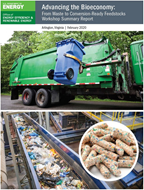
Advancing the Bioeconomy: From Waste to Conversion-Ready Feedstocks Workshop Summary Report
The Advancing the Bioeconomy: From Waste to Conversion-Ready Feedstocks Workshop gathered experts in the fields of waste management, solid materials handling, and biofuel and bioproduct development and production.
Workshop presenters explored the potential of using the various components of the municipal solid waste stream (e.g., yard waste, unrecycled paper, food waste, and plastics) to produce feedstock for fuels, chemicals, and products. This document provides an overview of the presentations and breakout session discussions.
Download the workshop summary report.
|
Feedstock-Conversion Interface Consortium Annual Review of Research–FY 2020
BETO’s Feedstock-Conversion Interface Consortium (FCIC) is a multi-lab collaboration focused on developing first-principles-based knowledge and tools to understand, quantify, and mitigate the effects of feedstock and process variability across the bioenergy value chain, from the field and forest through downstream conversion.
The FCIC recently published its Annual Review of Research FY 2020 report, which presents an overview of the accomplishments of FCIC researchers for fiscal year 2020, covering both the low- and high-temperature conversion pathways and all three process areas (feedstock harvest and storage, preprocessing, and conversion). In the report, key research achievements of each task are presented, along with planned FY 2021 work that will build on the FY 2020 accomplishments.
Download the workshop summary report.
|
|
 |
National Laboratory Success Stories
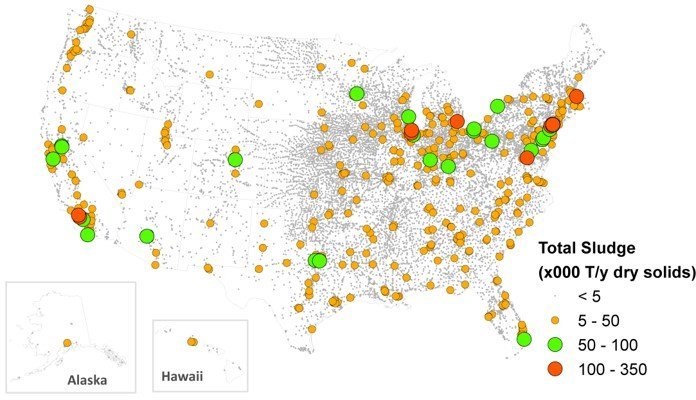
Example of wastewater treatment plant sludge waste resource availability. More than 14 million dry tons/year of sludge is generated during wastewater treatment operations. This feedstock represents a potential biofuel, bioproduct, or biopower feedstock. Image courtesy of NREL.
A Community-First Approach to Energy and Resource Recovery from Waste
In 2015, DOE’s National Renewable Energy Laboratory (NREL) and Pacific Northwest National Laboratory (PNNL) embarked on a first-of-its-kind nationwide resource assessment to understand how much organic waste is generated each year and how much of this waste is beneficially used.
This assessment resulted in useful data on organic waste material available and utilized each year, costs per county to manage these wastes, and trends in the data over a recent time period. These results are now being applied to a DOE Technical Assistance Program that helps municipalities to gain the knowledge and funding needed to increase the utilization of organic wastes.
Read the full Bioprose: Bioenergy R&D Blog.
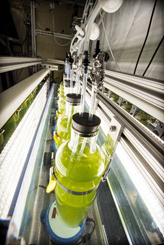
NREL Cultivates Algae Indoors to Learn How to Boost Growth and Productivity Outdoors
In order to make algae-based products affordable, industry must master the science of growing algae in large outdoor cultivators. Like any farm crop, the algae may be exposed to a range of weather conditions, potentially impacting their growth and productivity.
With funding from BETO, a team of scientists at four national laboratories are coming together to develop algae species that can withstand outdoor cultivation conditions. A custom-built, indoor algae cultivator at NREL is giving researchers a controlled environment in which to test and push the boundaries of algae productivity.
Read the full Bioprose: Bioenergy R&D Blog.
|
|
 |
Updates on Upcoming and Past BETO Events
Learn more about BETO events on the event calendar. See below for updated information on past events.
|