News
Join the Sustainable Corrections Infrastructure Partnership (SCIP) Accelerator
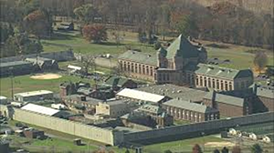
The Sustainable Corrections Infrastructure Partnership (SCIP) Accelerator welcomes state and federal agencies to join this voluntary initiative to upgrade public correctional facilities. Over three years, partners will design solutions that catalyze energy and water efficiency, renewable energy and storage technologies, and energy management planning to reduce operating and maintenance costs in public correctional facilities while maintaining their sector priorities of security and resilience. State and federal agencies can now join SCIP by submitting a partnership application. For more information, contact Alice Dasek at Alice.Dasek@ee.doe.gov
|
Featured Resource: Updated Tool Finder for Local Government Clean Energy Initiatives
Are you looking for the right tools and resources to help measure the various impacts of your local government’s current and prospective environmental programs and policies? The U.S. Environmental Protection Agency (EPA)’s updated Tool Finder for Local Government Clean Energy Initiatives can help you navigate the many freely available tools and resources for measuring emissions, energy, and economic impacts of energy efficiency, renewable energy, transportation, and waste programs in your government operations and communities.
Based on user inputs, the Tool Finder provides a tailored list of tools and resources that may be appropriate for achieving your goals. The Tool Finder offers key details on each tool and resource so you can quickly decide if it is relevant to your needs. Users may also review and print summaries on each tool or resource.
View the Tool Finder.
Partners in Commercial PACE Working Group Achieve $70M in Investments
Since the launch of the U.S. Department of Energy’s (DOE's) commercial property assessed clean energy (C-PACE) Working Group in 2018, Partners have achieved $70M in C-PACE-financed projects. This milestone includes several programs closing C-PACE-financed projects for the first time such as the Philadelphia Energy Authority, the Delaware Sustainable Energy Utility, and Chicago, Illinois. C-PACE is a financing mechanism enabled by states and local governments used by property owners to make energy-saving and other eligible upgrades to their buildings. Learn more about the Working Group and find the latest C-PACE resources from DOE online.
DOE Selects Seven State and Local Governments to Establish “Proving Grounds” for Advanced Building Technologies
DOE’s Office of Energy Efficiency and Renewable Energy (EERE) selected two state energy offices, four local governments, and a state judicial council to install promising building technologies and systems in commercial and multi-family buildings that DOE expects to significantly improve energy efficiency, demand flexibility, and building-to-grid capabilities. DOE has awarded $6 million through the Building Technologies Proving Ground – Public Sector Field Validation Funding Opportunity to governments in California, Kansas, Rhode Island, Tennessee, Texas, and Wisconsin. Learn more about how field-validation efforts like these advance DOE’s priorities.
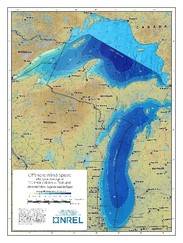
The ability to assess and characterize available wind resources is critical to the development, siting, and operation of a wind plant. DOE’s Wind Energy Technologies Office (WETO), which supports efforts to accurately define, measure, and forecast the nation’s land-based and offshore wind resources, recently released a new series of wind resource maps for the Great Lakes region of the United States. Consisting of five new maps, the series includes two maps detailing offshore wind resources around Lake Superior and Lake Michigan as well as Lakes Huron, Erie, and Ontario, and three land-based resource maps for Indiana, Michigan, and Ohio.
|
Video Tutorial for Understanding Land-Based and Offshore Wind Resource Maps
WETO’s WINDExchange initiative continues to publish 100-meter wind resource maps to provide easy-to-understand snapshots of wind energy potential based on validated data specific to different regions in the United States. Funded by WETO and developed by experts at the National Renewable Energy Laboratory, these maps will give audiences a quick and simple understanding of key considerations when weighing wind power options. This video tutorial explains how to read these new maps, where to access them, and the difference between land-based and offshore wind resource maps.
Deadline Extended for HydroWIRES Notice of Opportunity for Technical Assistance
City Decision Analysis at Every Scale Online Workshop
Feb. 17–18, 2021
Join fellow city leaders and decision-makers for the National Renewable Energy Laboratory’s (NREL) City Decision Analysis at Every Scale Online Workshop, which will take place over two half-day sessions the afternoon of Feb. 17 and morning of Feb. 18. Experts will provide updates, in-depth trainings, and key insights on NREL tools and data available to help your city achieve its clean energy goals and support decision-making around future energy-related system planning. Register today.
Demonstrating Solar Plus Storage: A Webinar Series
Feb. 25–26, 2021
Join DOE's Solar Energy Technologies Office (SETO) for a webinar series from Feb. 25–26, 2021, showcasing projects that improved the performance of solar energy systems by connecting them with storage and demand-response technologies. Five project teams—three utilities and two companies—received $18 million through SETO’s 2016 Sustainable and Holistic Integration of Energy Storage and Solar PV (SHINES) funding program. Members from each of the teams will discuss their demonstrations of smart inverters used in conjunction with smart buildings, smart appliances, and utility communication and control systems. Register today.
CounterpointeSRE Meets Need for New Construction Funding With $2.8 Million in C-PACE Financing for Assisted Living and Memory Care Development in Houston, Texas: Counterpointe Sustainable Real Estate (CounterpointeSRE) announced last month that it secured $2.8 million in C-PACE financing for a planned 108-bed senior housing community in Houston, Texas. The facility will include 74 assisted living units, 22 memory care units, and 12 independent living cottages, providing local access to quality senior housing and care in the Copperfield area of Houston. The PACE-financed project will support planned energy-saving measures including building envelope, interior and exterior LED lighting, HVAC, and domestic hot water, as well as low-flow fixtures.
Seattle Expands Energy Efficiency as a Service Program: Seattle City Light has announced that it will significantly expand its “Energy Efficiency as a Service” (EEaS) pilot program in 2021. The program leverages the success of the Metered Energy Efficiency Transaction Structure (MEETS) modeled at Seattle’s Bullitt Center. The MEETS/EEaS financing model provides a new revenue stream for building owners by allowing them to capitalize on the energy efficiency potential of their buildings. It also creates incentives for deeper energy efficiency retrofits and financing over a much longer term than standard energy efficiency programs. Seattle City Light has announced two new rounds (Phase 2 and Phase 3) of solicitation for projects to participate in the EEaS program.
Learn about what types of EERE funding are available for state and local governments. To view all open funding opportunity announcements, access:

|