
Bioenergy Technologies Office
October 15, 2019
DOE’s BETO Consortia: The Spirit of National Laboratory Collaboration
The U.S. Department of Energy's (DOE) National Laboratories collaborate on cutting-edge research and development (R&D) projects through the use of multi-lab consortia. DOE's Bioenergy Technologies Office (BETO) funds numerous bioenergy consortia across the United States. Each is devoted to the expansion of competitive, cost-effective, and scalable fuels and products made from renewable biomass.
Get to Know Your BETO Consortia
Starting in October, each week BETO will feature one bioenergy consortium, participating labs, and project examples. Look for social media hashtags that include, #bioenergy; #betoconsortia; #collaboration to learn about each consortium.
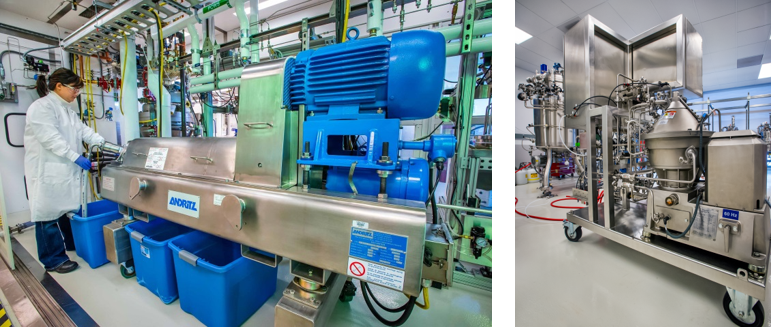
Pilot-scale centrifuge equipment located in the Advanced Biofuels and Bioproducts Process Development Unit at Lawrence Berkeley National Laboratory (LBNL) used for research projects at the Bioprocessing Separations consortium. Left photo: Continuous decanter (6 cubic meters per hour capacity). Right photo: Semi-continuous solid-liquid-liquid separating disk stack centrifuge (150 liter per hour capacity). Photos from LBNL.
Bioprocessing Separations Consortium
The Bioprocessing Separations Consortium (BioESep) platform unites the unique abilities of six DOE National Laboratories to explore targeted R&D outcomes, such as developing cost-effective, high-performing separations technologies that are coordinated with challenges relevant to industry.
Learn more at bioesep.org; #BioESep
National Laboratory Collaboration at BioESep
Six DOE National Laboratories collaborate on R&D projects through BioESep:
- Argonne National Laboratory
- Lawrence Berkeley National Laboratory
- Los Alamos National Laboratory
|
- National Renewable Energy Laboratory
- Oak Ridge National Laboratory
- Pacific Northwest National Laboratory
|
Examples of Ongoing Work at the BioESep Consortium
|
Lawrence Berkeley National Laboratory - Lignin separations challenges remain complex due to the heterogeneity of lignin streams after biomass processing, so lignin valorization is essential to lower the cost of second generation biofuels. Researchers at this lab work to fractionate lignin streams by molecular weight so that lignin valorization can be specifically targeted for different molecular weights of lignin streams.
|
National Renewable Energy Laboratory has developed a novel in situ product recovery system to recover fermentation products in real time that generates no waste, has lower energy and water footprints, and increases microorganism productivity—all with the near-time goal to scale up the technology and produce a purified bioproduct.
|
|
Oak Ridge National Laboratory works on developing advanced membranes for dewatering and hydrothermal liquefaction aqueous fraction enrichment of organic (carboxylic) acids or purification and concentration of the 2, 3-butanediol fermentation broth.
|
Pacific Northwest National Laboratory is developing separation methods to remove nitrogen from wastewater sludge hydrothermal liquefaction biocrudes. Nitrogen removal ensures that subsequent processing steps can be run under milder conditions, resulting in reduced costs for producing renewable fuels.
|
For more information on the Bioprocessing Separations consortium and others please see BETO's Bioenergy Consortia web site.
Learn more about the Office of Energy Efficiency and Renewable Energy on Facebook and follow Assistant Secretary Daniel Simmons on Twitter.
View in browser
|