
Bioenergy Technologies Office
August 1, 2019
Vampire Algae Killer’s Genetic Diversity Is a Threat to Biofuels
Multiple species of harmful bacteria pose challenges to commercial algae production
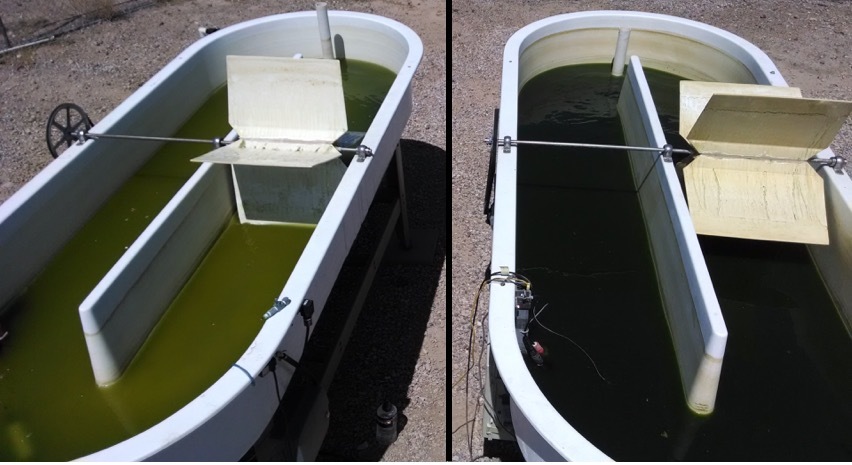 The predatory bacterium Vampirovibrio chlorellavorus sucks out the contents of the algae cells, ultimately transforming a healthy productive green algae pond (right) to a vat of sludge (left). Photo: Seth Steichen and Judith K. Brown, Plant Sciences, University of Arizona, Tucson, Arizona The predatory bacterium Vampirovibrio chlorellavorus sucks out the contents of the algae cells, ultimately transforming a healthy productive green algae pond (right) to a vat of sludge (left). Photo: Seth Steichen and Judith K. Brown, Plant Sciences, University of Arizona, Tucson, Arizona
A bacterium called Vampirovibrio chlorellavorus poses a persistent threat to the algae biofuels industry. The bacteria ruin thriving algae ponds by sucking out the contents of the algae cells, reducing the entire algae pond to a vat of sludge that can no longer be used for producing biofuel. Blake Hovde, a Los Alamos National Laboratory biologist, sequenced two strains of Vampirovibrio from the same pond, one year apart. The pond was an outdoor algae cultivation system in the Sonoran Desert of Arizona run by the University of Arizona. The DNA sequences showed that the two strains of Vampirovibrio are likely different species, so the treatment for one algae pest might not work for another.
With Chlorella algae valued as a key source of harvestable biomass for biofuels and bioproducts, it is extremely useful to be able to enhance our fundamental understanding of interactions between a unique bacterial pathogen and its green algal host, Hovde noted. The results of this research have direct relevance to the success of large-scale commercial algal production projects under way to advance U.S. energy security (biofuels) and the production of aquaculture feedstocks and algal-based nutraceuticals.
The work was funded by the U.S. Department of Energy’s Office of Energy Efficiency and Renewable Energy’s (EERE) Bioenergy Technologies Office.
Read more in the paper, “Vampirovibrio chlorellavorus draft genome sequence, annotation, and preliminary characterization of pathogenicity determinants,” in Phycological Research.
Learn more about EERE on Facebook and follow Assistant Secretary Daniel Simmons on Twitter.
View in browser
|



