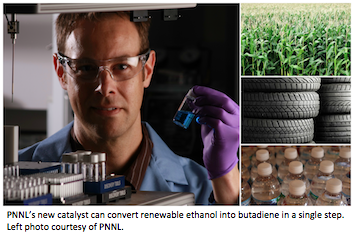
The Relay Race toward Energy Security: Passing the Baton from Applied Bioenergy Research to Industrial Commercialization
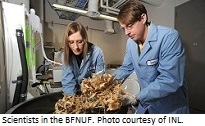 BETO is racing full speed ahead to advance U.S. energy independence by enhancing relationships between DOE’s national laboratories and industry. For example, BETO helps streamline companies’ access to DOE testing facilities, like Idaho National Laboratory’s (INL’s) Biomass Feedstock National User Facility (BFNUF). Check out this Bioprose blog post to learn more about BFNUF’s research tools and the companies and institutions that have benefitted from its facilities and personnel. Then, take a virtual tour of BFNUF on INL’s website. BETO is racing full speed ahead to advance U.S. energy independence by enhancing relationships between DOE’s national laboratories and industry. For example, BETO helps streamline companies’ access to DOE testing facilities, like Idaho National Laboratory’s (INL’s) Biomass Feedstock National User Facility (BFNUF). Check out this Bioprose blog post to learn more about BFNUF’s research tools and the companies and institutions that have benefitted from its facilities and personnel. Then, take a virtual tour of BFNUF on INL’s website.
Apply by January 31 for the Feedstock-Conversion Interface Consortium’s Directed Funding Opportunity
 There are only a few days left to apply! DOE’s Feedstock-Conversion Interface Consortium (FCIC) has announced a directed funding opportunity for research to understand the causes of feed handling failures and develop technologies to increase the reliability of biorefinery operations. FCIC, a newly launched national laboratory–led research consortium, expects to issue up to six awards under this funding opportunity, with project sizes between $500,000 and $2,000,000. Applications are due by January 31 at 10 p.m. Eastern Time. There are only a few days left to apply! DOE’s Feedstock-Conversion Interface Consortium (FCIC) has announced a directed funding opportunity for research to understand the causes of feed handling failures and develop technologies to increase the reliability of biorefinery operations. FCIC, a newly launched national laboratory–led research consortium, expects to issue up to six awards under this funding opportunity, with project sizes between $500,000 and $2,000,000. Applications are due by January 31 at 10 p.m. Eastern Time.
Success Story—Archer Daniels Midland Partners with PNNL to Become a Leading Producer of Biobased Propylene Glycol
Archer Daniels Midland (ADM) has teamed up with PNNL to develop a cost-competitive process for making biobased propylene glycol, which is found in common household items like plastics, food additives, and cosmetics. As a result of this collaborative research, ADM now has a full-scale production facility in Decatur, Illinois, which employs 140 people and can produce 100,000 metric tons of propylene glycol from renewable sources per year.
Oak Ridge Develops Biobased Shape-Memory Conductors
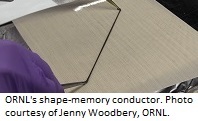 Oak Ridge National Laboratory (ORNL) researchers have developed a biobased leathery material that conducts electricity and can be programmed to remember its shape. ORNL created this shape-memory conductor by streamlining a process that mixes lignin (a byproduct of woody biomass) with an acrylonitrile–butadiene rubbery melt. This technology could have applications in sensors and robotics, offering a low-cost alternative to conventional conductors. Check out ORNL’s article in Macromolecules to learn more. Oak Ridge National Laboratory (ORNL) researchers have developed a biobased leathery material that conducts electricity and can be programmed to remember its shape. ORNL created this shape-memory conductor by streamlining a process that mixes lignin (a byproduct of woody biomass) with an acrylonitrile–butadiene rubbery melt. This technology could have applications in sensors and robotics, offering a low-cost alternative to conventional conductors. Check out ORNL’s article in Macromolecules to learn more.
Advanced Development and Optimization Workshop Presentations Now Online!
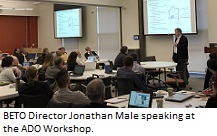 Last month, BETO sponsored the Advanced Development and Optimization (ADO) Workshop at the National Renewable Energy Laboratory in Golden, Colorado. At this event, federal and laboratory managers from BETO discussed the latest in bioenergy research and development and received participant feedback on (1) how BETO’s ADO program area can best serve its stakeholders in the bioenergy industry and (2) opportunities that will help to optimize the ADO program’s impact on the evolving bioeconomy. To learn more, check out the workshop presentations, which are now online. Last month, BETO sponsored the Advanced Development and Optimization (ADO) Workshop at the National Renewable Energy Laboratory in Golden, Colorado. At this event, federal and laboratory managers from BETO discussed the latest in bioenergy research and development and received participant feedback on (1) how BETO’s ADO program area can best serve its stakeholders in the bioenergy industry and (2) opportunities that will help to optimize the ADO program’s impact on the evolving bioeconomy. To learn more, check out the workshop presentations, which are now online.
Past and Upcoming Events with BETO Representation
|