In This Issue
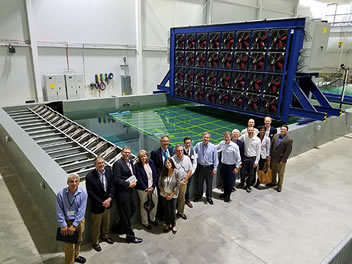
 From August 17-19, 2016, EDA deployed an Economic Development Assessment Team (EDAT) to assist Maine’s struggling forest-based economy. Over the course of the three-day tour, participating federal agencies, along with key members of the forest-products industry and local community development officials, traveled together to see firsthand the various components of the forest-product ecosystem.
The EDAT team engaged closely with businesses and communities that have been deeply affected by the economic transition and transformation occurring throughout the state. EDAT members met with local, small and large land owners and loggers, toured a saw mill and state of the art paper mill, visited a small woodlot, and saw multiple shuttered facilities, including a biomass facility and two former paper mills. The team also met with many community leaders to discuss the effects the struggling industry has on towns and communities, and the various approaches to grow their economies.
 At the end of the process,
EDAT members came away with a clear sense of the federal programs available
that could provide much needed assistance.
The meaningful dialogues and engagement during the
three-day visit will be used to develop an action plan and report that will
align specific federal resources and partnership opportunities with the ideas
and needs uncovered during the visit.
View more photos of EDA's visit to Maine.
 In FY 2010, EDA provided a $2 million grant to the Pacific Northwest Diabetes Institute to fund the acquisition of new technology and upgrades of scientific equipment. The grant also funded instrumentation to support new hi-tech companies in their research facility and medical technology incubator. The project was intended to address severe job loss in the biotech and life science sectors in metropolitan Puget Sound, Washington.
After six years, the Pacific Northwest Diabetes Institute has indicated that the project has resulted in $500,000 in private investment, created 184 jobs, and retained 110 jobs for a total of 294 jobs. Several tenant companies were established and the Institute has also licensed product inventions to large companies including Eli Lilly and Merck.
|
 On August 5, 2016, Deputy Assistant Secretary for Regional Affairs, Thomas Guevara signed a Cooperation Arrangement between the U.S. Department of Commerce’s Economic Development Administration and Mexico’s National Entrepreneurship Institute (INADEM). The agreement aims to facilitate the linkages of clusters in the United States and Mexico to form strategic partnerships across North America.
The signing took place during the Fifth Annual Meeting of the Mexico-U.S. Entrepreneurship and Innovation Council (MUSEIC) in Tijuana, Mexico. This meeting, which brought together entrepreneurs, government officials, businesses, academic institutions, and innovators from the United States, Mexico, and Canada, was an opportunity to highlight the group’s accomplishments and push for continued progress on key issues to strengthen the entrepreneurship ecosystem in North America. MUSEIC is a component of the U.S.-Mexico High Level Economic Dialogue, launched in 2013 by President Barack Obama and Mexican President Enrique Peña Nieto, to elevate and strengthen the bilateral commercial and economic relationship.
One of the achievements highlighted at the MUSEIC
meeting was the publication of Mexico’s National Cluster Map, which identifies
areas for investment and job creation, and enhances regional economic
development between the United States and Mexico. The map is available to users
around the world as a free, open website,
and is compatible with the U.S. cluster mapping website.
This project is the culmination of extensive collaboration between the United
States and Mexico to ensure the maps can be used in a binational fashion.
During his remarks,
Deputy Assistant Secretary Guevara applauded this project’s completion and
underscored the value of the maps. “The introduction of Mexico’s cluster map is
an unprecedented opportunity for Mexico to participate more fully in a global
economy characterized by innovation, research and development, and emerging sectors.
And, it is an even greater opportunity for North American countries to start to
compete globally as one economic region. U.S. and Mexican communities within
the border region have not always had the ability to leverage their assets,
capabilities, and culture towards regional economic prosperity. Now, with the
introduction of the compatible cluster maps, these cross-border regions will
have an easier time identifying joint assets, increasing collaboration, and
developing shared objectives.”
The President of INADEM, Enrique Jacob Rocha, pointed
out, “The linkage of clusters in Mexico and the United States has been
strengthened by the signing of this agreement to consolidate the strategic
bilateral relationship and enhance the global value chain. This is the result
of a fully integrated strategy that promotes the interchange of specialized
knowledge to foster economic and technological regional development. In this
regard, I welcome this initiative as an innovative mechanism to strengthen
bilateral cooperation.”
The compatibility of the U.S. and Mexican cluster maps is just the beginning. The real work lies in getting stakeholders to use them as tools for investment, economic development, and job creation. Thus, through the Cooperation Arrangement, Commerce and INADEM will:
- Regularly
update relevant information about cluster developments in Mexico and the United
States on the U.S. cluster map and Mexican cluster map;
- Encourage
cluster, cluster businesses and supporting organizations to voluntarily
register on these websites in order to attract strategic partners in the
U.S. and Mexico;
- Conduct
outreach in the United States and Mexico about the benefits of and
opportunities for cluster cooperation;
- Organize
workshops along the U.S.-Mexico border with economic development
organizations, mayors, and other stakeholders to teach them how to use the
map and discuss best practices in implementing economic development
strategies;
- Exchange
best practices on supporting the growth and development of clusters; and
- Collaborate
to jointly promote that other countries adopt cluster mapping and cluster
collaboration as important tools for achieving prosperity in local,
regional, and national economies.
Commerce’s contribution will be led by the
International Trade Administration (ITA) and the Economic Development
Administration (EDA). ITA has a global network of experts located in more than
100 U.S. cities and three cities in Mexico that give U.S. businesses access to
services, such as counseling on developing an international business strategy
and increasing brand awareness abroad, and connects businesses with new
markets, business partners and customers. In addition, ITA provides easy access
to information about federal-level programs and services related to business
investment. EDA funded the development of the U.S. Cluster Map and registry,
and leads the federal economic development agenda by promoting competitiveness
and by preparing the nation’s regions for growth and success in the worldwide
economy. EDA makes investments in economically distressed communities in order
to create jobs for U.S. workers, promote American innovation, and accelerate
long-term sustainable economic growth.
|