|
 State and local election offices participated with social media posts and events.
Thank you to all who joined the EAC for National Poll Worker Recruitment Day! This day encourages citizens to sign up as poll workers in their communities and support the recruitment efforts of election officials. Election officials in 30 states, including 24 state election offices, participated.
Voters, You Can Still Support Your Friends and Neighbors at the Polls
Interested in becoming a poll worker? Use the EAC’s lookup tool to find information on being a poll worker in your jurisdiction, including requirements, hours, pay, training, and more. Links are provided so you can sign up directly with your state or local election office.
|
|
Election Officials, You Can Still Use the EAC’s Toolkit to Recruit Election Workers
The EAC’s social media toolkit, featuring customizable Canva and PowerPoint graphics, can be used year-round. These templates can be edited to suit your jurisdiction's requirements and adapted for printed materials, websites, and more.
Beyond social media, the toolkit includes a newly created Poll Worker Recruitment Media Outreach Template, along with a sample email pitch to send to local media partners.
|
|
This month, the EAC is highlighting: |
|
 |
|
Election Officials on the Value of EAC’s Training Programs |
 |
|
Updates on VVSG 2.0 & EAC’s Voluntary Electronic Poll Book Certification Program |
|
 |
|
New Election Official Resource: Best Practices from the Past Decade of the Clearinghouse Awards |
 |
|
Clearinghouse Awards Spotlight & More!
|
|
|
New Resource for Election Officials to Communicate How Elections are Secured
 Every state and local jurisdiction utilizes procedures and tools to safeguard the voting process. While they vary across jurisdictions, the EAC's new Election Security Voter Pamphlet covers topics such as voter registration, mail ballots, election equipment, and contingency planning. This resource can help election officials communicate with voters about their election security practices.It also complements the EAC's "Ever Wondered About Election Security?" video.
|
|
Election Officials on the Value of the EAC Learning Lab, a No-Cost Training Program
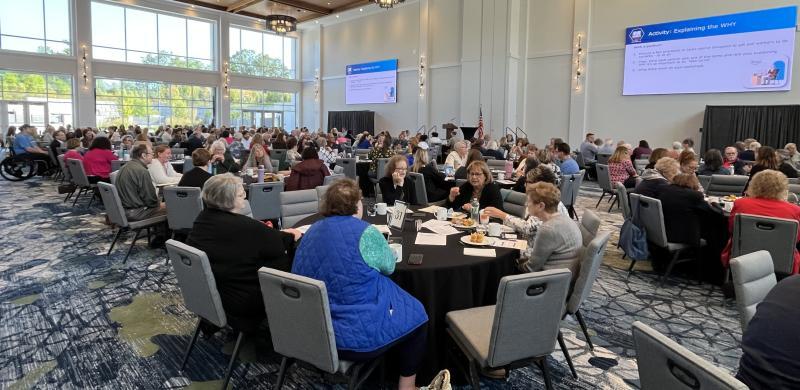 The EAC Learning Lab is an interactive, no-cost training program for election officials and staff in on-demand and live formats. Check out what election officials have said about the value of the EAC’s on-demand and in-person training in a new 2026 Impact Snapshot. It features participants from the agency’s virtual Training Roundtable, available to watch on the EAC’s YouTube channel.
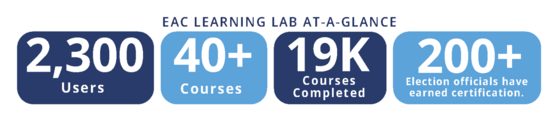 Through the Learning Lab on-demand courses, anyone working in an election office can now earn an EAC Certificate of Federal Professional Training. This is a national credential for election professionals dedicated to expanding their knowledge, skills, and expertise.
Those who are not in an election office can watch all of the Learning Lab trainings on the EAC's YouTube Channel.
|
|
Watch the EAC and Vet the Vote’s National Poll Worker Appreciation and Recruitment Event
 Photo Credit: Harris County Clerk's Office Elections Department
On August 6, the EAC and Vet the Vote hosted a National Poll Worker Appreciation and Recruitment Event at The Space Center Houston Mission Briefing Center in Texas. Participants gathered to thank poll workers for their service and encourage others to become poll workers in their communities.
"In election cycles like this coming November, hundreds of thousands of our fellow citizens will serve as poll workers," said William McArthur, a former NASA Astronaut who provided the keynote speech. "Like the NASA team of thousands of people who ensure the success of our space missions, you are the team that ensures the success of our democracy."
The event's speakers also included local election officials, a Veterans Affairs representative, and poll workers who have served in the military.
|
|
EAC Certifies Fourth Poll Book Under Voluntary Electronic Poll Book Certification Program

The EAC has certified Tenex Software Solutions’ Precinct Central Touchpad v6.1.3, under the agency’s Voluntary Electronic Poll Book Certification Program. This marks the first EAC-certified electronic poll book from Tenex Software Solutions and the fourth system certified through the program overall. Tenex Software Solutions joins KNOWiNK as the second manufacturer to have electronic poll books certified by the EAC under this program.
To learn more about the program, certified electronic poll books, or those currently undergoing testing at the EAC, and related state standards, please visit eac.gov/epb.
|
|
|
The EAC Issues Guidance on Encryption Standards for Voting System Certification Under VVSG 2.0

In June 2026, the EAC clarified how cybersecurity standards apply to voting system certification under the Voluntary Voting System Guidelines (VVSG) 2.0. with its Decision on Request for Interpretation 2026-01.
Voting systems use encryption hardware or software, called a "cryptographic module,” to protect the integrity of vote data. Before a voting system can be certified, its cryptographic module must pass a federal security review process called the Federal Information Processing Standard (FIPS) 140, which is administered jointly by the National Institute of Standards and Technology (NIST) and Canada's cybersecurity agency. A FIPS validation confirms the module was built and tested to a recognized security standard. But that certification does not last forever. Every validated module is labeled "Active," "Historical," or "Revoked.” The EAC's VVSG 2.0 requires voting systems to use a module with "current" FIPS validation.
-
Active means the module was recently reviewed and is considered fully up to date.
-
Historical means the certification is more than five years old. The module isn't necessarily unsafe, but it hasn't been re-checked against the newest guidance, so there's less certainty it still meets current standards.
-
Revoked means the certification is no longer valid at all and cannot be used to show compliance.
The EAC’s Decision on Request for Interpretation 2026-01 clarifies that VVSG 2.0's requirement for "current" FIPS 140 validation refers only to cryptographic modules with an "Active" status.
To support a smooth transition as the federal government moves from FIPS 140-2 to FIPS 140-3, the EAC also issued temporary guidance with its Policy Memorandum on the Use of Historical FIPS 140-2 Cryptographic Modules. This allows manufacturers to request case-by-case consideration for certain modules that were active when development began but later moved to historical status. This temporary option is available through January 1, 2027, helping avoid unnecessary delays while maintaining strong security standards for voting systems.
|
|
|
EAC Certifies Voting System to VVSG 2.0

On June 26, the EAC certified Hart InterCivic's Verity Vanguard 1.1, a modification of the previously certified Verity Vanguard 1.0. The system was tested by SLI Compliance and certified to the Voluntary Voting System Guidelines (VVSG) 2.0 standard.
|
|
|
New Election Official Resources: Clearinghouse Awards Spotlight
Best Practices from the Past 10 Years of the Awards
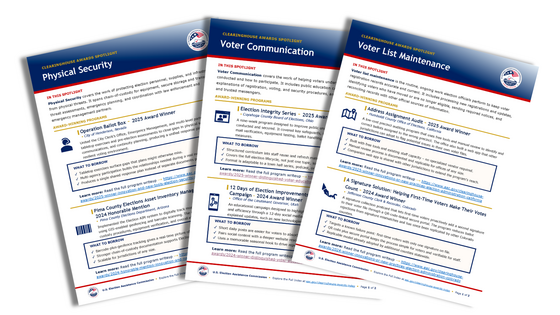
Over the past decade, the EAC’s Clearinghouse Awards have recognized outstanding work by election officials across the country, including innovations in areas such as voter list maintenance, poll worker recruitment, accessibility, and communications.
To continue to highlight these best practices, the EAC has created a new spotlight series that focuses on a single area of election administration and showcases replicable programs.
To view and search all Clearie Award Winners (2016-2024), check out the Clearinghouse Awards Index.
|
|
|
Clearinghouse Awards 10th Anniversary: Blog Series
Harris County Clerk’s Office, Texas, 2020 Clearie Award Winner for Recruiting and Training Poll Workers

In recognition of National Poll Worker Recruitment Day, the EAC interviewed Harris County Clerk Teneshia Hudspeth on the Clerk’s Office’s Electronic Support Specialist High School Student Program. This 2020 Clearie award-winning was recognized in the “Best Practices in Recruiting and Training Poll Workers” category.
Ms. Hudspeth says the program “has improved staffing needs at vote centers and has boosted support for some of the elderly election workers who are not as familiar with technology.”
|
|
|
|
|
|